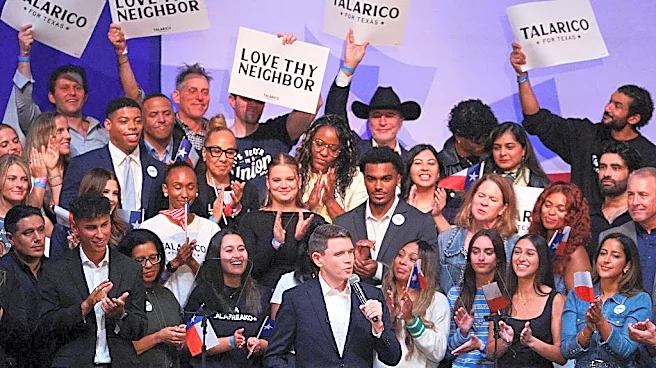





Everything's bigger in Texas, even the blue wave.
After more than three decades of Democratic futility, the Lone Star State will have a Democratic governor and a Democratic senator.
At the start of this campaign, Democrats Gina Hinojosa, the party’s nominee for governor, and James Talarico, who was running for Senate, were obscure state legislators. Now they are rising stars, having upset three-term Republican Gov. Greg Abbott and embattled state Attorney General Ken Paxton.
Those were just several of the key races across the state, as even some districts recently redrawn by the Republican-dominated state legislature to elect Republicans to Congress appeared to be going Democratic.
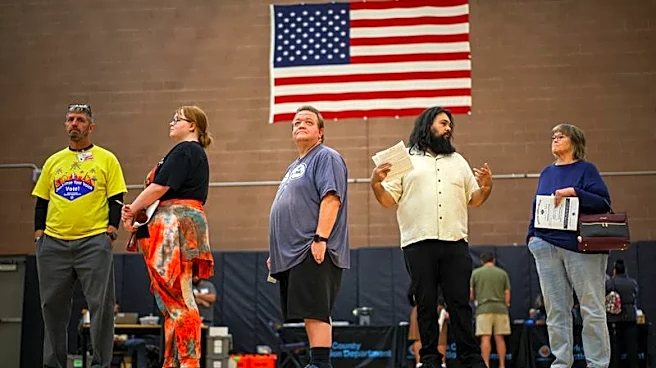
The wins were fueled by a rebuke from the growing Latino voter population,
who make up roughly a third of the state’s voting electorate, and the widespread growing discontent among voters for high prices – from beef to gas – as well as President Donald Trump’s immigration enforcement crackdown.
The big wins by Democrats will also likely put the massive state in play ahead of the 2028 presidential election, as it holds 40 electoral votes.
Latino voters help push Democratic wins
Democrats had been targeting Texas for years, hoping that the growing Latino share of the electorate would boost them to victory.
But Republicans made historic gains among Latino Texas voters in the Trump era, especially in the predominantly Latino region of the Rio Grande Valley, an area nestled at the southernmost tip along the U.S.-Mexico border.
Trump in 2024 won 55% of the Latino vote in the state, a 13-percentage-point increase from 2020, a record high for a Republican presidential candidate and a 27-percentage-point increase from 2016, according to data from the Texas Politics Project.
He also in 2024 won all four counties that make up the Rio Grande Valley, which Democrats had a century-long hold on: Cameron, Hidalgo, Starr and Willacy.
But polling leading up to the Nov. 3 election showed the tide was turning for Republicans among Latino voters.
In apoll released in October by Equis Research, a group focused on researching Latino voters, Talarico was leading Paxton, 58% to 33%. Hinojosa had a lead of 59% over Abbott’s 35% in that same survey.

Preliminary results showed Democrat incumbent Rep. Vicente Gonzalez held on to Texas’ 34th Congressional District, which encompases Cameron County in the Rio Grande Valley north towards Corpus Christi, according to DDHQ and NBC News.
The Democratic candidates in the other districts that make up the Rio Grande Valley, Texas 15th and Texas 28th districts, were trending to the Democratic candidates, Tejano star Bobby Pulido and longtime Rep. Henry Cuellar.
"I cannot believe the way Latinos have come out in such strong numbers," Hispanic Federation President and CEO Frankie Miranda told USA TODAY. "Latinos were once again taken advantage of, and the Republicans thought that they were in the bag. This is a sound rejection of the Trump administration's policies.
A referendum on Trump’s economy
Among the top concerns for Texas voters who turned against Republicans, especially man Latinos, were the rising cost of living and aggressive immigration enforcement.
In the October Equis Research survey, rising prices and immigration enforcement were the top two issues among Latino voters.
Stephanie Valencia, co-founder of Equis Research, previously told USA TODAY that for the first time in Texas or national polling, immigration enforcement and deportations were the number two issue cited by Hispanic voters after grocery and gas prices.

Miranda said that along the border in Texas, Hispanic voters felt “the weight of the federal policies on immigration enforcement and how the economy was not working for them and how they were struggling to find a solution to these issues.”
Voters across the state of Texas cited the economy as one of the top issues at 21%, according to a final poll from theNew York Times/Siena University that was released Nov. 1. Immigration followed at 13% and inflation and cost of living at 8%, the poll found.
Contributing: Terry Collins
This article originally appeared on USA TODAY: Why did Texas turn blue? Democrats send shockwave in GOP stronghold