








COLORADO SPRINGS, CO – Here comes Diggins! Here comes Diggins!
If you are an American, it’s hard not to get goose bumps when you watch the clip.
Color commentator Chad Salmela captured the moment as American Jessie Diggins secured the USA’s first gold medal at cross country skiing by passing Sweden's Stina Nilsson at the last moment to win.
Recalling the 2018 race with teammate Kikkan Randall at the Pyeongchang Games, Diggins, 35, doesn’t remember the sprint over the final 100 meters, or throwing her leg out ahead of Nilsson. But she remembers her teammate jumping on top of her after she collapsed in the snow, and the ensuing togetherness with her entire squad, and with her country.
It was a moment in time, but only one moment in time.
“What I want
people to get out of this is that you never know from the outside what someone is going through,” she says. “And you can't tell by looking at somebody if they are struggling with mental health. It is not always a visual thing. You might not know. And so it's important to check up on each other and ask, ‘How are you doing today?’ And building a team culture where people feel really supported, really safe, in going to their coaches, going to their parents, going to their teammates or loved ones, and asking for what they need.”

Diggins was speaking at last week’s TrueSport Talks, which brought to the forefront mental wellness issues and the digital pressures athletes face. She was discussing, with interviewer Kara Goucher, how she endured an eating disorder as a teenager – and a relapse about three years ago – that she says could have killed her had she not sought help.
“That process of recovery is really hard, but when you invest in it, it is absolutely possible to get to a really happy, healthy place,” she told USA TODAY Sports. “And that's what my story is really about: not just focusing on this sickness and the illness, but really focusing on the recovery and the fact that when you ask for help, when you get a good care team in place around you, it is absolutely possible to get to a really happy place.”
Diggins spoke about how her story, which is also portrayed in a 2026 documentary known as “Threshold,” can help young athletes overcome struggles, whether with mental illness or something else, and thrive.
How learning the psychology of sports can protect athletes
Diggins is the older daughter of Clay and Deb Diggins’ two daughters. Her parents were born in Canada but raised their family east of Minnesota’s Twin Cities. Clay taught Deb how to cross country ski and, after Jessie was born, they put her in the backpack with them.
She grew up on snow, looking for frozen waterfalls, finding animals in trees and playing soccer on skis.
She joined the team at Stillwater (Minnesota) High School and remembers how her coach, Kris Hansen, would emphasize taking care of yourself: Eating, hydrating and putting on dry clothes after a race. She emphasized how, as a female athlete, you should get your period and get enough iron.
“She was really invested in the whole human and health first, and even with all that, I still developed an eating disorder, because these are psychological illnesses,” Diggins says. “They're very powerful, but without all of that help and guidance, I imagine I might have developed it very early on. She impressed upon me the importance of sports psychology.”
A first lesson was telling the team that before you look at your race results, ask yourself: What are the things that I did really well? And what are the things I want to work on? When you decide how you feel about your effort, then you look at the result sheet.
“We had like 120 kids on the team, and it was this incredible camaraderie, and it was a place where everyone was welcome,” Diggins says. “We value teamwork. We value hard work. We value standing up for one another, showing up ready to work hard. But it wasn't about winning, which is perhaps why maybe we did actually find success. Like, when you make it about the process, and about teamwork, and about work ethic, and just dedication to trying to become the best that you can be, those are all the ingredients to become the most successful athlete that you can be without that burnout.
“But of course, then I developed my eating disorder, and it got quite serious quite fast when I was 18 years old.”
'It's not your fault': A first step in dealing with an illness is telling someone something isn't right; not trying to fix it
According to the National Eating Disorders Association, 9% of the U.S. population, or nearly 31 million Americans, will have an eating disorder in their lifetime.
Diggins says the speed with which her eating disorder took over her life was terrifying. When food was present, it was very much about food, but really, it was a coping mechanism for stress, perfectionism, “and feeling like I wasn't allowed to meet my needs of rest and recovery. And I had to keep driving and keep pushing.”
“The root of the eating disorder is unique to each person,” she says. “And I think when young athletes understand, ‘Hey, if I'm struggling with this, it's not my fault.’ This is not a behavioral choice. You are not a bad kid. Nobody asks for this. And it is possible for you to get better.
“This does not have to be your life, because when I was 18, within a matter of months of getting sick, I truly believed, ‘This is it.’ It's gonna just be like this. And it's amazing how quickly, especially when you're not receiving adequate nutrition, how quickly your brain can get into that state of believing: This is how it is for me.”
Diggins had eaten a wide variety of foods as a kid without thinking much about it. But, she says, as the disorder took over her brain, food had values that somehow reflected her worth. Some were safe, but “unhealthy foods were now the equivalent of rat poison.”
She felt shame in eating, and she was diagnosed with bulimia. She thought she wasn’t skinny enough and didn't look sick enough on the outside to deserve help, and it was hard to ask for it. She felt frighteningly alone on the inside.
“One of the tools that I want everyone surrounding someone struggling with an eating disorder to know is you do not have to fix it,” she says. “And one of the most powerful things you can say is, ‘Look, I know that I'm not an expert. I don't have the answers, but because I care about you, I couldn't live with myself if I said nothing. So I'm gonna say something. I might not say the right thing, but I just want you to know I care about you.’
“People said (those things) to me, and it mattered so greatly. And it saved my life. And so it's OK to say, ‘Hey, I don't have the answers here, but I have researched a list of qualified experts. I can help you pick up that phone and make that call. I can go with you to the appointment. I can hold your hand. I can go for a walk with you, if you want to unload your feelings; I love you enough that I can be here for you.’”
Her mother got to the point where she would check on her daughter at night to make sure she was still breathing. Then she and her husband brought Jessie to The Emily Program to begin her recovery.
'I care about you as a person first': Sports success is about showing humanity
She got better, and she kept competing. She had been only 16 at Pyeongchang and, at 20 in Beijing, she won two medals, including a silver in the 30-kilometer freestyle.
It was the COVID Olympics, and she was already lonely, and then she got food poisoning. She couldn’t test her skis the day before, and she says the bracing wind nearly blew her over when she attempted to go for a short jog.
On the bus ride to the venue, she opened up an email from her mom, which read: “You don't owe the world anything, and you don't owe the team more medals, but if you want to, then do this because you love it, because you love to challenge yourself. Don't set any expectations, just get out there and see what you can do with those sparkles on your cheeks.”
“It was everything I needed to hear,” Diggins recalled.
The conditions were dangerously cold, and after the gun went off someone stepped on her ski, and she crashed. She was face down in the snow. But she got up, following her pre-race visualizations, and got back to the pack.
She was in a position to win, but Norway’s Therese Johaug pulled ahead. Diggins was in second place, skiing alone with 17 kilometers – or more than 10 miles – left and her body started to cramp.
Years and years of positive sports psychology training kicked in, and she talked herself, step by step, through the last 45 minutes of the race, repeating over and over in her mind: I can, I can, I can.
Sprinting through the wind and snow, she saw her supporters lining the side of the hill, lifting her up on the power of their cheering alone. She crossed the finish line for the sweetest silver medal she ever won.
“It was racing through pain, fear, doubt, and uncertainty,” she told the crowd at TrueSport Talks. “And I think it is ridiculous that they only allow the athlete up on that podium because it took an entire team to get me there.”
Her documentary centers around a year in her life when she was suffering through a relapse of her eating disorder, and she leaned heavily on her support system again.
She recalled the moment she told her coach, Jason Cork, the eating disorder had resurfaced. She remembered the empathy of his response, which she paraphrased:
I'm really sorry that this has come back for you. I know that that's really hard. I care about you as a person first, and an athlete second. How can I support you? I'm gonna keep checking in on you. And thank you for telling me this. I really appreciate that you have the courage to tell me.
Be brave and have that conversation. It might save your friend's life.
While she used to define her self-worth by external factors, she has learned to talk to herself with kindness and acknowledge she doesn’t have to be happy all the time. As psychologist Kevin Chapman said at the TrueSport Talks, emotions aren’t a sign of weakness; they’re just information.
Diggins has learned that it’s healthy to feel them.
“The cool part is I never stopped having fun,” Diggins says of going through her relapse, in which she says she never put herself in danger by competing. “And that's something that I wish the movie had shown, because your mental health isn't just a light switch: All the way on or all the way off. It's like a dimmer, and it can slide even hourly. And so even in that year that they had filmed, where I was deeply struggling internally, I very quickly got my body to a really good place, but then I was still working on the mental inside part.
“But there were still so many moments of joy. I was doing TikTok dances with my teammates. We were braiding each other's hair. We were putting glitter on each other. I was having a really good time with people, and, no, it wasn't fun and games every minute, but it also wasn't deep, dark, sad, danger zone every minute. And so I think it's possible to have levity and a sense of joy, even when you are working on something really challenging … .”
“Recovery is not linear. It isn't this ladder that you climb, rung by rung. Sometimes you slide back. That's normal.”
During her relapse, she remembers telling herself: I can acknowledge this sucks. I'm gonna keep trying to focus on what is the next right thing. What is the next right decision I can make? What's the step that I'm in control of right now, and trying to bring that sense of control and autonomy and power back to me.
She was motivated to get better because she saw the toll her illness was taking on her family.
“I'm so grateful to all the people in my life,” she says. “My parents never made a bunch of food and body comments. My coaches never made comments about my body or weight, and I still had an eating disorder. But I also firmly believe it lessened the severity because I saw really healthy relationships modeled all around me.”
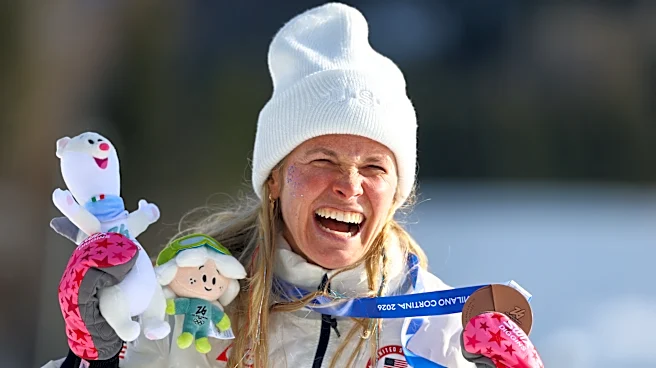
She retired in March, after winning a bronze in Milano Cortina in the 10-kilometer freestyle, and her next step is doing more speaking.
“I really want coaches and parents, and all of the people surrounding especially young athletes to have that education, awareness, and empowerment to talk about things that are hard,” she says. “But one thing I've heard, actually, from an eating disorder doctor is that so many patients came to her and said, ‘No one ever asked if I was OK. Nobody ever check up on me. And I got sicker and sicker.’
“We're not always gonna do the right thing. When you show up with a full heart and with really good intentions, even if you make a mistake, people will generally see that and get over it. And I think being brave enough to have that conversation is better than just not having it at all.”
Steve Borelli, aka Coach Steve, has been an editor and writer with USA TODAY since 1999. He played baseball in high school, rowed in college and spent 10 years coaching his two sons’ baseball and basketball teams. He and his wife, Colleen, are now sports parents to a college and high school baseball player.For his past columns, click here.
Order his "Youth Sports Survival Guide" for athletes and parents here.
Got a question for Coach Steve you want answered in a column? Email him at sborelli@usatoday.com.
This article originally appeared on USA TODAY: U.S. skier Jessie Diggins opens up about how she healed from eating disorder