







Atlanta is home to some of the most consequential and influential historically Black colleges and universities in the nation, with five campuses calling the city home.
Thousands of students continue their education at Clark Atlanta University, Morehouse College, Spelman College, Morehouse School of Medicine, and Morris Brown College each year, becoming the next generation of doctors, business owners, political leaders, and more.
Now, in Forbes' first-ever ranking of the top HBCUs in America, the city of Atlanta puts its best foot forward with three universities in the top 20 schools.
Here's where Atlanta's HBCUs rank nationally.
Three Atlanta HBCUs make the top of the rankings
The Forbes ranking included both private and public universities, though ranked separately. All three of Atlanta's schools
are private institutions.
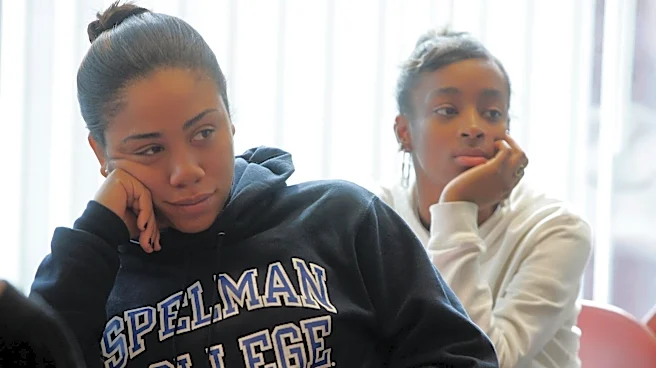
Spelman College, the first HBCU for women in America, was ranked second overall, behind Howard University, according to Forbes. The school includes programs across disciplines from biology to drama to literature.
There are about 2,500 women enrolled at Spelman each year, and the school has given rise to figures like Alice Walker, Stacey Abrams, Lisa Cook, Bernice King, and more.
Spelman has a 76% six-year graduation rate, a 91% retention rate, and graduates earn $102,700 a year by mid-career on average in the job force following their time in Atlanta.
Morehouse College, a men-only university, came in third in the Forbes private HBCU ranking. The college was founded in 1867, about 14 years before Spelman. Figures like Martin Luther King Jr., Sen. Rev. Raphael Warnock, Spike Lee, and Samuel L. Jackson all graduated from Morehouse College.
Morehouse has programs in business, political science, biology, and pre-medicine, among others. Morehouse also launched the now separate Morehouse School of Medicine in 1975.
The retention rate at Morehouse is 84%, with a six-year graduation rate of 53%. Mid-career graduates of Morehouse make $126,700 a year on average, according to Forbes.
Clark Atlanta University came in ninth overall among private HBCUs after Atlanta University, founded in 1865, and Clark College, founded in 1869, were consolidated. The school is most well-known for its business administration degrees, but also offers programs in media, science, and cyber-physical systems.
Clark Atlanta offers both undergraduate and graduate programs, and includes notable alumni like James Weldon Johnson, Kenya Barris, and Ralph Abernathy. Unlike the other two Atlanta schools, Clark Atlanta is a co-ed university.
Clark Atlanta has a retention rate of 70%, a six-year graduation rate of 48%, and mid-career graduates make, on average, $98,300 a year.
Where do other HBCUs rank nationally?
According to Forbes, here are the top private and public HBCUs across the country.
Private
- Howard University
- Spelman College
- Morehouse College
- Xavier University of Louisiana
- Hampton University
- Tuskegee University
- Fisk University
- Talladega College
- Clark Atlanta University
- Tougaloo College
Public
- North Carolina A&T State University
- Florida A&M University
- Prairie View A&M University
- Morgan State University
- University of the Virgin Islands
- Tennessee State University
- Bowie State University
- Winston-Salem State University
- Elizabeth City State University
- Delaware State University
Irene Wright is the Atlanta Connect reporter with USA Today’s Deep South Connect team. Find her on X @IreneEWright or email her at ismith@usatodayco.com.
This article originally appeared on USA TODAY: Atlanta HBCUs celebrated in Forbes Top 20 report. Where schools rank