






The midterm blue wave was largely won in swing districts by moderate candidates backed by independent voters. But progressives and democratic socialists were also elected in more liberal districts across the country, adding to a growing coalition on Capitol Hill.
Sen. Bernie Sanders, I-Vermont, and Reps. Alexandria Ocasio-Cortez, D-New York, and Rashida Tlaib, D-Michigan, are the only democratic socialists already on Capitol Hill. But after winning on Nov. 3, at least six members of the Democratic Socialists of America and three progressives somewhat aligned with their movement will join the House of Representatives.
While Ocasio-Cortez and Tlaib belong to the controversial Democratic Socialists of America organization, Sanders is not a member,
though he identifies as a democratic socialist.
The DSA members joining the House
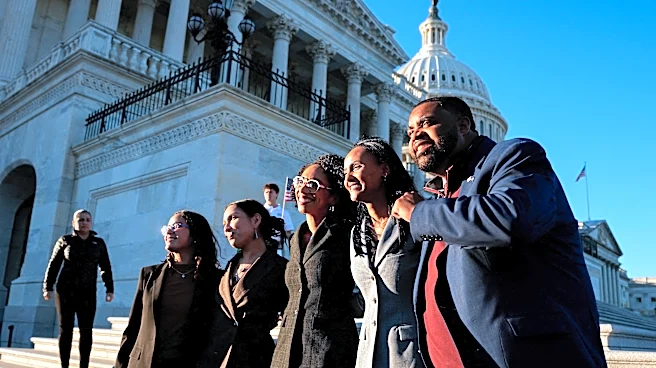
The DSA members headed to Congress in January are Darializa Avila Chevalier and Claire Valdez of New York, Melat Kiros of Colorado, Chris Rabb of Pennsylvania, Donavan McKinney of Michigan, and Angela Gonzales-Torres of California.
Valdez, Rabb, and McKinney bring political experience, having served as state legislators. Valdez first won office in 2024 and McKinney in 2023. Rabb has the most experience, having served in the Pennsylvania House since 2017 and previously worked as a legislative aide for former Sen. Carol Moseley Braun, D-Illinois.
Avila Chevalier, Kiros and Gonzales-Torres are political newcomers who won their first bids for office, though each has experience in community advocacy and grassroots organizations in their cities.
Kiros, the first Gen Z woman elected to Congress, is the youngest at 29. Rabb, 56, is the only one over 40. The group is also racially and ethnically diverse, with Black, Dominican, Ethiopian, Puerto Rican, and Mexican backgrounds represented.

Avila Chevalier and Kiros both drew national attention during their campaigns for their outspoken advocacy for Palestinians. In June, CNN's investigative KFile team reported that Avila Chevalier had deleted social media posts calling for abolishing police and prisons and one post that directed explicit language toward former Vice President Kamala Harris.
Another incoming progressive House member is New York's Brad Lander, who voted for Jeffries as leader. He was previously a member of the Democratic Socialists of America, but left the organization after it promoted a rally in New York City days after the Oct. 7, 2023 Hamas attack in Israel, at which some participants defended the attack. Avila Chevalier attended the same rally.
None of those seven members flipped any of the Democrats' 45 new seats. Instead, they come from seats already held by Democrats, some ousting current members in the primaries and others running in retired members' seats.
Ohio's Brian Poindexter, an ironworker who campaigned as a working-class populist, will join the House of Representatives after beating scandal-tarred Republican Rep. Max Miller. Poindexter was endorsed by the Congressional Progressive Caucus and Sanders, but he has called himself a capitalist and also had an endorsement from the moderate Blue Dog Democratic group.
There are many other progressive Democrats in the House, including Reps. Pramila Jayapal from Washington, Ro Khanna of California, Greg Casar from Texas, Ilhan Omar of Minnesota, and Ayanna Pressley of Massachusetts who do not belong to the DSA or identify as socialists.
Tensions with Jeffries
Seven incoming progressive and democratic socialist representatives-elect issued a joint statement Nov. 18 opposing the selection of Democratic House leader Hakeem Jeffries as the next speaker of the House, saying they were not convinced he would champion their agenda.
"Whether on Medicare for All, stopping ICE terror, getting money out of politics, or ending the genocide in Gaza, our constituents sent us to Congress with a mandate on these issues. We have worked to secure commitments from Leader Jeffries in good-faith conversations," Avila Chevalier, Adam Hamawy, Frederick Haynes, Kiros, McKinney, Rabb and Valdez wrote.
"While we have seen meaningful progress, there is still work to be done to ensure that the direction our party takes this coming Congress reflects what our constituents are demanding of leadership. Those conversations are ongoing. As such, our vote in caucus today was no," they wrote.
Hamawy from New Jersey and Haynes from Texas are both progressive member-elects who joined the Nov. 18 statement, but neither identify as democratic socialists. Rep.-elect Don Leonard of Ohio, viewed as an anti-establishment progressive, voted against Jeffries after saying he got threats from top Democrats if he didn't back the party leader.
The announcement follows years of tension between Jeffries and DSA activists in his own backyard. At Avila Chevalier's and Valdez's victory parties on the night of New York's June primary, crowds chanted "you're next" at Jeffries' image on TV screens, meaning the Brooklyn representative could face a primary challenge in 2028.
Jeffries ultimately won the vote among Democratic caucus members by a huge margin, 251-11. With a few races still uncalled or headed to runoffs, USA TODAY's most recent election results put Democrats with at least 258 seats and Republicans at 174, giving Democrats the numbers to pass legislation even without the more progressive faction.
But in some cases, moderate Democrats may defect and leave Jeffries with a narrow enough margin that he needs to keep the left wing of his caucus on board.
An urban phenomenon
Democratic socialism is spreading in major cities. New York City and Seattle elected democratic socialist mayors in 2025, and Los Angeles and Washington, DC, joined them in 2026.
The slate of DSA members represents largely urban areas. Ocasio-Cortez, Avila Chevalier, and Valdez all represent New York City districts. Rabb's Pennsylvania district is in Philadelphia, Gonzales-Torres will represent a Los Angeles district, and Kiros' Colorado district is based in the heart of Denver. McKinney will represent parts of Detroit, while Tlaib represents a neighboring district that also includes parts of the city.
Lander's district is also in New York City, while Hamawy's New Jersey district includes Trenton. Haynes won in Rep. Jasmine Crockett's Texas district, which is anchored in Dallas, after she lost a primary bid for the U.S. Senate. Omar represents Minneapolis, and Jayapal's Washington district includes most of Seattle.
In Ohio, Poindexter won in the state's 7th Congressional District that includes Cleveland suburbs, and Leonard's district includes parts of Columbus.
According to the DSA's election night tracker, the organization's endorsed candidates and ballot proposals had 176 wins to 118 losses across federal, state, and local offices. The wins spanned the country, and statewide office winners came from cities like Tampa, Florida, Louisville, Portland, Oregon, Tuscon, Arizona, Atlanta, and Buffalo, New York. Losses came in Sacramento, California, New Orleans, and Las Vegas.
According to NBC News exit polls from the midterms, 18% of all voters identify as democratic socialists.
In statewide elections, the democratic socialist faction did not win any general elections, despite some impressive performances in primaries. State Rep. Angie Nixon, a DSA member, lost in Florida's Senate race by almost 3 percentage points after her upset primary win over Alex Vindman. She got 50,000 fewer votes than David Jolly, the moderate Democratic nominee for Florida governor.
Earlier in the season, state Rep. Francesca Hong, also a DSA member, narrowly lost in the Wisconsin gubernatorial primary after leading in the polls.
In Michigan and Illinois, Sens.-elect Abdul El-Sayed and Juliana Stratton won their primaries, after being seen as more progressive candidates, and ultimately won in the general election. Neither El-Sayed nor Stratton, though, identify as democratic socialists.
Sanders will remain the sole democratic socialist in the Senate.
This article originally appeared on USA TODAY: Congress is about to have 4 times as many DSA members. Who they are