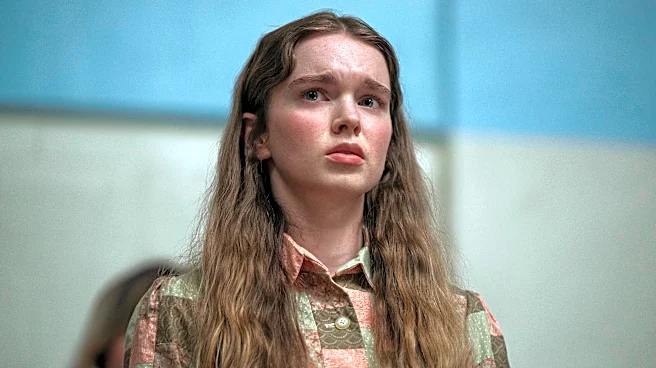





Get used to the name Summer H. Howell: It could become ubiquitous in Hollywood after "Carrie."
Howell, 22, has been acting since she was 8 and previously starred in a pair of "Chucky" movies. But her remarkable turn as Carrie White in Mike Flanagan's TV series adaptation of Stephen King's
classic novel (streaming Oct. 7 on Prime Video) could bring her an entirely new level of fame, as "Wednesday" did for Jenna Ortega."I can still remember the feeling of right after the call, knowing I had the role," she says. "It's really weird how your body can remember feelings. It was definitely life-changing. The first thing my mom said to me after I told them was, 'Oh, your life is going to change forever.' She was crying immediately, and I couldn't fully
process in that moment."

With "Carrie," Flanagan felt another faithful adaptation of King's novel about a bullied telekinetic girl would be pointless when the 1976 movie already exists, so he made many drastic changes. Among the biggest: Carrie, in this version, has spent her entire life locked away at home before going to school for the first time when the story begins. In the book, she has been in school, and consistently bullied, for years.
This transforms "Carrie" into a "fish out of water" story, which asks viewers to "reassess what we've accepted and normalized" in society, Flanagan says.
The show also reconsiders why Carrie is bullied in the first place. This Carrie is defined by her empathy, so the series suggests that cruelty has become such an epidemic that kindness stands out. This is part of why Flanagan felt it was unnecessary for Carrie to match the book's description of a "chunky girl with pimples," which led to some criticism of Howell's casting.
"The idea of her being tormented for her physical appearance I felt like had been done many times, and while that's absolutely still a major problem for kids and adults in the world, I thought it was really interesting to see how the world targets kind people and earnest people," Flanagan says, adding that taking appearance off the table left him "free to cast whoever does the best performance, which is what you want to do regardless."

After growing up balancing school with acting, Howell could relate to feeling like an outsider in class.
"I was the only actor I knew in my school growing up," she says. "I'd be gone randomly for a month every couple of years, or whenever I could get a job, and I'd come back. And that's what people knew me as. So maybe they just assumed things about me, and it made it a little difficult to connect with people truly."
True to its 2026 setting, much of the bullying in "Carrie" occurs through an anonymous Instagram account, which Flanagan says reflects how social media has "normalized cruelty." But although the account initially torments Carrie specifically, it soon targets many others in school, even teachers. And because the account takes submissions, a large number of students are either complicit or actively involved.
"It's not as simple as the bully and the victim," Flanagan says. "There's this whole other ecosystem around it, and the degree to which we engage with, or amplify, or refuse to engage with, or refuse to criticize these things when we see them."

Carrie's primary bully, Chris Hargensen, is more three-dimensional, with an expanded plot involving difficulties at home. "What she does is from a place of pain and desperation," star Alison Thornton says.
But perhaps the most drastic change concerns Carrie's mother, traditionally depicted as a monstrous lunatic who hates her daughter. Samantha Sloyan was initially concerned Margaret White would be too familiar after she played a religious zealot, Bev, in Flanagan's "Midnight Mass." But her concerns were eased when she learned Flanagan had a radically different take: A loving Margaret, driven by a desire to protect Carrie.
"She loves her daughter, and I love her for that," says Sloyan, who connected to the idea of "loving somebody and being bound to them in so many ways, but still being two different people, and the difficulty of navigating that."
The star could also understand Margaret's "terror" of the world. "There are many days where I'm like, 'No thank you!'"
This Margaret was inspired by Flanagan's fears over his son starting high school when teens "have to grow up in front of the whole world in a way that can live forever on the internet."
King was on board with the big changes and particularly "loved" how Carrie and Margaret "were the opposite of the characters he expected," Flanagan says. But the "most exciting thing" for the author, Flanagan notes, was the show expanding to explore how Carrie exists in a "long legacy" of women with similar powers.
In another modernization, Margaret eventually starts her own Instagram account to defend Carrie and turns it into a platform for anti-bullying advocacy, though Carrie questions who she's really doing it all for.
Sloyan says this plot further speaks to the "insidious" side of social media. "She becomes so excited by the likes and the attention, and the approval and feeling important. We see her really start to fall for that."

In her own life, Sloyan stays off social media, and Howell is aiming to do the same.
"My generation has been programmed to be addicted to our phones, and we have to make the decision when to put it down and not to believe those comments," she says. "…It's been interesting, especially with the show coming out and many comments of different opinions. I try to avoid it now."
While Howell couldn't process landing the role at first, she's had "plenty of time" to digest it since. And with the series now arriving, she's bracing for a dramatic shift in her life.
"I don't think I'm fully prepared," she says. "But I'm just gonna do my best and stay true to myself."
This article originally appeared on USA TODAY: Meet Summer H. Howell, the rising star of Prime Video's new 'Carrie' TV show