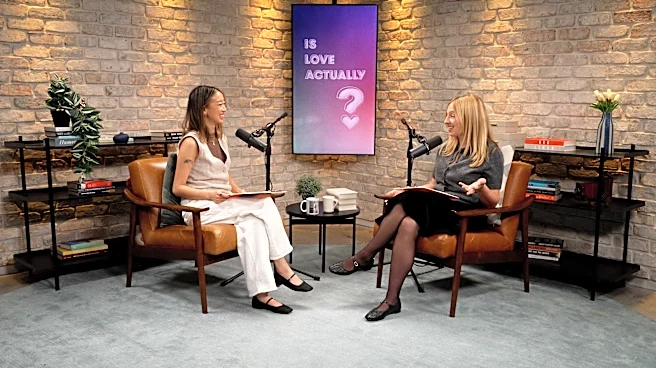







The second episode of "Is Love Actually?," a new five-part vodcast series from Humankind and USA TODAY, explores how kindness spreads.
In this episode, hosts Madeline Gunderson and Ronnie Li continue their investigation into love by exploring the power of acts of kindness between strangers.
All five episodes of the vodcast premiere this World Kindness Week. You can watch or listen to the entire series
now.Is kindness contagious?
Simple acts of kindness like holding the door open for a stranger, returning a lost wallet or treating someone to a meal might seem small on their own, but their impact can extend far beyond the people directly involved. According to scientific studies, these gestures have a ripple effect that often reaches past our expectations.
Research shows
that one act of kindness can beget many more acts of kindness. Dr. Lara Aknin runs the Helping and Happiness Lab at Simon Fraser University. Her research focuses on the predictors and consequences of acts of kindness, as well as what leads people to experience positive emotions. One remarkable finding of Dr. Aknin's research is that helping other people actually makes the helper feel better. Givers feel inclined to give again, while receivers experience feelings of awe, which then encourage them to engage in acts of kindness themselves.
Her research demonstrates that acts of kindness have positive effects for people not directly involved as well. For instance, someone who witnessed a kind gesture can be inspired to perform one themselves. Dr. Aknin stresses that "other people are a key source of our happiness. Our relationships are probably one of the most robust and reliable predictors of our wellbeing." She encourages people to engage in small acts of kindness to help build and sustain their relationships.
Dr. Aknin is also a co-editor of the World Happiness Report, a publication which records data on global wellbeing. Its annual rankings tabulate self-reported happiness levels across 140 countries, offering insight into the different factors that contribute to people's sense of life satisfaction. Dr. Aknin and her colleagues track the different variables that make up peoples' sense of wellbeing through survey responses. While data on GDP and life expectancy are informative markers when studying happiness, Dr. Aknin says it's also important to consider trends related to human trust and connection.
"Countries at the top levels tend to report high levels of social relationships, captured by asking people, 'If you were in trouble, do you have someone who you could call in times of need?' And levels of generosity captured roughly by whether people donated to charity in the past month."
What causes people to engage in heroic acts?
Dr. Abigail Marsh uses brain imaging to research a wide range of human social behaviors at the Laboratory on Social and Affective Neuroscience at Georgetown University. She studies people diagnosed with psychopathy as well as extraordinary altruists, people who engage in generous behavior that poses a level of risk or cost to themselves. Extraordinary altruists are the type of people that might donate their kidney to a stranger, offer humanitarian aid in a war zone or rush into a burning building to save someone.
Her work seeks to understand what's going on inside the brains of these altruists. Brain scans conducted in her lab have shown that these altruists possess amygdalae that are about 8% larger than typical adults. Research is still underway to understand the exact function of the amygdala, but Dr. Marsh describes how it plays a role in our brain's recognition and response to other people's distress, as well as value calculations regarding people's welfare.
Dr. Marsh says that these extraordinary altruists are unique for their sense of humility and their lack of judgement towards the recipients of their kind acts, but that altruism itself isn't a unique trait. She notes that her study subjects can teach us a lot about extending a helping hand to people we might not typically assist. "Most people are capable of altruism and do help other people. The real problem is the ways that our helping tends to be selective."
Acts of kindness don't have to be extraordinary to matter. Episode 2 of "Is Love Actually?" leaves viewers with a challenge: What small gesture of kindness could you put into practice today?
You can watch or listen to "Is Love Actually?" now. The series is available on all podcast platforms, including Spotify and Apple Podcasts
Funding for the project was provided by the Greater Good Science Center and the Templeton Foundation, in conjunction with the GGSC’s “Spreading Love Through the Media” project.
This article originally appeared on USA TODAY: Is kindness contagious? Research says yes.