





Stalking through Bolivia's cloud forest in South America is a feline a bit smaller than a house cat that was unknown to science until now.
Leopardus tilcayo is the first species of cat discovered in over a century, according to a new study published by CellPress. Local communities call the cat tilcayo.
"The discovery of the tilcayo will hopefully help to free up resources for the conservation of tiger cat populations, which are often in a vulnerable position," Jonas Lescroart, the evolutionary biologist who co-led the study with cat conservationist Paola Nogales-Ascarrunz, said in a statement emailed to USA TODAY. "At the same time, this new species draws attention to the incredible ecological richness of Bolivia.”
Although the cat had never been
formally named or described until now, the study said it was "widely known" in the area where it lived. Researchers used genetic data to confirm the cat was a new species and proposed that its common name be "tilcayo."
"We decided to keep the name 'tilcayo,' the name used by local communities for this cat," said Nogales-Ascarrunz, who is also a National Geographic Explorer. "For us, it was also a way of recognizing and preserving the local knowledge connected to this species.”
The tilcayo is part of a group of cats found across South America called "tiger cats," which was originally thought to be a single species, a news release emailed to USA TODAY stated. However, it is made up of five species, including tilcayo. Researchers call the group a "cryptic species" because, while they are genetically different, they look similar to each other.
Here's what to know.
What does the cat look like?

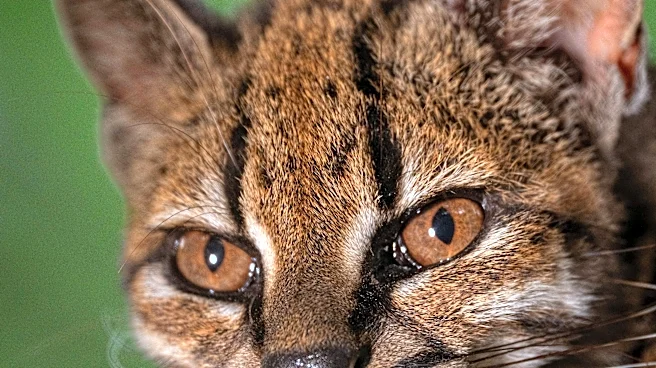
The tilcayo is smaller than your typical house cat and looks similar. It has yellow eyes, pointed ears and a long tail.
Photos show leopard-like patterns across its body, with two black vertical stripes running from the top of its head to its eyes. It also has horizontal stripes near its mouth and cheeks, and black fur around its eyes.
Where was the newly discovered cat found?
Researchers found the cat in Bolivia's Yungas forest in the Andes Mountains in South America. It is called a "cloud forest" because it's in a mountainous area usually covered by clouds, Reuters reported.
It often rains in the forest, and there is high humidity, which mainly comes from clouds that move through the trees and plants in the area, according to the Community Cloud Forest Conservation.
The Yungas are one of the more threatened ecosystems, Reuters reported. Multiple factors put it at risk, including deforestation, agricultural expansion, human-caused fires and mining, according to Nogales-Ascarrunz.
The tilcayo could be classified as endangered

Although it was only recently discovered, the tilcayo could be classified as endangered as more assessments are done.
According to Reuters, the International Union for Conservation of Nature (IUCN) categorized tiger cats as two species that are "vulnerable" and said their populations are declining. Researchers submitted their research to the organization, which will look at the species separately.
This could give a more accurate analysis of the risk the species face.
Once more accurate assessments are done, the tilcayo may be considered an endangered species, reported Reuters.
Tiger cats as a whole are threatened by habitat loss, hunting and diseases that can be contracted from domesticated animals, according to the news release. Their habitats are also greatly affected by climate change, which can further limit the areas where they can live.
Some tiger cat species may also have low genetic diversity, which can reduce their ability to adapt to a changing environment.
"The Earth’s biodiversity is still poorly known, to the extent that even in a charismatic group such as cats there are still new species to be discovered," the news release stated. "And yet, it is being rapidly lost. Speeding up such discoveries and using them to enable conservation strategies for the Earth’s natural habitats are more important than ever."
USA TODAY has reached out to the IUCN for more information.
Contributing: Reuters
Julia Gomez is a Trending reporter for USA TODAY and covers space phenomena, scientific studies and natural disasters. Connect with her on LinkedIn, X, Instagram, and TikTok: @juliamariegz, or email her at jgomez@gannett.com.
This article originally appeared on USA TODAY: Cat's out of the bag. Meet the newly discovered cat species