










For most of the past half-century, the federal government almost never tried to take citizenship away from naturalized Americans. Now it is doing so at a pace not seen in decades − and its most prominent target so far is a sitting member of Congress.
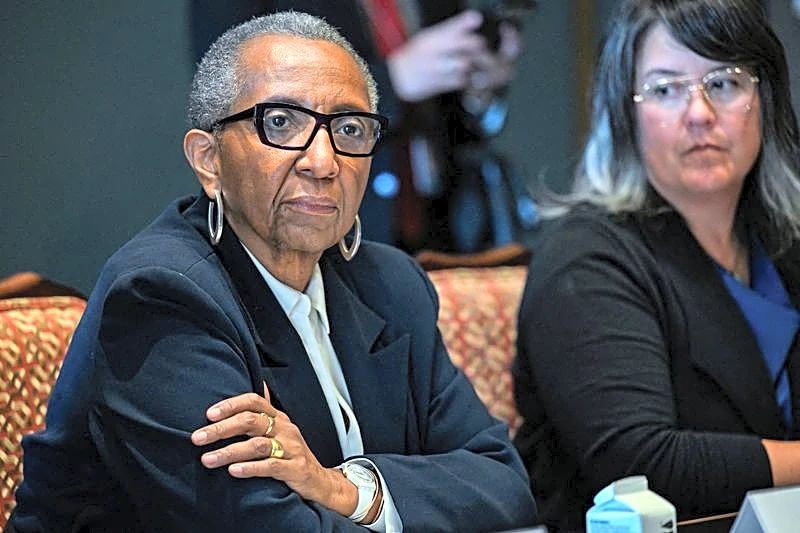
The Justice Department’s investigation into Rep. Ilhan Omar, a Minnesota Democrat, is aimed at revoking her citizenship and deporting her, if investigators can prove she or her relatives lied to immigration authorities, two people familiar with the matter told USA TODAY. The people spoke on condition of anonymity because they are not authorized to discuss the investigation.
Last week, investigators searched Omar's home in Washington and issued subpoenas to her relatives. The probe, one official said,
is focused on two questions. One is whether the family misrepresented Omar’s age, and the other is whether her late father, Nur Omar Mohamed, concealed details of his military career. Both lines of inquiry go back to whether she was allowed to derive citizenship from her father.
A former DOJ attorney as well as four legal scholars who study denaturalization – the legal process by which the government revokes U.S. citizenship – said the case looked unlike any they had seen.
"Nothing about this case is a normal denaturalization case," said Amanda Frost, a professor of law at the University of Virginia. "I think it’s about punishing a political enemy."
Omar, who was born in Somalia and naturalized in 2000, has denied the Trump's administrations accusations and called the probe into her citizenship "an authoritarian move to silence an opponent right before an election."
She has not been charged, and no case has been filed to revoke her citizenship, so it is unclear what the government will ultimately try to do. But her case offers a window into a legal tool that is old, rarely used and newly central to the Trump administration’s immigration agenda.
How does the process work?
The government can try to revoke citizenship through a criminal case or a civil one. Criminal cases carry a 10-year statute of limitations, require proof beyond a reasonable doubt and give defendants a jury and a lawyer. Civil cases have none of those features. There is no time limit, no jury and no right to a court-appointed lawyer.
"So procedurally, it’s just easier for the government to win a civil case than it is to win a criminal case," said Cassandra Burke Robertson, a professor of law at Case Western Reserve University who has written extensively about such cases. Many defendants cannot afford lawyers, she said. "So these cases often go forward with the individual unrepresented."
The bar is still high for civil cases, where the government must present "clear, unequivocal and convincing" evidence.
"Even in the civil cases, the burden is the highest standard that our civil law recognizes," said Daniel Kanstroom, a law professor at Boston College.
The government generally takes one of two approaches, Kanstroom said. It can argue the person was never eligible, for example, because a crime committed before naturalization meant they lacked the good moral character the law requires. Or it can argue the person lied or concealed something that mattered. Kanstroom said the second kind is much harder to win, because the government must prove the misrepresentation was willful, material and serious enough that it would have led officials to find the person ineligible.
Such cases often take years. Defendants can fight back through discovery, motions, a trial before a federal judge and appeals.
"People have due process rights to their citizenship, which they gained through a lawful process," Kanstroom said. "Citizenship is a very precious thing."
And losing citizenship does not mean automatic deportation. The person reverts to their earlier status, usually a green card, and the government must start separate proceedings in immigration court to remove them.
Why was it so rare, and what changed?
It wasn’t always. In the first half of the 20th century, the government routinely stripped citizenship from anarchists, suspected communists and labor leaders, Frost said. Then, in 1967, the Supreme Court shut most of that down, ruling that citizenship could be taken away only in cases of fraud or error in the process.
Robertson said the court warned then that using denaturalization in a political sense "is just flatly incompatible with democracy."
The ruling also drew a firm line around what people do after becoming citizens, Frost said. A naturalized U.S. citizen who commits a crime can be prosecuted like anyone else, "but you can’t lose your citizenship for conduct after your naturalization."
At the heart of that protection, she said, is an idea the Supreme Court has returned to repeatedly, that in a democracy "the people choose their government. The government doesn’t choose the people."
What followed was decades of restraint. Administrations of both parties filed about a dozen cases a year, and prosecutors "have been very careful about bringing them," Kanstroom said. Because denaturalization cases are costly and hard to win, the government saved them for sure bets and the worst offenders, like Nazi war criminals, terrorism suspects and people who hid serious crimes.
Because of how selective prosecutors were, they won in the vast majority of cases, he added.
The first Trump administration tried to expand the practice but filed on average 25 civil cases a year, according to the nonpartisan Migration Policy Institute. Under President Joe Biden, the number fell to about four a year, data from the Transactional Records Access Clearinghouse at Syracuse University shows.
Research by Irina Manta, a law professor at Hofstra University, found 168 cases in the courts during the first Trump administration and 64 under the Biden administration.
This time, the administration has gone much further. In June 2025, the Justice Department told its lawyers to "maximally pursue" denaturalization. It later set a goal of 250 cases by this month.
"I think it’s to send the message that everyone’s at risk, that you’re never safe, that your status is never secure," Frost said.
How many denaturalization cases have been filed?
Since President Donald Trump returned to office, the government has filed 196 civil denaturalization cases, according to a database maintained by Democracy Forward, a legal advocacy group that is suing the administration for records on the effort. The database covers filings through Oct. 8.
The pace started slowly. The government filed 12 cases in 2025, in line with the roughly dozen a year that previous administrations brought. Then, last spring, it accelerated sharply, peaking at 44 filings in July. From May through September, the government averaged about 33 cases a month. So far, a dozen cases have been filed this month.
The people targeted span decades of American citizenship. One had been a citizen since 1978. Another had been naturalized only in 2023.
On Oct. 5, the Justice Department announced that it was seeking to revoke the citizenship of 40 people in cases filed from late August through early October, the largest single batch of the Trump era. Attorney General Todd Blanche called it the “largest denaturalization effort in modern history.”
The department said the cases involved people accused of concealing crimes, immigration fraud, marriage fraud and using false identities, and Blanche said they included people convicted of offenses ranging from espionage and money laundering to sexual crimes against minors.
Most of the cases are still unresolved. Of the 196 filed, 20 have closed, and the rest are pending, some of them on appeal. Twenty-three people have had their citizenship revoked.
But those early wins may not last, the experts said. Many of the newer cases accuse people of lying on their applications, which Kanstroom said is the hardest kind of case to prove. And any defendant who fights back could tie the government up for years.
"I think these cases are going to be easier for the government to bring than they’re going to be for the government to win," he said.
Can they take away Omar's citizenship?
In theory, yes. In practice, the experts said, the government would face steep obstacles.
Omar became a citizen in 2000, at 17, through her father’s naturalization, a route open only to children under 18. To qualify, Kanstroom said, she needed little more than the right age, a father who was a citizen and a home with him in the United States.
Investigators are focused on her age, a person familiar with the matter said. But proving she was older would be difficult, Kanstroom and Roberston said.
The way the government is building its case is also unusual. The statute of limitations on criminal naturalization fraud expired long ago, the experts said, so any realistic attempt to revoke Omar’s citizenship would have to be a civil case.
That makes the search warrant, a tool of criminal investigations, all the more striking. Robertson said she had never seen one used in a civil denaturalization case.
Even if the government won, Omar might not be deported. What she would lose is her seat in Congress, which requires members to be citizens. First, though, the government would have to get past her lawyers.
"I would have said none of this could happen until it did happen," Robertson said.
This article originally appeared on USA TODAY: Can Ilhan Omar lose her citizenship? How revoking citizenship actually works