






Few fruits are as widely enjoyed as strawberries. They top the list of the most popular fruits sold in the U.S.
and appear in lunchboxes, smoothies, salads, shortcakes and countless desserts. And their appeal extends well beyond flavor as each strawberry provides plenty of fiber, vitamin C, folate, potassium, manganese and an array of beneficial plant compounds − all while containing only about 4 calories per medium-sized berry."Strawberries are one of those foods that check a lot of nutritional boxes at once," says Bonnie Taub-Dix, a registered dietitian, nutritionist and author of "Read It Before You Eat It – Taking You from Label to Table." "They’re also naturally sweet, can be enjoyed any time, are versatile, and, most of all, they are delicious."
But before you enjoy them, strawberries should be handled and washed properly. Here’s why – and how best to do so.
When are strawberries in season?
Peak strawberry season across most of the U.S. runs from spring through early summer. "That’s when strawberries are usually at their sweetest and available at their best prices," says Taub-Dix. Indeed, many June-bearing varieties produce most of their fruit during this relatively short window, though California’s long growing season and Florida’s winter crop help keep strawberries available nationwide throughout most of the year.
Because strawberries are delicate and do not continue ripening after they are picked, those destined for the fresh market – whether conventionally or organically grown – are typically harvested by hand at or near peak ripeness, says Taub-Dix.
But some of the crop is also frozen, canned, dried or processed into jams, jellies, purees and other products, allowing the fruit to be enjoyed long after its peak season ends.
Why do strawberries need to be washed?
One of the reasons strawberries need to be washed is because, unlike bananas or oranges, strawberries have no removable peel protecting the edible portion from the outside environment. Taub-Dix says that they also grow close to the soil and pass through numerous hands during harvesting, packing, shipping and stocking.
Dr. Carolyn Newberry, an attending physician and nutrition scientist at Weill Cornell Medicine, says dirt, dust and small insects may also remain on the surface, "along with pesticide residues or disease-causing microorganisms introduced through soil, irrigation water or animals." Such contamination has contributed to foodborne illness and recalls, and both fresh and frozen strawberries have been linked to hepatitis A outbreaks.
Another factor is that fresh strawberries are generally not washed before packaging because added moisture can accelerate softening and mold growth − something consumers may not realize before popping one into their mouth.
The fruit’s structure further complicates matters as a strawberry’s exterior is soft, uneven and covered with tiny seedlike structures called achenes, creating numerous places where dirt and other material can collect. "Due to this porous nature, strawberries need to be rinsed for longer than other fruits as they may absorb more pesticides and dirt than other fruit varieties," says Newberry.
How should you wash strawberries?
To reduce these concerns and prevent illness, Newberry says it’s important to properly wash fresh strawberries before eating them. Start by washing your hands with soap and water, so you don’t transfer germs to the fruit. Then, Newberry recommends inspecting the berries and discarding any that are moldy or leaking, along with those that are too bruised or beginning to rot.
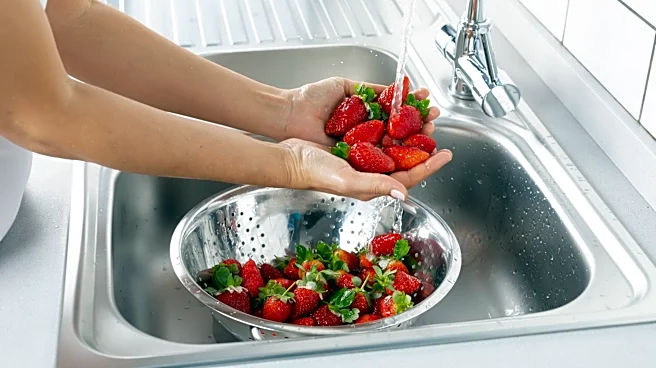
Next, "rinse individual strawberries under cool, running water over a colander while gently rubbing them with your hands," says Taub-Dix. When doing so, the U.S. Food and Drug Administration recommends against using soap, detergent or commercial produce washes because fruits are porous and may absorb residues that could make you sick. Besides, "commercial produce washes generally haven’t been shown to be more effective than thoroughly rinsing produce with water," says Taub-Dix.
She adds that soaking the fruit briefly in a vinegar or baking-soda solution is another option.
"These methods may help remove additional surface residues, but they’re not essential," she says. "If you do use a vinegar rinse, be sure to rinse the berries again with plain water afterward to avoid affecting flavor."
After washing, Newberry says to gently pat the berries dry or let them air-dry on a clean towel. If any washed berries remain uneaten, refrigerate them in a breathable container lined with paper towels to absorb any lingering liquid. After all, "excess moisture," Taub-Dix says, can lead to spoilage and "is one of the biggest enemies of fresh berries."
This article originally appeared on USA TODAY: How to wash strawberries the right way