






At a time when many automakers are cutting back on electric-car production, Toyota appears to be going all in.
Environmental groups have criticized the world's largest automaker for relying on hybrids instead of full electric vehicles. But the Japanese manufacturer has announced three new electric models, and it has also moved to discount its existing bZ electric crossover SUV.
"Toyota is accelerating when most are slowing down," Stephanie Valdez Streaty, Cox Automotive’s director of Industry Insights, said in a statement provided to USA TODAY.
We recently tested 2026 models for two of Toyota's currently available electric cars, the Toyota bZ and the luxury brand Lexus RZ, to see which one is a better buy.
What makes the 2026 Toyota bZ stand out?
The Toyota bZ is the automaker's first
fully electric car, and after receiving a midcycle refresh in 2025, the 2026 model has 25% more battery range than its earlier iteration.
I drove the 2026 Toyota bZ XLE for a week to see if it is deserving of its plaudits from reviewers and "Most Improved EV" award from ARS Technica. The 2025 Toyota bZ was also an Insurance Institute for Highway Safety Top Safety Pick+ award winner, but the 2026 version fell short of the organization's most stringent recent round of testing.
The XLE we tested is the base model of Toyota's bZ, and it starts at just under $35,000. The more souped-up limited trim starts at $43,300. I've recently tested one of the bZ's main competitors in the electric SUV segment, the Chevrolet Blazer EV.
The bZ stands out from rivals in its segment because of its unique new exterior and interior designs. In a week of testing, the Toyota bZ's interior and cargo area felt spacious for daily driving needs. I also enjoyed bZ's large screen for infotainment and Android Auto and Apple CarPlay connectivity.
The 2026 Toyota bZ offers a smooth, quiet and comfortable ride, and it has excellent battery range. It handles well, and its acceleration is quick enough to keep daily driving fun. It comes with a lithium-ion battery and uses a single electric motor for front-wheel-drive models and dual motors for all-wheel-drive models.
Toyota says it offers up to 338-horsepower total system power output. The electric SUV achieves an estimated 314 miles per battery charge in front-wheel drive. Our base model test vehicle lost only about 20% of its battery charge during a week of local driving.
What makes the Lexus RZ stand out?
The Lexus RZ is the luxury version of Toyota's first fully electric car.
I drove the 2026 Lexus RZ 550e for a week to see if it is deserving of its plaudits from reviewers like my colleague Charles Singh. Previous editions of the Lexus RZ have received the "Green Car of the Year" award at 2023 Grand Prix Auto Moto in France.
The RZ 550e F Sport I tested is the top trim model of the Lexus EV, and it starts at just over $58,000. Base model limited trims start at a little over $47,000.
Like the bZ, the RZ offers a smooth, quiet and comfortable ride, and it also has excellent battery range. Both cars handle well, and their acceleration is quick enough to keep daily driving fun.
The RZ 550e F Sport comes with a lithium-ion battery and uses an alternate concurrent synchronous electric motor. Lexus says it offers up to 402-horsepower total system power output. The electric SUV achieves an estimated 229 miles per battery charge.
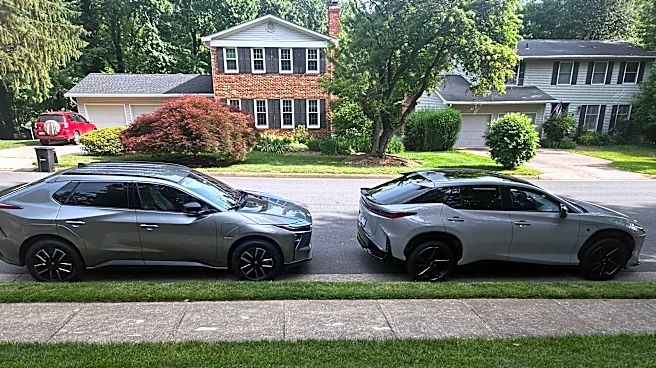
The RZ looks similar to the bZ, but it is slightly larger and has a few distinguishing features such as leather heated seats that come standard, compared to those requiring an upgrade in the bZ.
The Lexus RZ starts at $47,395 before taxes and additional fees, which seems modest for a luxury car in light of most modern new car prices. It's available in six trims, ranging from the base model 350e and the top-of-the-line 550e F Sport.
Which one is better? 2026 Toyota bZ or Lexus RZ?
There's an age-old debate about whether it is worth it to pay for a luxury car. That choice is crystalized when you compare the Toyota bZ and the Lexus RZ.
The bZ starts at $34,650 before taxes and additional fees, which seems modest in light of most modern new car prices. It's available in two trims, the base model XLE and the top-of-the-line Limited. The top-trim Limited vehicle starts at $43,300, but it comes with bells and whistles like all-wheel drive, panoramic roof with a power sunshade and split roof rear spoiler.
The RZ starts at $47,395 before taxes and additional fees, which also seems modest for a modern luxury car. It's available in six trims, ranging from the base model 350e and the top-of-the-line 550e F Sport I drove. The top-trim 550e vehicle starts at $58,395, but it comes with bells and whistles like all-wheel drive, a panoramic glass roof with a power sunshade and rear spoiler.
The vehicles are built on the same platform, and in many ways it's hard at first glance to tell them apart.

If driving a car with a luxury nameplate is your thing, you can't go wrong with the Lexus RZ. But if affordability was a top concern for me, I would likely opt for the top trim of the comparable but cheaper bZ. The bZ starts at just under $35,000, and the cars were so similar in my opinion that at times I honestly felt like I was driving the same vehicle. A top trim bZ starts at $43,300, which is still cheaper than the base model RZ, and the differences between the vehicles are negligible in many cases.
Keith Laing is an automotive reporter on the National Trending Desk at USA TODAY. Contact Keith at klaing@usatodayco.com.
This article originally appeared on USA TODAY: Are luxury brands worth it? We compared the Toyota bZ and the Lexus RZ