
For more than a year, the U.S. government's plan for Kilmar Abrego Garcia had been an ICE Air flight to Africa, with shackles and a destination chosen by someone else.
Instead, he settled into an economy
plus seat on a United Airlines flight out of Washington Dulles International Airport on Nov. 24 after agents removed the GPS monitor he had worn on his ankle for months.
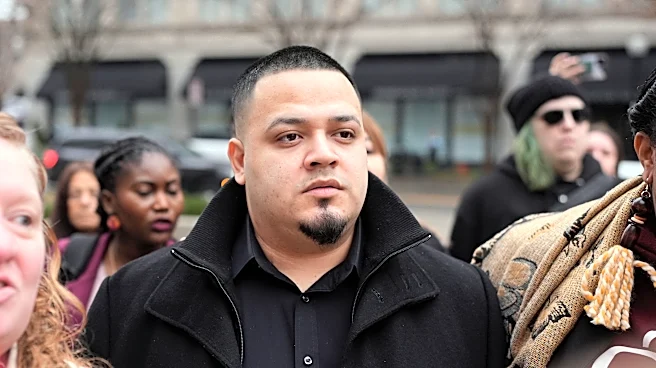
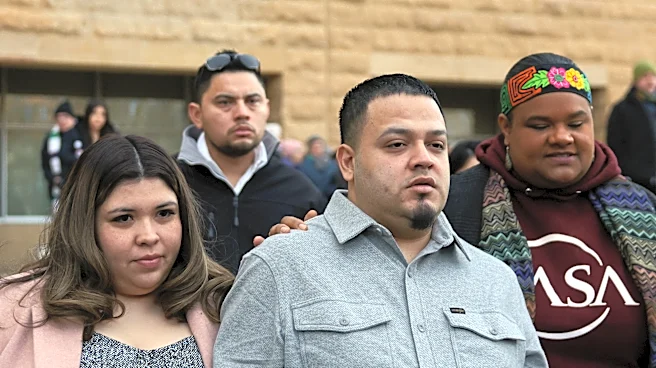
The 31-year-old Salvadoran father landed in Madrid, the destination of his choosing, early Nov. 25 with his wife, Jennifer Vasquez Sura, and brother at his side. Outside the terminal, he said nothing to the cameras waiting for him. Before stepping into a van, he raised a fist.
It was a small gesture from a man who had spent the better part of two years being described by others. Illegally deported to a notorious prison in El Salvador despite a judge's order, then brought back to the United States only to face criminal charges in Tennessee, Abrego Garcia had become one of the most recognizable faces of President Donald Trump's mass deportation campaign.
To the administration, he was a gang member and a danger to the country. To the thousands who chanted his name outside courthouses in Maryland and Tennessee, he was an ordinary working man whose case had become a test of how far the government was willing to go in pursuing its immigration enforcement agenda. For much of that time, the man himself was locked away, out of earshot.
On Nov. 25, Abrego Garcia spoke for himself. In his first public remarks since landing in Spain, delivered in Spanish at a virtual news conference, he struck a note of defiance, casting his departure not as an exile but as the end of a 20-month ordeal he had survived on his own terms.
"The government does not decide where my story continues," he said. "My family and I decide our future."

He drew a sharp line between this exit and the first time he was forced out of the country, in spring 2025. "This time I am leaving with my freedom," he said, "and not the way they took me out before, practically inhumanely."
"At the beginning, yes, I was afraid," he said. "But now I'm not afraid. I'm not afraid to face a government, as I already have."
His attorneys say he had been asking to leave the country since August 2025, and that the administration refused for more than a year, first holding him in a U.S. Immigration and Customs Enforcement detention center for five months and then keeping him on electronic monitoring in Maryland while officials tried to deport him to a series of African nations.
"The government wanted to deport him in shackles on an ICE Air flight to Liberia," his attorney, Simon Sandoval-Moshenberg, told USA TODAY. "Instead, he departed on a commercial aircraft, to a country that he chose, and able to move freely around the world."
When officials offered to let him plead guilty to criminal charges in exchange for a way out of the country, some on his own legal team urged him to take the deal, Sandoval-Moshenberg said at the news conference. Abrego Garcia refused and the government threatened to deport him to Uganda.
"He has now obtained the precise result that the government was offering him in exchange for a coerced guilty plea," Sandoval-Moshenberg said.
The Trump administration celebrated the departure in language that echoed its long campaign against him.
"We are delighted to announce that Kilmar Abrego Garcia has self-deported from the United States to Spain," Homeland Security Secretary Markwayne Mullin said in a statement to USA TODAY. "We promised the American people that this human trafficker, wife beater, gang member, and child predator would not remain in our country. Now, this El Salvadoran man cannot terrorize innocent Americans."
Abrego Garcia has never been convicted of a crime or charged with gang membership. The only criminal charges filed against him, the Tennessee smuggling counts, were dismissed this spring by a federal judge who found the prosecution vindictive.
The terms of Abrego Garcia's exit were laid out in an order U.S. District Judge Paula Xinis signed Nov. 20 and unsealed five days later. It required the government to lift any holds that might stop him at the gate and barred officials from diverting him anywhere other than the country he picked, a safeguard against the third-country deportations the administration had pursued for months.
The order also specifies that his departure "shall constitute execution of his order of removal," meaning the government will record it as a deportation, a designation that could complicate any attempt to return. Federal law generally bars people in his situation from returning for 10 years.
Sandoval-Moshenberg called the absence temporary. As the husband of a U.S. citizen and the father of a young, severely disabled U.S. citizen child, Abrego Garcia is eligible to return as a lawful permanent resident, he said, though he would first need waivers from the State Department that the family does not expect the Trump administration to grant.
The attorney said he hopes the next administration will prioritize reunifying the family and allowing Abrego Garcia's return to Maryland.
"This does not require an act of extraordinary executive grace," Sandoval-Moshenberg said. "There is an existing immigration pathway. It is a well-trodden immigration pathway that brings Mr. Abrego Garcia back to the United States as a lawful permanent resident a little over two years from now."
Until then, his attorney said, "the sky's the limit." Abrego Garcia entered Spain as a tourist on his Salvadoran passport, Sandoval-Moshenberg said, at the invitation of several organizations and academic research institutes. Where he goes next has not been decided, but Abrego Garcia made clear he intends to keep speaking out "for all the people who are going through a process or an injustice."
"I have many options for my future," Abrego Garcia said. "We haven't chosen yet. My family and I will choose the next steps."
We Are CASA, the advocacy organization that has worked with him and his family for over a year, said Abrego Garcia plans to speak at events in several countries.
An ordinary life, upended
Few people outside his corner of Prince George's County, Maryland, had heard his name before March 2025. He was a sheet metal apprentice who had fled El Salvador as a teenager after the Barrio 18 gang threatened his life. In 2019, an immigration judge had granted him withholding of removal, which barred the government from ever sending him back there.
That protection came at the end of a months-long detention that began when county police, citing an informant, accused him of belonging to an MS-13 clique in New York, a state where he had never lived. Abrego Garcia denied it, and he was never charged with a crime. The detective who filed the report was later fired over an unrelated misconduct case.

After his release, Abrego Garcia went home to Maryland and to Vasquez Sura, and together they raised three children, two of whom are autistic and one of whom has epilepsy. It was not an easy life, and it was not a flawless one. In 2021, Vasquez Sura sought a protective order against him after an argument, a petition she later dropped. She has said the couple worked through it privately, including in counseling.
Then, in March 2025, ICE officers pulled him over as he drove with their young son in the back seat. Three days later, he was on a plane to CECOT, El Salvador's Terrorism Confinement Center. The administration acknowledged in court that the deportation was an "administrative error." It then spent months insisting it could not, or would not, bring him back.
That refusal is what turned a deportation into a national debate. A unanimous Supreme Court ordered the government to facilitate his return. U.S. Sen. Chris Van Hollen, D-Maryland, flew to San Salvador to see him. And as the White House and DHS called him a gang member and a wife beater, Vasquez Sura was left to raise the children alone.
Vasquez Sura moved the children into a safe house after DHS posted a court document online that showed the family's address. She nevertheless became her husband’s fiercest advocate, attending hearings and stepping up to microphones to tell the country who Abrego Garcia was.
His attorneys credit Van Hollen's trip with turning the case. Abrego Garcia had been held incommunicado, Sandoval-Moshenberg said, with no idea that a legal fight was underway or that people were marching behind "Free Kilmar" banners. The first he learned that anyone knew where he was came when the senator sat down with him in a hotel restaurant in San Salvador.
"They wanted to leave him to rot there for the rest of his life," Van Hollen said on Nov. 25. "If we allow the constitutional rights of one person to be taken away, to be violated, we put at risk the constitutional rights of everybody."
When Abrego Garcia finally came back to the United States in June 2025, it was to face human smuggling charges in Tennessee stemming from a 2022 traffic stop, in which a state trooper pulled him over for speeding with nine passengers in the car, and then let him drive on.
After a judge released him that August, ICE re-arrested him days later at a check-in appointment in Baltimore and announced plans to send him to Uganda. Officials later turned to Eswatini, then Ghana, then Liberia, even as Costa Rica offered to take him in as a refugee.
Each turn widened the circle of people who felt they had a stake in his fate. Union members from his sheet metal local marched beside clergy. Strangers mailed him postcards in detention. In Nashville, protesters walked from a Lutheran church to the federal courthouse chanting "Todos somos Kilmar," or "We are all Kilmar."

The courts, meanwhile, kept siding with Abrego Garcia. Xinis ordered him released from immigration detention in December 2025. Five months later, a federal judge in Nashville dismissed the smuggling case, finding that prosecutors had brought it to punish him for winning his fight against deportation.
"The evidence before this court sadly reflects an abuse of prosecuting power," U.S. District Judge Waverly Crenshaw, the federal judge in Tennessee, wrote in his ruling. The Justice Department has appealed.
By the end, his name had come to stand for something larger than his own case, said Ama Frimpong, We Are CASA's chief of services and legal advocacy and one of Abrego Garcia's attorneys.
"Everyone has a Kilmar," Frimpong said. "Everyone has a loved one, neighbor, co-worker, union brother or community member whose life can be torn apart when the government decides to ignore our rights."
Abrego Garcia spoke less about the movement than about the people who had carried him through it. "I am happy because I am not alone," he said. "There is a community that has given me its love, and many people have given me their affection and understanding."
He thanked his union, Van Hollen, We Are CASA and the churches that had prayed for him. He said he still believed in the country that had expelled him and then fought to keep him from coming back. "I have always said the United States is a country of laws," Abrego Garcia said, "and thank God, justice has been respected."
At the end, he spoke to the people still waiting on their own cases. He said he remembered being unable to raise his voice from the first day, and that his wife and thousands of strangers had raised theirs for him instead.
"I ask them not to fall, to keep their heads up, the way I left with my head held high, standing tall before the whole world," Abrego Garcia said.
"And I will not bow my head," he said, "to anyone."
This article originally appeared on USA TODAY: Abrego Garcia was a symbol in Trump's immigration battle. Now he speaks