








For homeowners across Allegheny County, where they live has a big impact on how much they pay in property taxes.
The county's 130 municipalities are approaching their year-end budget deadline, when the local governments must finalize spending plans that help determine what residents will pay to fund their communities in 2027.
Not long after that, the county must begin a court-ordered property reassessment, replacing values that have remained largely unchanged for 14 years. Those are the values used to calculate taxes owed.
The timing puts renewed attention on just how dramatically local property tax rates already vary across Allegheny County.

USA TODAY analyzed municipal, county and school property tax data collected from theAllegheny County Treasurer’s
Office, examining how rates have changed in recent years and how much residents can pay depending on where they live. The dataset includes all 130 municipalities and 43 school districts in Allegheny County and annual rates from 2022 through 2026.
And the differences can be enormous.
Explore the data
Use our interactive map to search for any Allegheny County municipality, compare its tax rate from 2022 through 2026 and see how its rate compares with other communities.
The interactive includes all 130 municipalities and allows readers to explore municipal millage, the 6.43-mill county rate and school rates, and estimate taxes based on taxable assessed value.
What is a mill?
Property tax rates are expressed in mills. One mill equals $1 in tax for every $1,000 of taxable assessed property value. For example, a property with a taxable assessed value of $100,000 would generate $100 in tax for every one mill imposed.
Here's a simple formula a property owner can use to figure out the tax based on mills: The tax owed is equal to the property's assessed value multiplied by the millage rate, divided by 1,000.
A millage rate alone does not tell you what a homeowner's final tax bill will be. Property assessments, exemptions, discounts and different taxing structures can all affect what someone ultimately pays.

Tax rates depend heavily on where you live
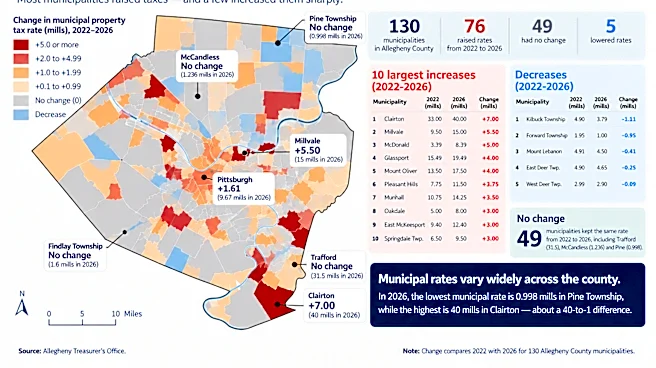
Among 2026 municipal rates, Pine Township is at 0.998 mill and McCandless at 1.236 mills. At the other end, Clairton's municipal rate is 40 mills, while Trafford's is 31.5 mills.
That makes Clairton's stated municipal millage about 40 times Pine Township's, although comparing millage alone should not be interpreted as comparing individual homeowners' final bills.
The gaps are not only between communities. Some municipalities have also increased their rates substantially over the past several years.
McDonald's municipal rate, for example, rose from 3.39 mills in 2022 to 8.39 mills in 2026, an increase of about 147%. Millvale went from 9.5 to 15 mills, while Oakdale increased from 5 to 8 mills.
Pittsburgh's municipal rate remained at 8.06 mills from 2022 through 2025 before increasing to 9.67 mills in 2026, a roughly 20% increase from 2022.
The county tax rate has increased, too
Municipal taxes are only one part of a property owner's bill.
Allegheny County's own property tax rate remained 4.73 mills from 2022 through 2024 before increasing to 6.43 mills in 2025, where it remained for 2026. That represented a 35.9% one-year increase.
On $100,000 of taxable assessed value, the county portion alone went from about $473 to $643 annually, before considering municipal or school taxes.
School districts create another layer of variation. South Allegheny's school millage, for example, increased from 21.17 mills in 2021-22 to 30 mills in 2026-27, while McKeesport Area, Montour and West Allegheny showed no increase over the period included in the dataset.
Taken together, the numbers show why a homeowner's location can matter so much. County taxes apply across Allegheny County, but municipal and school rates can differ substantially from one community to another.
And with municipalities again confronting their budgets, today's rates offer residents a baseline for understanding whether their local tax burden could change next.
All property tax data used in this analysis was collected from the Allegheny County Treasurer's Office. Municipal rates cover 2022-2026, county rates are calendar-year rates and school rates cover budget years 2021-22 through 2026-27.
This story was produced by reporter Gabby Sartori, [gsartori@usatodayco.com], with the assistance of Artificial Intelligence (AI). Journalists were involved in every step of the review, editing and publishing process. Learn more at cm.usatoday.com/ethical-conduct. Find more from the Steel City at our newsletter. Follow us on Instagram, TikTok, and Facebook.
This article originally appeared on USA TODAY: Allegheny County property tax rates: See how yours compares