



Conor Tobin played most of his career in the lower divisions of American soccer. He saw the same scenario play out too many times.
"I watched players way better than me not last because it was like, 'I've got to get on with my life,'" Tobin told USA TODAY Sports. "Think about the overall impact of that."
As the executive director of the United Soccer League (USL) Players' Association, Tobin is now uniquely placed to stem the tide of that talent loss across American soccer. As he tells it, there is more at stake than just the financial health of players in the USL.
"It's a place that's often overlooked that has not got the requisite attention over the last 30-plus years," Tobin said of the lower-league infrastructure in the United States. "And I think
there's been a tremendous negative impact on U.S. soccer in general. If you're not pushing anything from the bottom, how is it going to get better?"
What was the new agreement between the USL and USLPA?
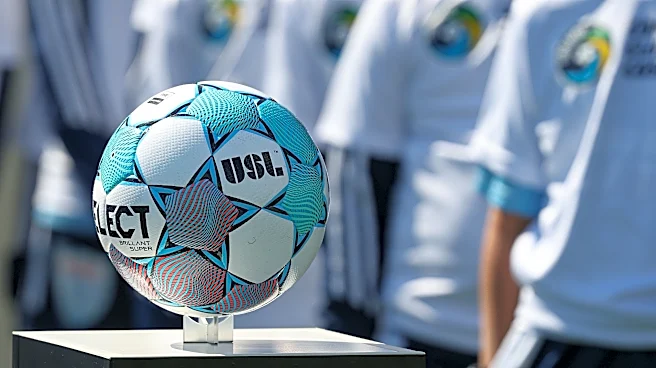
Earlier this month, the USL and USLPA ratified a new five-year collective bargaining agreement that could alter the landscape of lower-league soccer in the United States.
The agreement is for players in the second-tier USL Championship and USL Premier, a top-flight league scheduled to kick off in 2028.
Among the biggest wins for the USLPA was an increase in player contract length from 10 months to 12 months, and a boost in minimum base compensation to $42,000 for USL Championship players in 2026, with scheduled increases for the remainder of the agreement.
For someone in the USL Championship, that could mean the difference between being a full-time soccer player or having to find work in the offseason.
"These are professional athletes and they're full-time employees," Tobin said. "We're expected to play so many games in a year. This is a full-time occupation, we should have contracts that run for 12 months and you're not facing an offseason period where you're scrambling to work."
The process of negotiating the new CBA
In addition to the increase in salary and contract length, Tobin also spotlighted a provision that requires every club to provide health insurance options to players.
The process for negotiating the CBA took more than two years, and was complicated when the USL announced its intent to establish a new Division 1 league in February 2025. USL Premier is scheduled to begin in 2028 and plans to incorporate a three-tiered structure of promotion and relegation, with USL Premier at the top followed by the USL Championship and then USL League One.
There is a minimum base compensation of $67,500 for USL Premier League players, but there are plenty of questions over how promotion and relegation could effect a lower-league apparatus where employment can be tenuous.
"There are very serious potential concerns from a players' association standpoint that as USL Championship players, we have a collective bargaining agreement that we fought for, standards, things that we viewed as a step forward," Tobin said.
"Well, all of a sudden, if we have relegation, if you're one of the players on a team that goes down and you're not entitled to those protections anymore, what does that look like?"
What's the status of the CBA for the USL League One?
That question will be looming as negotiations over a CBA for USL League One start in earnest. The third-tier league has a current CBA that runs through 2027. USL League Two, meanwhile, does not have a CBA as it is not a professional league where players are employees of the teams.
The fate of USL Premier looms large in the overall landscape of American soccer.
In an ideal world for USL, the league emerges as a viable alternative to MLS while giving American soccer fans promotion and relegation, a long sought-after move that would raise the stakes and create real drama throughout three divisions of competition.
But there is a vast gulf between the present moment and that reality. U.S. Soccer lays out a number of requirementsfor a league to receive Division 1 sanctioning, from market size to stadium capacity to ownership net worth. Not every team is currently positioned to meet those guidelines.
The USL is currently reviewing applications for clubs to join the new top flight, but Tobin said that the league's players are still in the dark on many details.
Would a successful USL strengthen the soccer pyramid in the United States?
If the USL succeeds, it could strengthen the entire soccer pyramid in the United States. That will be relevant to the players that simply want to earn enough money to survive, and it could impact the very highest echelons in the game as well.
Tobin played at USL League One side Forward Madison near the end of his career. He recalls playing against Ricardo Pepi and Tanner Tessmann, at the time two teenagers earning valuable first-team experience with North Texas SC.
"If you've went back even five years previous [to that], there wasn't a third-division league where you're playing against pros. So where do they develop?" Tobin said.
"This is massive thing. Making this sustainable at a lower-division level has a massive knock-on effect. In terms of putting the building blocks in place for real progress, it's as important as any of these other things that are routinely brought up."
This article originally appeared on USA TODAY: USL players won bigger salaries. They say American soccer will benefit too