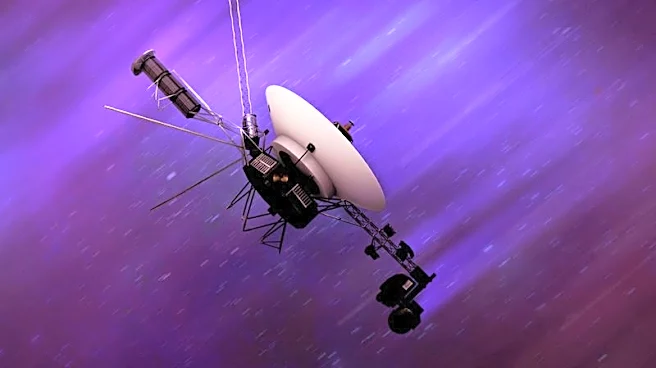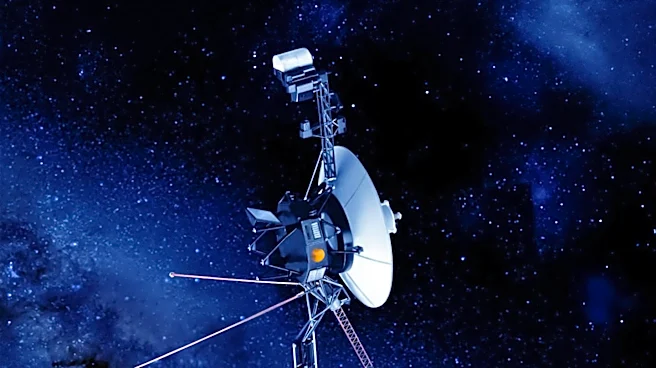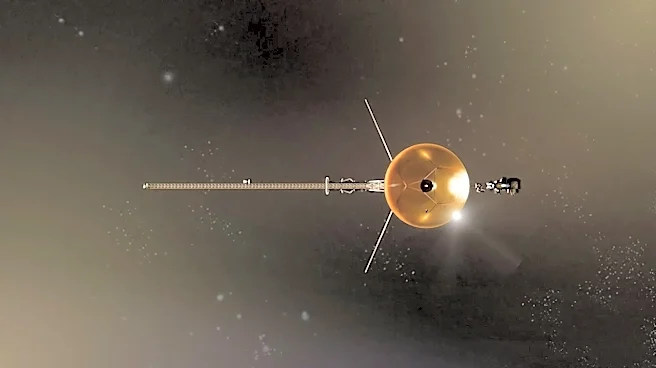



You may have heard that one of the twin Voyager probes is about to make history once again, becoming the first human-made object to travel so far from Earth that it will take a full day for its light to reach us.
The light-day milestone, which Voyager 1 is expected to reach Wednesday, Nov. 18, already has the space community abuzz.
Now, NASA is inviting you to join in on what it hopes will be worldwide celebration to mark the momentous occasion a day before it happens. And fortunately, you don't have to travel farther than your own backyard to join in.
All you need is a phone or other light source. A rudimentary knowledge of morse code is also a plus, but by no means required.
What's NASA got in mind, you may be wondering? Here's how the public
can help mark Voyager 1's light-day.
Voyager probe to reach light-day away from Earth

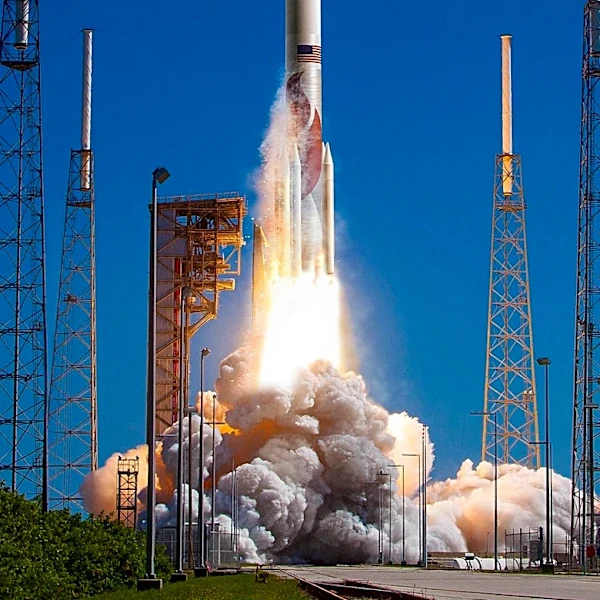
Nearly 50 years after the twin Voyager probes launched on separate dates in 1977 from Florida, one of them is about to travel a distance of one light-day from Earth.
Contrary to its name, Voyager 2 was the first of the vehicles launched into space on Aug. 20, 1977. Its twin probe, Voyager 1, then launched Sept. 5. But because it was on a faster route, Voyager 1 quickly made up ground on its twin, whizzing beyond the asteroid belt between Mars and Jupiter and passing Voyager 2 by December of that year.
Voyager 1 already has long had the distinction of being the farthest human-made object from Earth – a record it has maintained since 1998 when it bypassed NASA's Jupiter-exploring Pioneer 10 probe. Then in 2012, the vehicle became the first spacecraft to reach interstellar space – the region between stars – followed in 2018 by Voyager 2, according to NASA.
Now, on Wednesday, Nov. 18, Voyager 1 is due to reach a new milestone: becoming the first human-made object to be so far from Earth, that it will take one day for its light to reach us.
NASA calls on public to participate in Voyager's light-day milestone
You can help NASA celebrate the milestone a day ahead by shining a light at the dark sky and flashing a message for Voyager 1, the agency said in a press release.
The activity, which NASA refers to as “Shine Bright for Voyager’s Light-Day,” asks participants to shine their phones, flashlights or any other sort of light at the sky. Then, simply flash Voyager 1's call signal, "VGR," in morse code.
Anyone proficient in the telecommunications method can, of course, do it themselves. Otherwise, NASA is making it easy for you by having created a website for the activity that links to an automated flasher that anyone with a smartphone or tablet can access for free.
"Your light can be tiny, but the moment is huge," NASA said on the website. "Shine bright, go gold, and join a global wave of light honoring Voyager’s journey into the deep unknown."
When should I shine my phone at the sky for Voyager 1?
NASA is asking the public to shine a light at the sky for Voyager 1 any time after sunset on Tuesday, Nov. 17.
How to sign 'VGR' in Morse Code
NASA provides a quick tutorial on how to flash "VGR" in Morse Code for anyone who wants to do it themselves.
Morse code is made of dots and dashes, with dots representing quick flashes of less than a second, and dashes being longer flashes of light lasting about a second.
Using a switch to turn off and on a light or a hand to cover it, here's how to sign "VGR:"
- V: three quick flashes and one long flash (dot-dot-dot-dash)
- G: two long flashes and one quick flash (dash-dash-dot)
- R: one quick flash, one long flash, and one more quick flash (dot-dash-dot).
Make sure to wait a second or more between each letter.
NASA officials to talk Voyager mission. How to watch live
Then on Thursday, Nov. 19, NASA officials will host a moderated discussion at its Jet Propulsion Laboratory in Southern California about the status of Voyager 1 and 2. A question-and-answer session with both the media and audience members will follow.
The event will also include a preview of a documentary on the Voyager missions that will debut in 2027 on the agency's free NASA+ streaming service to mark the 50-year anniversary.
The discussion, set for 12 p.m. ET, will stream live on NASA's YouTube.
What is the mission of Voyager 1, Voyager 2?
Both Voyager probes have spent nearly five decades traveling billions of miles away from Earth to explore the outer solar system and beyond.
The spacecraft have investigated all the giant planets of our outer solar system ‒ Jupiter, Saturn, Uranus and Neptune ‒ as well as the planets' magnetic fields and a combined 48 of their moons, NASA says. The probes completed that portion of their respective journeys by 1989, after which NASA retooled their mission as an interstellar expedition – meaning one journeying beyond our solar system into the region between stars, farther into the Milky Way.
Each probe also carries the famous "golden record," functioning both as a time capsule showcasing Earth's various cultures, languages and more, as well as a friendly Earthling greeting should either vehicle encounter extraterrestrials.
Where are Voyager 1 and Voyager 2 now?
Voyager 1 is more than 16 billion miles away from Earth, traveling through the cosmos at more than 37,800 mph, according to NASA. Voyager 2, meanwhile, is whizzing at about 34,000 mph while 13.4 billion miles away.
The space agency provides an interactive three-dimensional diagram tracking both Voyager probes' positions outside the solar system.
Eric Lagatta is the Space Connect reporter for the USA TODAY Network. Reach him at elagatta@usatodayco.com
This article originally appeared on USA TODAY: NASA wants you to flash a light at the sky tonight for Voyager 1