



Even though the World Cup just ended, FIFA has managed to keep itself front and center of the global sports discourse this week.
That is due to a hugely controversial proposal put forth by the global governing body on Tuesday, July 28. The plan would invite private investors into the game, raising up to $20 billion for FIFA and its member associations.
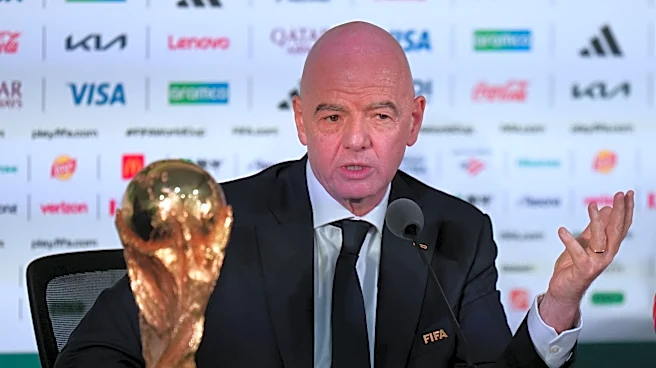
FIFA president Gianni Infantino has called the plan "a golden opportunity to turbocharge the development of the game globally"
But not everyone shares Infantino's sunny outlook. Let's look at what the plan is, why it's causing such fury, and what comes next.
What is FIFA's proposal?
The proposal would see FIFA created a subsidiary called FIFA Forward Enterprise (FFE).
FFE would control much of FIFA's most lucrative enterprises
for its tournaments, including the World Cup. FFE would run commercial and event operations, including broadcast, sponsorship, ticketing and licensing deals.
The new subsidiary would be hugely valuable, of course, and in order to cash in on this value, FIFA is looking to bring in outside investors. FIFA has said its goal is to initially raise $4.2 billion for FFE, which would be based on a $20 billion valuation.
Though it would be inviting private industry into its non-profit business for the first time ever, FIFA has insisted that the investors would not have the final say in any matters related to its competitions.
"Outside investors will have only a minority stake in FFE and will not play any operational role," FIFA said.
Infantino is hoping to push the deal through by promising to distribute the proceeds among all 211 of FIFA's member associations.
The FIFA president has reportedly sent a letter to each member association offering up to $40 million if they back the plan — but they must sign up by September 19.
Why is the plan controversial?
Though commercializing its most valuable properties is nothing new, FIFA's new proposal invites private capital into its operations for the first time ever.
FIFA seemed to understand that there would be a backlash to such a move. In its announcement of the proposal, FIFA attempted to minimize the influence that any potential investors may have.
"Outside investors will have only a minority stake in FFE and will not play any operational role," FIFA said. "Equally, they are investing in a subsidiary of FIFA, and not in FIFA itself. For FIFA, nothing changes."
But it's clear that private companies will expect something in return for their investment.
That has led to fears that FIFA's competitions will continue to view profit as their main goal. That could see further expansion of World Cups from 48 to 64 teams, highly expensive ticket prices like we saw at the 2026 World Cup, more frequent tournaments and prioritizing hosts like the United States over smaller nations.
The biggest backlash so far has come from UEFA, the European governing body that has often clashed with FIFA.
"This crosses a line that football's governing institutions should never cross," a statement from UEFA said earlier this week.
“The soul and governance of football are not assets to trade — especially with zero transparency as to who gains financially. None of us are the owners of football. It is not FIFA's to sell.”
What is Trump's involvement?
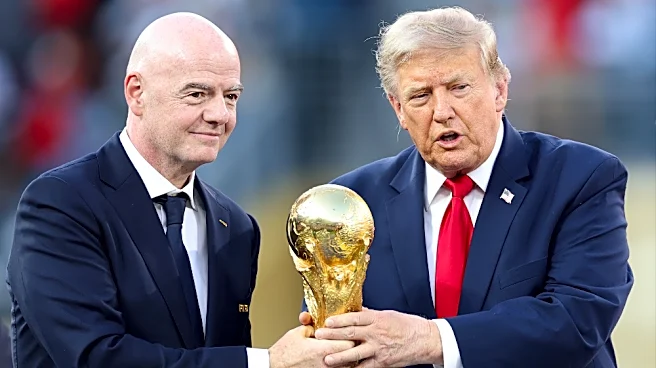
The close relationship between Infantino and U.S. President Donald Trump has been a major talking point over the past year. It will come as no surprise to see Trump involved in this deal — albeit indirectly.
FIFA said the proposed investment group will be lead by Thrive Eternal, which was founded by Joshua Kushner, the brother of Trump’s son-in-law Jared Kushner.
According to The Times, "figures close to the Trump administration have been consulted about the plan."
What does this mean for Infantino?
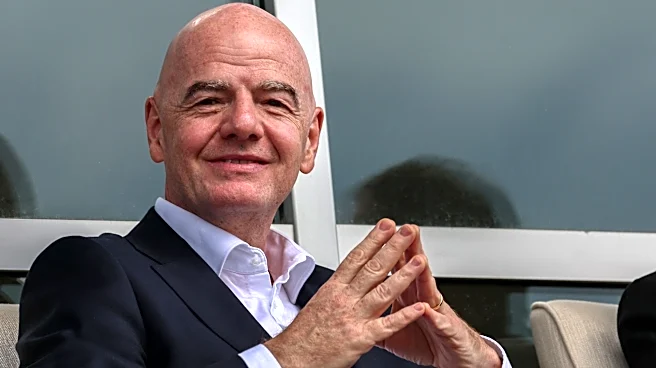
There is plenty at stake for Infantino personally when it comes to this proposal.
Infantino is currently up for re-election to a new four-year term in 2027. By raising capital and distributing the funds to each of the 211 member associations, Infantino could be shoring up the votes of the nations upon whose support his re-election depends.
Though Infantino doesn't have a serious challenger for re-election right now, Politico reported on Thursday, July 30 that UEFA officials are eyeing Qatari executive and Paris Saint-Germain president Nasser al-Khelaifi as a potential candidate.
Regardless of how his re-election bid goes, Infantino could stand to financially benefit in a massive way from the new venture.
The Times reported that Infantino would plan on running FFE starting in 2031, when his final term as FIFA president would expire.
Infantino's salary would reportedly be on par with NFL commissioner Roger Goodell, who earns about $64 million annually.
Will the proposal pass?
UEFA appears steadfastly opposed to the proposal. The European confederation has called an emergency meeting of its 55 members for Thursday, with a potential boycott of the World Cup on the table.
The boycott threat could be a major bargaining chip that may, in theory, spook non-European member associations into opposing the plan. Without European teams, any World Cup would be nearly irrelevant from a competitive standpoint.
But it isn't entirely clear what the rest of the world thinks.
Concacaf and the Asian Football Confederation (AFC) have both voiced some disapproval of the proposal, but their objections for now appear limited to a lack of transparency from FIFA — rather than critiques of the plan itself.
The Confederation of African Football (CAF) was more measured in its own statement, saying that its executive committee will meet next week to "assess and evaluate the proposed FIFA Forward Enterprise initiative."
The Oceania Football Confederation (OFC) released a statement similar to the one from CAF.
The proposal will need a simple majority from the 211 member associations as well as approval from the 37-member FIFA Council.
With the majority of the 55 nations from Europe assumed to be in opposition, all eyes will be on the AFC (47 members), CAF (54), Oceania (13) and Concacaf (41).
This article originally appeared on USA TODAY: The controversial FIFA proposal shaking the soccer world, explained