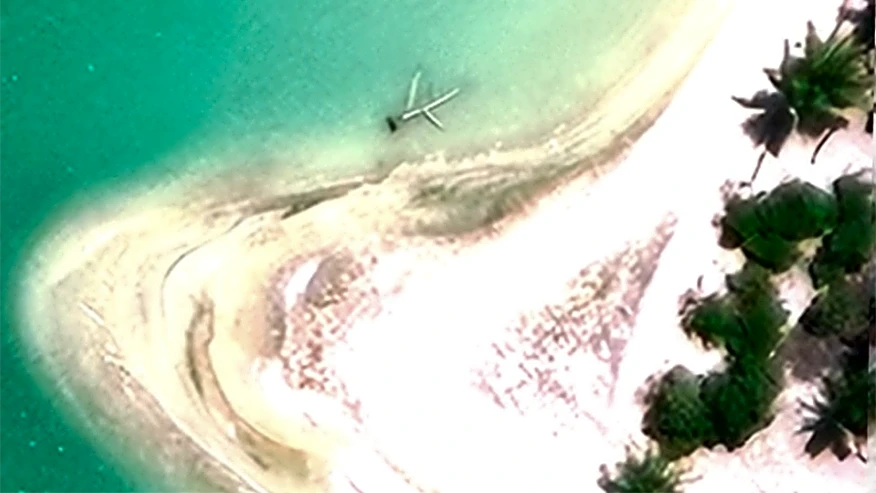







Satellite images taken a decade ago captured a plane-like shape on a remote island, fueling theories that it could be the wreckage of the aircraft flown by pioneering aviator Amelia Earhart when she disappeared in 1937 during her ambitious round-the-world flight.
The photographs led to a highly anticipated October expedition that Purdue University described as the best chance yet at locating the vanished aircraft. Enthusiasts around the globe watched with bated breath, hoping the nearly 90-year mystery would be solved.
But on Oct. 19, the expedition team announced that the object was not Earhart’s Electra 10E plane, but rather likely a "collection of large trees."
"We accomplished our goal to determine what the Taraia Object was, and we’re deeply
grateful to the private donors who shared our vision and made this journey possible," lead archaeologist Rick Pettigrew said in a statement. "Our team remains in great spirits and proud of what was accomplished."
The latest expedition follows the same pattern as every other that came before it – great anticipation followed by dashed hopes and disappointment. Two years ago, an exploration company announced that what it thought was Earhart’s plane on the ocean floor was just a rock formation.
But despite the many failed attempts to find out what happened to the trailblazing pilot, researchers and expedition companies don't appear to be slowing down their efforts to locate the missing aircraft. Deep sea exploration company Nauticos is raising money for its fourth search for Earhart's plane.
"It's the greatest unsolved mystery of the 20th century," said Dorothy Cochrane, a retired general aviation curator at the Smithsonian National Air and Space Museum and a leading expert on Amelia Earhart. "She was a worldwide celebrity and what happened leaves people unfulfilled. I don't anticipate the interest going away."
Latest expedition comes up empty
News of the expedition, which was a joint effort between Purdue University, the Purdue Research Foundation and the Archaeological Legacy Institute, drew international headlines as researchers appeared to be on the cusp of a major finding.
"I am feeling very confident about this," Pettigrew told USA TODAY ahead of the expedition. "I'm pumped."
In early October, a 17-person team journeyed by plane and boat to Nikumaroro, a small Pacific island between Australia and Hawaii, where a popular theory suggested Earhart and Noonan may have landed there during their ill-fated attempt to circumnavigate the globe.
The theory is largely based on images of the "Taraia Object," a visual anomaly in the island's lagoon identified through satellite imagery that some believed to be Earhart's plane.

But after several days on the island, the team announced that it found no conclusive evidence linking the object to Earhart's aircraft. Researchers determined that the visual anomaly was likely a collection of large trees and other debris deposited along a sandspit on the island.
"By the time the team arrived at the site, a good portion of the debris had fragmented and washed away, leaving only a single Y-shaped segment — a fraction of the anomaly’s original size observed in imagery when the Taraia Object hypothesis was developed," Purdue University said in a news release.
Earhart's disappearance remains a subject of fierce debate
The expedition is among dozens of costly voyages that have taken researchers from remote islands to the depths of the Pacific Ocean in hopes of finding Earhart’s Lockheed Electra 10E.
Several of the expeditions are based on different theories surrounding Earhart’s unsolved disappearance. The most widely accepted explanation is that Earhart and Noonan ran out of fuel and crashed into the Pacific Ocean near Howland Island, where the pair were expected to land before they vanished.
Some of the more implausible theories suggest the flight was part of a secret spy mission, that Earhart assumed another identity or that Earhart and Noonan were captured by a foreign government.
In a statement, Purdue said the research team supports the broader "castaway theory," which posits that Earhart and Noonan did not crash into the sea, but rather landed on the reef flat of Nikumaroro and were marooned there.
During the recent expedition, the team located several artifacts that they intend to study, including a steel tube about 30 inches long, according to Purdue. These items could be the latest pieces of evidence supporting the theory that Earhart and Noonan landed on Nikumaroro, the university said, including radio bearings that converge there, and an analysis of human bones discovered on the island which resemble a person of Earhart's stature.
Attention turns to other expeditions
With the decades-old mystery remaining unsolved, other researchers and exploration companies are poised to move ahead with their own searches.
Last year, deep sea exploration company Nauticos announced plans for a fourth expedition. In a statement, the company said it will search an area near Howland Island where an analysis suggests Earhart and Noonan were located less than an hour before their last radio transmissions.
"We have narrowed the search area dramatically," Dave Jourdan, President of Nauticos, said in a statement. "This new expedition presents our best chance yet to finally locate Amelia Earhart's plane."
Purdue University, where Earhart worked as a visiting professor, said it remains committed to solving the enduring mystery. It has not announced plans for any future expeditions.
"Amelia Earhart never gave up — she kept pushing boundaries and flying into the unknown," Steve Schultz, Purdue general counsel and a member of the recent expedition, said in a statement. "That same fire fuels our search. She kept flying, and we will keep searching."
Christopher Cann is a national reporter for USA TODAY. He can be reached by email at ccann@usatoday.com.
This article originally appeared on USA TODAY: Search for Amelia Earhart answers isn't over. Here's what's next