






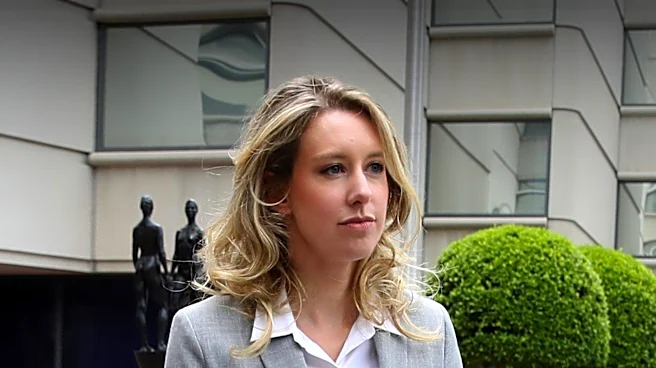
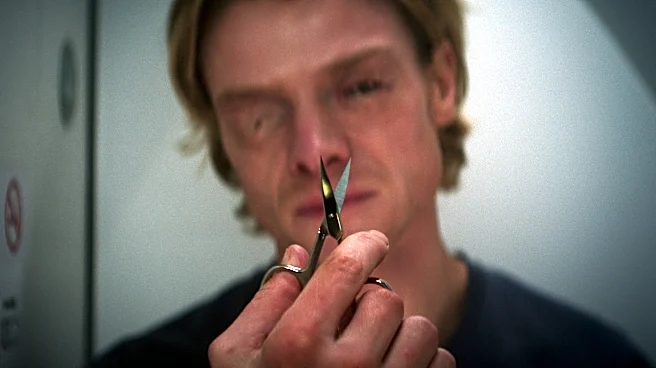

Spoiler alert! We're discussing major details about the Elizabeth Holmes documentary "You Can See Everything" (in theaters now).
“You Can See Everything” raises a bunch of questions about Elizabeth Holmes.
Among them: Why does she whisk her eggs like that? Does she really not understand “Who’s on First?” And was she in cahoots with fiancé Billy Evans to make money from the documentary?
But one of the biggest queries that the film keeps coming back to centers on a seemingly straightforward New York Times profile from 2023. In the article, reporter Amy Chozick asks Holmes about actors portraying her in movies and TV series.
“They’re not playing me. They’re playing a character I created,” Holmes allegedly told Chozick.

The quote becomes a sticking point
for both Holmes and Evans in “You Can See Everything,” as the couple claims that she actually said: “They’re playing a character they created.”
Fielder fixates on this particular pronoun switch and how it changes the entire meaning of the sentence: Did Holmes merely suggest that the public has projected their own ideas onto her? Or did the disgraced Theranos founder actually admit that her public persona is made up and none of what we see is genuine?
The now-incarcerated Holmes disputed Chozick’s reporting in 2023, claiming that she was misquoted. But the New York Times stood by the story, though the conversation wasn't recorded.
In a recent interview with the newspaper published Oct. 22, Chozick explained that she took notes about what Holmes had said, although she has since thrown away the notebook.
“I generally keep my reporter’s notebooks for a couple of years before getting rid of them,” Chozick told the New York Times. “My editors confirmed the quote with me in 2023, and I thought the matter was resolved. I didn’t anticipate that the quote would become a part of a documentary years later.“
Chozick goes on to share that she spent considerable time interviewing both Holmes and Evans, and many of the “most revealing moments” happened when recording devices were turned off.

“Holmes and I talked extensively about the character she created at Theranos, which she says her romantic and business partner, Sunny Balwani, pressured her to adopt,” Chozick says. “Holmes told me repeatedly how Balwani encouraged her to ‘kill Elizabeth’ ‒ to wear black turtlenecks, to not talk like a ‘little girl,’ to drink green juice, go vegan, not sleep for more than five hours, etc.,” all of which Balwani’s lawyer denied.
“Hollywood screenwriters didn’t invent the black turtlenecks, the deep voice or the red lipstick,” Chozick adds.
Fielder and co-director Lance Oppenheim conclude that we are all unknowable and that true authenticity doesn’t exist, especially when cameras are rolling. “You Can See Everything” posits that it’s not our place to judge what’s genuine and not in Holmes’ relationship with Evans, and that any stab at “radical transparency” in this film is ultimately futile.
Chozick, too, maintains that the much-memed Holmes is a lot more self-aware than she lets on.
“I’ve profiled some of the most controversial figures of our time, and I am always surprised by which details or quotes strike a nerve with them,” Chozick says. During their time together, “Holmes spoke openly, over several days, about the persona she created at Theranos. This was the first interview she had given since the blood-testing company imploded, and she looked and sounded like a completely different person from the public figure people remembered.
“How and why she’d created that persona was a topic that we returned to repeatedly.”
This article originally appeared on USA TODAY: Elizabeth Holmes disputes one word in her New York Times profile