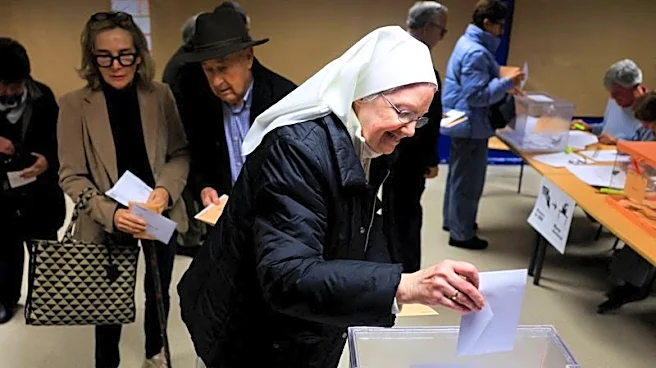





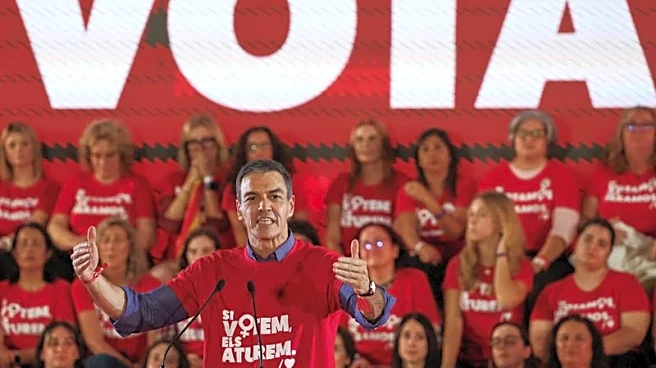


Voters in Spain ousted the country’s longtime progressive leader Pedro Sánchez, U.S. President Donald Trump’s top nemesis in Europe, ushering in a new conservative government that is poised to include a far-right party for the first time since the country became a democracy.
The center-right People’s Party, which is led by Alberto Núñez Feijóo, declared victory after it was projected to win the most seats in the election on Nov. 29. It will likely seek to form a governing coalition with the far-right Vox party. Sánchez called Feijóo to concede and congratulate the People’s Party on its election victory, according to Sánchez’s spokesperson.
Vox, a nationalist, anti-immigration party, surged in the election, winning a record number of seats and
finishing third, behind the People’s Party and the center-left Socialist Party. Santiago Abascal, the leader of Vox, is a longtime admirer of Trump and his party’s triumph will give the U.S. president an ideological ally in the next Spanish government.

Trump celebrated Sánchez’s election defeat in remarks to reporters at the White House on Nov. 29.
“He did a terrible job. He deserves to lose,” Trump said. “Sánchez lost, huh? That’s great news.”
Vox’s success in Spain could mark the beginning of a renewed resurgence for the far right in Europe after recent defeats in Hungary and Serbia. Abascal’s party was endorsed by Marine Le Pen in France and Alice Weidel in Germany, two far-right politicians who are leading in the polls ahead of elections next year.
The presence of Vox in the next government would likely result in a dramatic shift in the relationship between Washington and Madrid. Sánchez, one of the last leftist leaders in Europe, styled himself as the continent’s anti-Trump during his eight-year tenure in power and frequently feuded with the U.S president.
Sánchez’s government granted legal status to hundreds of thousands of undocumented immigrants, strengthened LGBTQ rights, refused Trump’s 5% NATO defense spending demand and closed Spanish airspace to the U.S. military after it launched a war against Iran.
“Spain is a terrible partner in NATO. They don’t participate. They don’t pay. I don’t want anything to do with Spain,” Trump said during a news conference in July at the NATO summit in Turkey. “They’re hopeless, bad people.”
In a symbolic illustration of the differences between Trump’s United States and Sánchez’s Spain, Kilmar Abrego Garcia – the longtime Maryland resident who was detained by ICE – chose Madrid as his first destination after voluntarily leaving the United States.
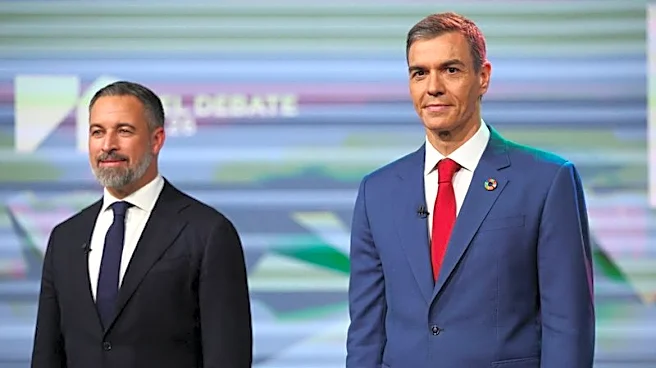
While other European leaders sought to avoid Trump’s wrath, Sánchez rarely shied away from criticizing Trump in public. Sánchez frequently compared a right-wing Spanish government to Trump and Argentine President Javier Milei on the campaign trail ahead of the election.
“What good has President Trump brought to the United States or to the world?” Sanchez said during a debate earlier this month. “What we don’t want for the world, we don’t want for our country.”
Abascal has taken the opposite approach, highlighting his proximity to the U.S. president. He traveled to Washington for Trump’s inauguration in 2025 and frequently attended the Conservative Political Action Conference.
Trump has spoken highly of the leader of Vox. During a speech at CPAC in 2025, Trump described Abascal as a “great guy” and praised the “great job” that he was doing in Spain.
Feijóo will seek to improve Spain’s relationship with the United States, but he will likely be more of a traditional conservative European leader in terms of his approach to Trump, according to Ignacio Urquizu, a former Socialist Party member of Spain’s parliament and the director of an independent polling firm.
“Ideologically, they don’t think the same,” Urquizu told USA TODAY. “On immigration, Feijóo and Trump don’t think the same. On the topic of Europe, they don’t think the same.”
The election in Spain largely centered on affordability issues, especially a housing crisis that has resulted in rents skyrocketing. Feijóo and Abascal, however, sought to emphasize corruption scandals involving several of Sánchez’s allies and immigration concerns.
In July, roughly 80,000 people briefly crossed the Moroccan border and entered the Spanish enclave of Ceuta in North Africa. Though most of the people did not stay in Spanish territory, the right-wing opposition parties blamed the event on Sánchez’s pro-immigration policies.
The Trump administration also hammered Sánchez’s government over the migrant rush.
“These images out of Spain are an unfortunate reminder of the consequences of mass migration and the radical left-wing globalist policies that have enabled the Invasion of the West,” Vice President JD Vance wrote on July 31 in a post on social media.
Abascal has pledged to deport undocumented immigrants and has blamed migrants for many of Spain’s problems, even though the influx of immigrants has boosted the Spanish economy.
This article originally appeared on USA TODAY: Spain ousts Trump’s nemesis in Europe, elects right-wing government