



We've come a long way from paper maps.
There were portable GPS systems and later Google Maps, which brought wayfinding into your pocket. Now, a Finnish tech start-up and a longtime German automotive supplier think they may be able to turn your windshield into a digital map — and a whole lot more.
The technology, developed by Helsinki-based start-up Distance Technologies and Forvia Hella, which has an American headquarters in Auburn Hills, seeks to replace the “bulky” optical systems used in many current head-up displays. Their product is a much thinner, mirrorless projector that can, according to the executives, turn the whole windshield into a display for information.
The companies are showing the system, designed to lessen distractions and make
infotainment more natural, to automakers and say they aim to bring it to production vehicles within three years. The sales pitch is one part safety, one part luxury and one part cool.

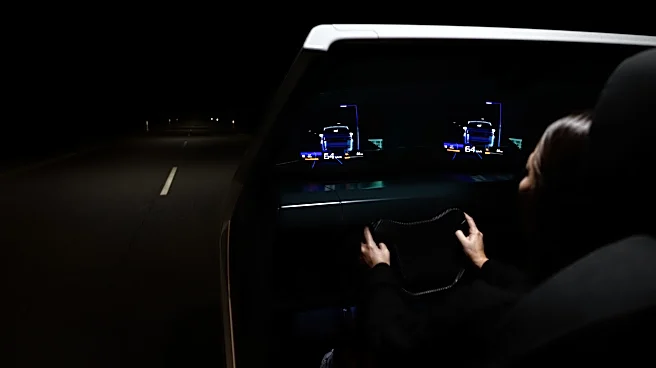
Instead of requiring drivers to look down at a center screen, information can appear in the driver's field of view and be positioned in relation to the road ahead: Blue arrows, in theory, could mark the directions a driver’s GPS has calculated. Speed, mileage, climate controls — you name it — would be visible within the driver's field of view on the windshield and not on the dashboard.
It is, in essence, a heads-up display taken to the max.
No mirrors
So how does it work?
Well, sort of like the tiny head-up displays that have become common in new vehicles, except it's across the whole windshield. To be clear, it’s not exactly the same: Those smaller HUDs use mirrors to bounce light onto the windshield. Forvia and Distance have developed a mirrorless optical system that works more like a projector.
"If you think about how typical head-up displays work, they have a projector and then one or two mirrors that guide the light to the windshield,” said Urho Konttori, CEO and cofounder of Distance Technologies. “These mirrors are specifically tailored for a single car, single windshield."
Those modern HUDs, using several mirrors, can be quite bulky. The new system, he said, removes those mirrors and uses a flat projector with a thin optical layer.
“(Our system) doesn't have these kinds of mirrors creating a long optical pipeline. It's a flat projector and very thin layer of optics on top that allows us to have a really high level of control over where the light is shown," Konttori said.
The result is a much smaller package, with a much larger display.
"That makes it very thin," Konttori said. "We can talk about centimeters, like one to two inches of thickness (of the new HUD) compared to 10 or more inches of thickness that you have typically in the HUDs of today."
According to David Schliwa, Head of New Business Sensors for Forvia Hella, it is like putting the experience of virtual reality glasses on a windshield.
Schliwa and Konttori both say the ability to put more information in front of the driver does not mean the windshield should become a giant screen — that likely would not be safe. The goal is to show information only when it is useful.
"I think the key is in the user-experience design. You should not be distracting the driver,” Konttori said.
The same idea applies to phone calls and other notifications, which could pop up on the windshield briefly but quickly go away.
"This is a powerful tool. You need to be responsible in how you use it," Konttori said.
It sounds sort of “Jetsons”-esque — like the technology of the future — but the executives said they believe the tech is capable of being implemented in all cars and not just high-tech luxury rides.
"It's very much scalable,” Schliwa said. “We have a version for luxury really going high, but we can also serve the volume markets with some less user-experience things but with future-ready hardware.”
Konttori said the technology has already been tested in pilot vehicles on Finnish roads and, while it may take a little getting used to, it can be quite helpful.

Moving at “China speed”
Much of the innovation in the automotive sector today takes place in China, a country whose automotive industry has boomed in the last decade. Distance and Forvia Hella, the executives said, are hoping to be just as agile.
“We have the so-called China speed,” Schliwa said. “(We have) fast, good, agile teams, smaller teams, really focused on the product.”
According to Konttori, preliminary estimates said it could take up to a decade to bring this product to market. After beginning to work on the project in January 2025, though, the two teams have gone at breakneck pace and are hoping to be hitting the market with the new HUD system in just three years.
Time will tell if it gets adopted in mainstream vehicle production (similar technology developed by Distance has been used in the defense industry already), but Schliwa is optimistic.
"We have access to every (automaker) in the world, and we are talking with worldwide (automakers), and there are concrete interests,” Schliwa said.
Konttori said the technology is arriving as automakers, particularly in China, increasingly adopt complex head-up displays.
As automotive tech developments abound, Schliwa and Konttori hope they have made one that “helps you keep your eyes on the road.”
Liam Rappleye covers the automotive industry for the Detroit Free Press. Contact him: LRappleye@freepress.com.
This article originally appeared on Detroit Free Press: New automotive tech aims to upgrade your windshield — with projectors