


In the year since the shooting of conservative activist Charlie Kirk, an intense free speech debate has unfolded across the United States − from college campuses to the halls of state legislatures.
The debate began quickly: In the days following Kirk's death on Sept. 10, 2025, dozens of university professors and others across the nation faced swift termination after comments they made about Kirk came under intense criticism from conservative lawmakers and activists.
A Tennessee professor, who shared a years-old news article about Kirk with no additional commentary, was fired. An Indiana professor, who posted on social media that Kirk's death was "a tragedy" and said his death was a "reflection of the violence, fear and hatred he sowed," was similarly
removed. Another Tennessee man who posted a quote from President Donald Trump in the comment section of a Kirk memorial post was jailed and charged with threats of mass violence.
But in the months since, a series of lawsuits stemming from these firings and other legal actions have cost taxpayers millions in settlements as the ripple effects of Kirk's death spread.
Kirk, a podcast host and activist who championed open debate, was fatally shot during an event at Utah Valley University, leaving behind his wife, Erika, and two children, along with a conservative media empire.
Tyler Robinson, the 22 year-old man arrested two days after the shooting and charged with Kirk’s murder, could potentially face the death penalty if found guilty. His case remains ongoing in a Utah court room.
Few places show the impact of Kirk's death more than college campuses.
Turning Point USA, the conservative college advocacy group founded by Kirk and centered on the concept of open debate and civil discourse, has reported staggering growth across the country over the past year.
At the same time, students continue to report fears of violence and a need to self-censor, according to the Foundation for Individual Rights and Expression’s annual College Free Speech Rankings report, released Sept. 9.
The survey reviews student attitudes toward free speech on campuses, this year getting response from 62,997 students at 2,621 campuses.
“There are reasons for cautious optimism,” said Sean Stevens, chief researcher at FIRE. “Around 189 schools improved their (free speech scores). However, we still only have around 25 schools getting like what would be a C or better on a traditional academic grading scale. Most schools still don't get a passing grade.
"There's still there's still plenty of reason for concern, and I do think the Charlie Kirk assassination...reverberated across the country."
Backlash to Kirk speech sparks lawsuits, pricey settlements

Firings of public employees for their speech about Kirk started just hours after his death, with lawmakers and activists largely taking to social media to share screenshots of posts.
Front and center in that battle was Vice President JD Vance, who served as guest host of Kirk’s podcast five days after his killing. During the episode, Vance said that people should report anyone who was “celebrating” Kirk’s death to their employer.
Indiana Attorney General Todd Rokita expressed similar sentiments, asking people in a Sept. 12 X post to report teachers who "celebrate or rationalize" Kirk's killing so they can be included in his office's government dashboard. The platform has been used to list and condemn instances of "objectionable" political ideology entering the classroom.
Indiana's Lt. Gov. Micah Beckwith made a similar request, stating his office would review the submissions and potentially contact those individual managers. Days later, Gov. Mike Braun threatened to suspend or revoke the licenses of teachers who made "terrible comments" on social media about Kirk.
A national website was even created shortly following Kirk's death, which allowed users to submit and catalog examples of people's online comments about Kirk into a database that would be "converted into a searchable database of over 30,000 submissions."
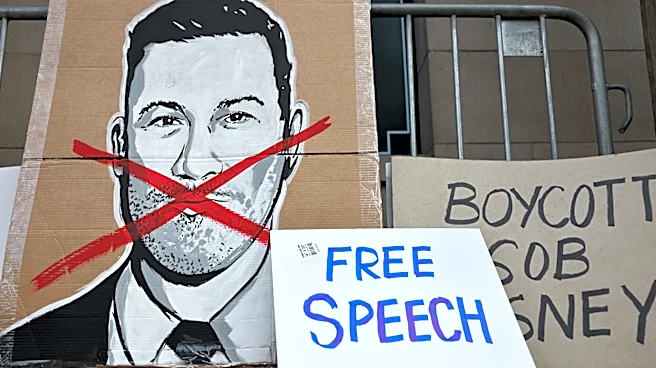
The examples, largely containing constitutionally protected speech, included details of the posters' locations, jobs and social media profiles, under a banner that read "this is the largest firing operation in history."
Legal action followed, testing the First Amendment
Lawsuits soon followed.
Settlements totaling nearly $4 million have been reached so far across the nation with people who lost their jobs over social media posts that were critical of Kirk.
Tennessee currently leads the nation in settlement payouts, having paid over $3.2 million in settlements, backpay and other damages to plaintiffs in the state in Kirk-related legal action.
Most recently, the University of Tennessee System agreed to a $1.9 million settlement in late June to a professor after she sued the university for violating her First Amendment rights. The figure is one of the highest settlements in the nation for Kirk-related firings.
A Tennessee man was also arrested for allegedly making threats of mass violence in connection to a series of social media comments he made quoting President Donald Trump in the comments of a Kirk memorial post on social media. He settled in May for $850,000.
In January, a professor at Austin Peay State University in Tennessee was reinstated and awarded $500,000 after he was fired due to a news article he shared on social media about Kirk, which was seen as negative.
Indiana's Ball State University agreed to pay $225,000 to its former health director, Suzanne Swierc, after she was fired for making a critical social media post following Kirk's assassination, according to reporting from IndyStar, part of the USA TODAY Network.
Florida will pay nearly $500,000 to Brittany Brown to settle a free speech lawsuit after she was fired from her state job for a social media post criticizing Kirk after he was killed.
Multiple ongoing lawsuits continue across the nation.
It’s “not surprising to see this flurry of settlements,” Aaron Terr, the Foundation for Individual Rights and Expression’s director of public advocacy, previously told USA TODAY. “I think the size and frequency of these settlements shows that violating the First Amendment is expensive.”
College free speech data shows some improvements, amid continuing discomfort
Campuses across the nation have seen a number of changes in attitudes toward student speech and conservative activism since Kirk’s death.
Data provided by Turning Point USA, the organization Kirk founded in 2012, has shown a 64% increase in TPUSA college chapters since last year.
The organization’s 2026 Chapter Leadership conference had more than 2,500 attendees – twice the 2024 attendance and with more than two-thirds of summit attendees reporting becoming involved with TPUSA after Kirk’s death.
The group stated the data shows that “more Americans are turning to faith, joining Turning Point USA, and finding the purpose, community, and courage to lead.”
But the ripple effects after Kirk’s death shows a mixed reaction from students and professors, according to FIRE’s new data: particularly in their comfort speaking on campus.
The survey found that, in the immediate weeks following Kirk’s death, 44% of the nearly 63,000 students surveyed nationwide found Kirk a “difficult” topic to freely discuss on campus: the third highest ranking in the nation, after Trump and the Israeli-Palestinian conflict, and above abortion and immigration.
"Some students... made direct references to faculty firings (in their survey responses about their comfort speaking)," Stevens said. "Students said that sent a clear message to them as to what can and can't be said on campus."
Students at Utah Valley University, the school Kirk was speaking at when he was killed, were particularly affected. FIRE issued data collected weeks after Kirk’s death that found students, particularly conservative students and those attending Utah Valley University, were less comfortable expressing their beliefs after the shooting.
UVU students also reported being considerably less comfortable attending public events on campus and even attending class, according to FIRE. The percentage of UVU students reporting self-censorship at least a few times a week also increased after Kirk's death, compared to the responses gathered just months earlier at the same campus.
Professors report feeling this pressure as well. In the months following Kirk’s death, Stevens said the free speech organization had a notable spike in professors reporting retaliation for their speech – both from university administration and lawmakers.
“We documented roughly 90 attempts to get faculty sanctioned in some way for commenting about the assassination, with 20 or more resulting in a firing or resignation," Stevens said. "The number of politicians that are openly going after faculty or student groups, and trying to get events cancelled on campuses, has exploded in the past few years, and spiked (after Kirk's death).”
Apart from hesitancy to speak about Kirk, another data point has changed this year: Nearly one-third of students – 30% – believe it is acceptable, at least in rare cases, to use violence to stop a campus speech, according to the report.
That marks a decline from last year's record-high percentage of students who said the same, at 34%.
"This year we saw a three to four percentage point decline for that statistic, which doesn't sound like a lot, but we are surveying over 60,000 students so that's going to be a statistically significant shift," Stevens said. "I do think some of that is in in response to the assassination, because we saw that shift at Utah Valley in the immediate aftermath of it, and saw basically almost no one there saying it's acceptable to commit violence."
Amid all of these reactions to what FIRE called a "jarring" year for campus free speech, it's easy to wonder why schools' scores went up at all.
According to Stevens, the data shows higher rates of student approval of their administrative support at schools that improved – support Stevens said is particularly notable at schools who defended free speech policies in opposition to the Trump administration.
Students, according to the results, seem to like that.
"Over the past seven years, it has become apparent that strong leadership at colleges and universities is needed to establish at the very least the basic conditions of an open expressive environment," the survey states. "Schools that clearly and consistently support First Amendment protections and do the best they can to establish a campus environment that prioritizes open expression perform better in (the survey).
"This comes not just from sending messages to students and faculty on campus that the school values free and open expression, but also from consistently demonstrating that they mean what they say on this issue when controversy inevitably erupts."
Angele Latham’s role covering First Amendment issues at The Tennessean is made possible by a collaboration among Freedom Forum, Journalism Funding Partners and the USA TODAY Network. Freedom Forum does not provide editorial input. Reach Angele Latham at alatham@gannett.com, on X at @angele_latham and on TikTok at @angelelatham.
First Amendment reporters BrieAnna Frank, Cate Charron, Taylor Seely and Stephany Matat contributed to this report.
This article originally appeared on USA TODAY: A year after Charlie Kirk's death, a fierce free-speech debate unfolded