








Election Day has arrived, and citizens across the United States are casting votes not only in contentious political battles, but also on controversial issues, like same-sex marriage and abortion.
This year, four states (Idaho, Nevada, Virginia and Missouri) have abortion measures on their ballots, with Missouri making a move to repeal rights enshrined in the state constitution only two years before and Nevada looking to get its amendment past its unique "two-election" rule.
After the Supreme Court overturned Roe v. Wade, which federally guaranteed the right to an abortion, in June 2022, states have enacted a range of laws. At least 13 have implemented near-total abortion bans, while others have enshrined the right to abortion access in state law or passed
shield laws protecting patients from other states who travel to get the procedure.
Now, states on both sides of the coin have measures on the ballot to strengthen protections, implement tighter restrictions, or overturn current legislation.
Here's what to know about proposed abortion legislation in the 2026 midterms and what each state is voting on.
Idaho: Prop 1 (Reproductive Freedom and Privacy Act Initiative)
Proposition 1, or the Reproductive Freedom and Privacy Act Initiative, would challenge some of the state's current near-total abortion ban and create a right to abortion before fetal viability and in the case of "medical emergency" afterward. Nonprofit Idahoans United for Women & Families spearheaded this citizen-led ballot.
How it defines viability: In this case, "fetal viability" is defined not by a set number of weeks, but instead as "the point in a pregnancy when, on the basis of a physician's good faith medical judgment, based on the facts known at the time, and determined on a case-by-case basis, the fetus has a significant likelihood of sustained survival outside of the uterus without extraordinary medical measures."
How it defines medical exemptions: "Medical emergency" is defined as a physical medical condition that would require abortion under the following parameters:
- To protect a pregnant patient’s life; or
- For which a delay may:
- Place the health of a pregnant patient in serious jeopardy;
- Cause serious impairment to a bodily function of a pregnant patient; or
- Cause serious dysfunction of any bodily organ or part of a pregnant patient’s body.
Current abortion laws in Idaho: Currently, the state has Idaho Code 18-622 (the Defense of Life Act), one of the strictest bans in the country, which generally makes performing or attempting to perform an abortion a felony that can result in two to five years in prison and the suspension of medical licenses. Abortions are only permitted when a physician "determines in good-faith medical judgment" that it is necessary to prevent the death of the pregnant woman. In cases of rape and incest, physicians may only perform an abortion during the first trimester and only if the victim met specific reporting requirements, including filing law enforcement reports and providing certain documentation to the physician.
The Idaho Medical Association already asked the state to clarify and widen the exemptions, as criminalization targets the provider and, it says, "delays and denials of care that threaten their lives, health, and future ability to have children."
What else the bill would do: Under Proposition 1, healthcare providers would be protected from professional discipline or legal liability for providing healthcare "consistent with this act."Proposition 1 provides that: "Every person has the right to reproductive freedom and privacy" and the right to “make personal decisions about reproductive healthcare that directly impacts the person’s own body." It states that the government cannot interfere with personal decisions about reproductive healthcare, including:
- Abortion
- Childbirth care
- Contraception
- Fertility treatment
- Miscarriage care;
- Prenatal, pregnancy, and postpartum care.
Because it is a statute, Prop 1 would not amend the state's constitution. This makes it easier to repeal in the future than a constitutional amendment.
A vote yes means establishing the right to reproductive freedom and privacy in Idaho, including abortion up to viability and in the case of risk to life or health afterward, and limiting government interference in reproductive healthcare decisions.
A vote no means leaving the current ban in place.
Nevada: Question 6 (Right to Abortion Initiative)
Question 6, or the Right to Abortion Initiative, is another citizen-led ballot spearheaded by Nevadans for Reproductive Freedom. This is a proposed constitutional amendment, meaning that it would enshrine the right to abortion in the Nevada Constitution until "fetal viability" and/or "when needed to protect the life or health of the pregnant patient" without state or government interference.
How it defines viability: In this case, "fetal viability" is defined as "the point in pregnancy when, in the professional judgment of the patient’s treating health care practitioner, there is a significant likelihood of the fetus’ sustained survival outside the uterus without the application of extraordinary medical measures.”
How it defines medical exemptions: In this case, an abortion would be permitted if it were to "protect the life or health of the pregnant patient."
What else the bill would do: The government could interfere in the case of “compelling state interest” under the amendment, definedas "limited exclusively to the state’s interest in protecting, maintaining, or improving the health of an individual who is seeking abortion care that is consistent with accepted clinical standards of practice."
This means the amendment would allow the government to regulate abortion only when doing so is necessary to protect the health of the person seeking the abortion and is consistent with accepted medical standards. For example, the state could require doctors to give patients clear and accurate information about an abortion, including how the procedure works, possible risks and other options, before the patient decides whether to have one.
Current abortion laws in Nevada: Currently, abortion is legal until 24 weeks in Nevada, which is often around the time a fetus is considered "viable." The state legislature cannot amend or repeal this law without voter approval, per Question 7, which passed in 1990.
Nevada has a specific rule for amending the state constitution called a“two-election” requirement. Under this rule, voters must approve a constitutional amendment twice in two even-numbered election years before it goes to the state supreme court, which can then make it the law. Question 6 was already passed for the first time in 2024 by a margin of about 64% to 36%.
A constitution is the highest legal document in a state or country; therefore, amendments have stronger legal protections than other forms of state law. Constitutional provisions are harder to change and can limit what future lawmakers may do, so if Nevada voters approve Question 6, future lawmakers generally could not pass a law that violates those protections without changing the constitution again with another two-election vote.
A vote yes means enshrining the right to abortion in the state constitution up to 24 weeks of pregnancy, and after that, when necessary to protect the life or health of the pregnant woman.
A vote no means leaving the laws as they are.
Virginia: Question 1 (Right to Reproductive Freedom Amendment)
Question 1, or the Right to Reproductive Freedom Amendment, would also enshrine abortion and reproductive rights into the state constitution. It would provide a constitutional guarantee of "right to reproductive freedom," defined as the "ability to make and carry out decisions relating to one's own":
- Prenatal care
- Childbirth
- Postpartum care
- Contraception
- Abortion care
- Miscarriage management
- Fertility care
How it defines viability: The amendment allows for the government to regulate abortion not based on just "viability," but rather gestational age. Abortion could be regulated or limited in the third trimester of pregnancy, based on the woman's last menstrual period.
How it defines medical exemptions: While the state could limit or regulate pregnancy in the third trimester, it could not prohibit abortions beyond this point if the "pregnancy cannot survive," or an abortion is deemed necessary by a physician to protect the life, physical or mental health of the mother.
What else the bill would do: Question 1 would also prohibit the state from prosecuting or penalizing a person for receiving or aiding in the event of a miscarriage, stillbirth or abortion. It would also protect doctors, nurses and healthcare providers from being punished for these decisions.
Current abortion laws in Virginia: Currently, abortion is legal up until the third trimester based on a woman's last menstrual period. Exemptions are also allowed beyond this if there is a threat to the mother's life or general health. Like Nevada, passing a constitutional amendment will make these laws harder to change or repeal in the future.
A vote yes means enshrining the "right to reproductive freedom" in the state constitution and allowing state regulation during a pregnancy's third trimester.
A vote no means leaving the law as it is.
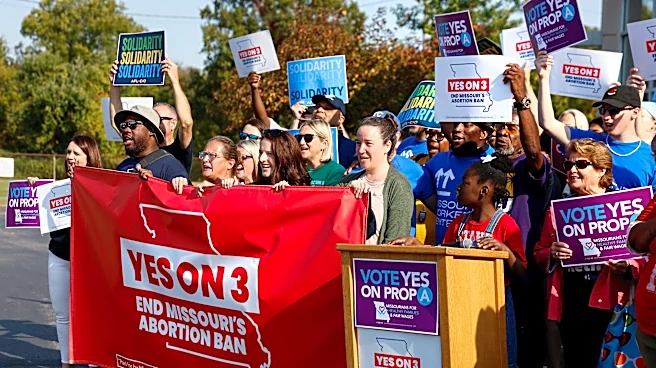
Missouri: Amendment 3 (Prohibit Abortion and Gender Transition Procedures for Minors Amendment)
Missouri is the only state with an anti-abortion bill on the ballot this midterm election, called Amendment 3 (Prohibit Abortion and Gender Transition Procedures for Minors Amendment). Led by Her Health and Her Future PAC, this measure seeks to overturn the constitutional amendment that enshrined the right to abortion passed by voters in 2024.
The amendment would both remove the "fundamental right to reproductive freedom" from the state constitution and impose new restrictions, including:
- Prohibiting abortion entirely except in cases of medical emergency, "fetal anomaly," rape, or incest.
- Limiting abortion for rape and incest to before 12 weeks.
- Prohibiting abortions based on diagnosis of disability through prenatal testing except in the case of "fetal anomaly."
- Requiring parental or guardian consent for minors seeking an abortion.
- Prohibiting fetal organ harvesting.
- Allowing state legislatures to regulate abortion providers and facilities.

How it defines viability: The bill does not define viability, as it does not seek to regulate abortion based upon it. It would ban all abortion except in the narrow cases listed above.
How it defines medical exemptions: The bill also does not define what constitutes a medical emergency or qualified fetal anomaly. It does say it would allow for continued care for "medical emergencies," "ectopic pregnancies" and "miscarriages," though it also does not further specify or define these conditions, either. Because the bill does not define or state the conditions under which its exemptions apply, its terms would likely be interpreted through existing law, regulations, or future court decisions.
Current abortion laws in Missouri: Currently, abortion is legal until fetal viability in Missouri, defined as "in the good faith judgment of a treating health care professional and based on the particular facts of the case, there is a significant likelihood of the fetus’s sustained survival outside the uterus without the application of extraordinary medical measures." It also prohibits the state from restricting abortion after this point if a medical professional deems it necessary to protect the life, physical or mental health of the pregnant woman.
What else the bill would do: The bill does not specify any punishment or repercussions for those who participate in abortion. However, because it seeks to repeal the 2024 Right to Reproductive Freedom Initiative,laws in place before that was passed would likely return. Before the 2024 amendment, abortion was entirely banned with few exceptions, including saving the life of or preventing a serious risk to the health of the pregnant woman. It required that patients undergo a mandatory 72-hour waiting period and receive counseling before an abortion and banned insurance coverage except in very limited circumstances.
A vote yes means repealing the amendment protecting reproductive freedom from the state constitution and implementing new restrictions on abortion.
A vote no means the Right to Reproductive Freedom Initiative stays in place.
This article originally appeared on USA TODAY: Abortion is back on the ballot: What 4 states are voting on today