



Less than 90 days out from the midterms, election officials are pleading with the Supreme Court to block the Trump administration from making changes that would allow the U.S. Postal Service to decide who gets mail-in ballots.
And after Postal Service changes earlier this year that affect how quickly mail is postmarked
, some states are urging voters to be cautious when putting ballots in the mail at all.Many people expect that their ballots will be postmarked the same day they place them in their mailboxes, and that is no longer guaranteed under the new rules.
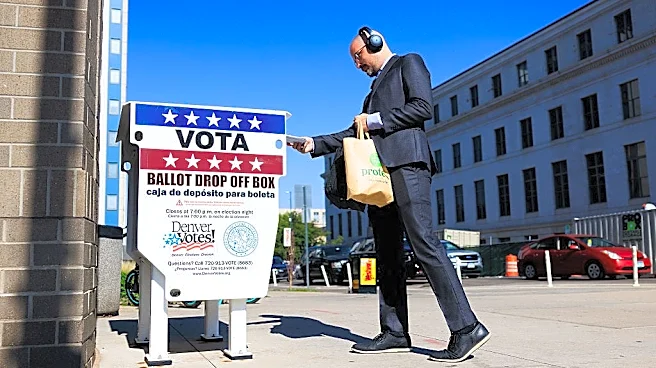
“We, and me personally as a messaging issue, encourage people to use our ballot drop boxes rather than the mail system; just to avoid any potential delays or errors or frankly at this stage
attempts to interfere by the federal government,” Washington state Attorney General Nick Brown told USA TODAY. “Our ballot boxes are locally controlled and operated and don't involve the federal government. We generally encourage that as the best way to get people's votes in.”
President Donald Trump issued an executive order in March instructing the Department of Homeland Security to compile lists of confirmed U.S. citizens eligible to vote for states to consult and ordering the USPS to only deliver ballots to voters on each state's approved mail-in ballot list.
The move, part of his second term efforts to extend more federal authority over how states run elections − and the postmarking changes − put the Postal Service at the center of the fight over who will control the House and Senate for the final two years of Trump's presidency. Trump, who has voted by mail himself, has zeroed in on absentee ballots, which he says, without proof, are often fraudulent.
The Department of Justice has argued that a lower court acted too soon in blocking the executive order because the Postal Service has not finished writing the rules that would put it in place.
"Because of pending litigation, we have no response to offer on any questions related to the Executive Order or the proposed rule," a Postal Service spokesperson said.
“The entire Trump Administration will continue lawfully enacting the agenda President Trump was elected to implement – which includes the safety and security of American elections," White House spokeswoman Lauren Bis told USA TODAY. "This campaign pledge from the President is why millions of Americans sent him back to the White House."
Legal challenges to the executive order
After lower courts blocked the order, the Trump administration asked the Supreme Court July 27 to allow federal agencies to implement two parts of his executive orderthat directed the USPS to create mail-in ballot rules and the DHS to compile a national database of eligible voters.
Trump filed the emergency appeal after lower courts blocked the administration from creating a federal list of eligible voters and limiting delivery of mail ballots only to people on that list in nearly half the states for the midterm elections.
The group of states that brought the lawsuit told the Supreme Court on Aug. 3 there would be “extraordinary consequences” if the Trump administration is allowed to move forward with an overhaul of mail-in voting rules so close to the election.

On July 5, a bipartisan group of more than 100 election officials filed a friend of the court brief to explain the administrative challenges if the executive order moved forward.
Preparations are long underway, they said, and there would not be sufficient time to test the new procedures, train election staff and educate voters about the changes.
"Should this Court approve the requested stay, thereby allowing the (executive order) to take effect within the plaintiff states fewer than 100 days before a major federal election where well over 100 million voters are likely to cast ballots, the result will be chaos," they wrote.
The Supreme Court could issue a decision any day.
Drop it off in person
Regardless of what the Supreme Court decides, states have been working to educate voters about submitting ballots by mail earlier or returning them in drop boxes all year. That includes direct appeals like social media outreach, media engagement, radio ads and mailers, according to multiple state election offices.
The USPS updated its postmark guidelines in December 2025 to reflect the date an envelope is first processed by an automated sorting machine rather than the date it was dropped off. In some cases, multiple days can pass between putting an item in the mail and it being processed and postmarked by a sorting machine.
For decades, the postmark – an official mark that shows where and when mail was accepted by the Postal Service – has been used in law as proof that an individual met a deadline, such as submitting a ballot by Election Day. More than a dozen states accept ballots as long as they were postmarked on or before the election.
"That's been a challenge for us to educate voters that, hey, if you're going to vote by mail on election day, make sure you drop it off at a polling location, not in a mailbox," Nevada Secretary of State Cisco Aguilar told USA TODAY.
The Supreme Court on June 29 said Mississippi can count late-arriving mail-in ballots. More than a dozen states accept ballots that arrive after Election Day but are postmarked before or on Election Day.
Sarah D. Wire covers national politics for USA TODAY and can be reached at swire@usatoday.com.
This article originally appeared on USA TODAY: Supreme Court faces plea to block Trump mail-in ballot rules