








They seemed to vanish into thin air.
A famed aviator. A hijacker who exchanged cash for passengers' lives. A labor leader linked to the Mafia. Three men who escaped from a prison thought to be escape-proof. An entire settlement full of English colonists.
Where did they go? And why, decades and even centuries later, do these mysteries still vex and fascinate us?
Americans "like the question," said Derek Arnold, a professor at Villanova University who teaches a course on conspiracy theories. "The story is art. The science is realism, and a lot of people would rather have the story than the explanation."
Cases where people seem to vanish without a trace are as old as time, Arnold said. And we like to construct stories around those cases, even when
we don't know all the facts.
"The theories are fun," he said. "Almost as alluring as what might actually have happened."
These "ultimate mysteries," he added, give us an opportunity to piece together our own narrative working from clues left for us.
"We take those clues and create what we think might have happened, even as we get more refined theories," like the recent expedition to find Amelia Earhart's long-lost plane, Arnold said. "We want to figure out how to explain things, but when we bring science and technology into the process, it's sometimes not as alluring. Having a hypothesis isn't the same as telling a story."
Let's dive into some of those stories, starting with the earliest one in American history.
The lost colony at Roanoke
A group of more than 100 men, women and children set out from England in 1587 on a small ship to establish the first English settlement in North America. After 10 weeks at sea, they landed at Roanoke Island off what is now North Carolina, but surviving in the New World would prove incredibly difficult ‒ though not without some joy, like the August 18, 1587 birth of Virginia Dare, the first English baby born in America.
The colonists clashed with Indigenous tribes, and as winter approached, they worried about a lack of reliable food sources, according to the National Park Service.
Nine days after Virginia Dare was born, according to the North Carolina History Project, John White, the colony's leader and her grandfather, returned to England to seek provisions and help from Sir Walter Raleigh, who'd led prior expeditions to the New World. Meanwhile, the colonists split into two groups, with one staying through the winter and the other traveling inland in search of a more hospitable location, the NPS says.
But what White thought would be a three-month trip turned into three years due to a Spanish Armada attack in 1588. When he finally again reached Roanoke in 1590, he found the colony abandoned, the word "CROATOAN" carved into a wooden post.
There have been numerous efforts over the years to ascertain the fate of the "lost colony." Theories include their massacre by a native tribe, their assimilation (voluntary or forced) into a tribe, mass starvation or disease.
The First Colony Foundation, a North Carolina-based nonprofit, said in June post titled "The Lost Colony is Found!", that evidence pointed to the colony splitting in two.
Working from a map drawn by White for Raleigh in 1585, archaeologists found a pair of sites near the Chowan River and the Albemarle Sound in what's now Bertie County, about 50 miles from Roanoke. They discovered a few shards of 16th century English pottery and other artifacts and believe the sites were "part of a larger, dispersed settlement of farms along the Chowan River, where 117 immigrants established their New World home."
Amelia Earhart: A missing aviator
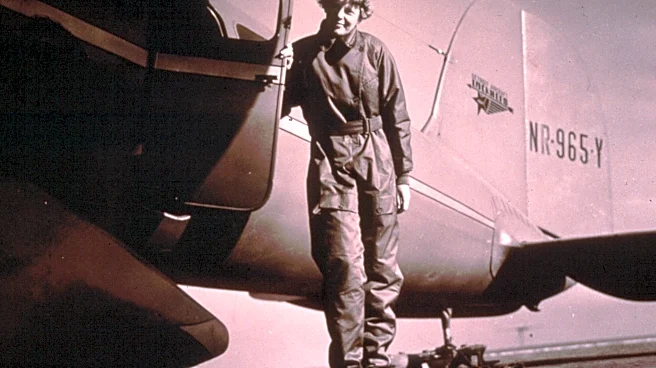
Amelia Earhart, and the plane in which she and navigator Fred Noonan tried to fly around the globe in 1937, remain missing, even after an expedition earlier this month.

A team of researchers traveled to the tiny, remote island of Nikumaroro, where a mysterious object attracted speculation that it may be the lost aviator's plane. The visual anomaly known as the "Taraia object," discovered through satellite imagery in the island's lagoon, brought the team to the island between Hawaii and Australia in search of the lost Lockheed Electra 10E.
But on Oct. 19, the team said it found no conclusive evidence linking the object to Earhart's plane.
Amelia Earhart was already famous for her aviation exploits when she and Noonan set out from Papua New Guinea toward Howland Island, where a U.S. Coast Guard cutter was waiting to refuel their plane. The pair began their journey on May 21, 1937, in Oakland, California, but disappeared on July 2 near the end of the trek. Earhart messaged the Coast Guard to say her plane was nearly out of fuel, but neither she nor Noonan knew Morse code, so there was no two-way contact, according to the Smithsonian Institution's analysis of government records of the incident.
After the Coast Guard lost contact with Earhart and Noonan, the U.S. government began what was then its largest-ever search for a lost aircraft. After two weeks with no trace of Earhart, Noonan or their plane, however, the search ended. On Jan. 5, 1939, Earhart and Noonan were each declared legally dead.
The Alcatraz escapees
It's probably the most famous prison in America: Perched on a rocky outcropping in the San Francisco Bay, Alcatraz seemed impenetrable and escape-proof. Originally the site of a military fort starting in the 1850s, the island later housed a military prison for a time in the early 20th century before opening as a federal prison in 1934, according to the Federal Bureau of Prisons.
But every prison has seen escape attempts, and Alcatraz, which ceased operating as a penitentiary in 1963, has had its share. According to the Bureau of Prisons, 36 men were involved in 14 separate escape attempts. Twenty-three were caught, six were shot and killed as they tried to escape and two drowned.
On June 11, 1962, two brothers, John and Clarence Anglin along with a third man, Frank Morris, "vanished from their cells and were never seen again," the BOP noted on its website. According to the FBI, Morris, in prison for bank robbery and burglary, was the mastermind. The men used homemade drills and dummy heads (complete with human hair) in their beds. Climbing through vents they'd made bigger and concealing the passages with fake wall pieces, they shimmied up utility poles to the roof, then back down a drainpipe before making their way to the water.
Prison authorities believed they then used life vests improvised from prison-issued raincoats and a pontoon-type raft. The tools they'd used to escape were later discovered, along with two life vests, oars, letters and photos, but the men never were found.
Weeks later, a man's body, clothed in blue material like a prison uniform, was found up the coast, but it was too badly decomposed to be identified. "Morris and the Anglins are officially listed as missing and presumed drowned," the BOP website says.
The FBI, which aided in the search for the three men, officially closed the case on December 31, 1979, turning it over to the U.S. Marshals Service, "which continues to investigate in the unlikely event the trio is still alive," the FBI website says.
The escape was later immortalized in the 1979 film "Escape from Alcatraz," starring Clint Eastwood.
DB Cooper: The hijacker who got away
Dan Cooper (at least that was the name he used) approached an airline counter in Portland, Oregon, on Nov. 24, 1971, and bought a one-way ticket to Seattle. He looked unremarkable, quiet, and seemed to be in his 40s, wearing a suit and tie, and just before the flight took off, he ordered a bourbon and soda.
And, the FBI says on its website, "Thus began one of the great unsolved mysteries in FBI history."

A short time later, he handed a flight attendant a note, claiming he had a bomb and would detonate it unless, as he said in a note to the pilot, he was given four parachutes and $200,000 in $20 bills. When the plane landed in Seattle, Cooper let the plane's 36 passengers go in exchange for the cash and parachutes, then ordered the remaining crew to fly to Mexico City.
A little after 8 p.m., Cooper jumped out of the plane somewhere between Seattle and Reno, Nevada, with a parachute on his back and the cash in hand. The pilots landed the plane safely, but Cooper had vanished into the night."His ultimate fate remains a mystery to this day," the FBI says. The agency embarked on a years-long investigation in the case it called NORJAK, or Northwest Hijacking, interviewing hundreds of people and tracking tips and leads across the U.S.
"By the five-year anniversary of the hijacking, we’d considered more than 800 suspects and eliminated all but two dozen from consideration," the FBI says.
Investigators aren't sure he survived the jump into the rough, wooded area, and that theory was bolstered by a 1980 discovery of $5,800 in rotting $20 bills whose serial numbers matched the money Cooper had absconded with. Still, the FBI says, "The daring hijack and disappearance remain an intriguing mystery — for law enforcement and amateur sleuths alike."
Jimmy Hoffa: Labor leader with mob ties
Jimmy Hoffa was to some a "worker's hero" and to others a mob-connected union leader who was ultimately killed by Mafia members who wanted him out of the way.
His disappearance on July 30, 1975 from a New Jersey restaurant parking lot has fueled decades of speculation about his ultimate fate.
President of the Teamsters union from 1957 to 1971, Hoffa was arguably the most powerful labor leader of the 20th century, but his connections to the Mafia ultimately led to a conviction on jury tampering, attempted bribery and fraud charges. He served time in prison but his sentence was commuted by President Richard Nixon in 1971 ‒ but only on the condition that he refrain from union activity until 1980, according to the Detroit Historical Society.

His disappearance, though, has never been solved: Most believe he was taken and murdered by mobsters to keep him away from the Teamsters. He was legally declared dead in 1982, but speculation about his (or his remains') whereabouts continue to this day.
According to the Mob Museum, since 2000, there have been efforts to find Hoffa's remains at at a former casino in Gardena, California; three sites in Michigan; a home in New Jersey and, most famously, the site of the now-demolished Giants Stadium in New Jersey. Searches of nearby landfills in North Jersey failed to yield results as well.
The FBI's Detroit Field Office continues to investigate the case, it said as recently as 2025, 50 years after his disappearance.
In a 2025 interview with FOX2 News in Detroit, Hoffa's son James P. Hoffa, who was 84 at the time, said his family has struggled with a lack of closure, but he doesn't expect any answers to his many questions.
"I think the answer is, it is what it is," he said. "If we ever find out anything, maybe, you know, one of the problems is that, you know, it's been 50 years and so many people that were involved are dead."
Phaedra Trethan is a national correspondent for USA TODAY, writing about history and Americana. Contact her by email at ptrethan@usatoday.com, on X @wordsbyphaedra, on BlueSky @byphaedra, or on Threads @by_phaedra.
This article originally appeared on USA TODAY: Amelia Earhart to Jimmy Hoffa: 5 mysteries that still vex us