





NEW YORK – Denise Brown won’t say O.J. Simpson’s name.
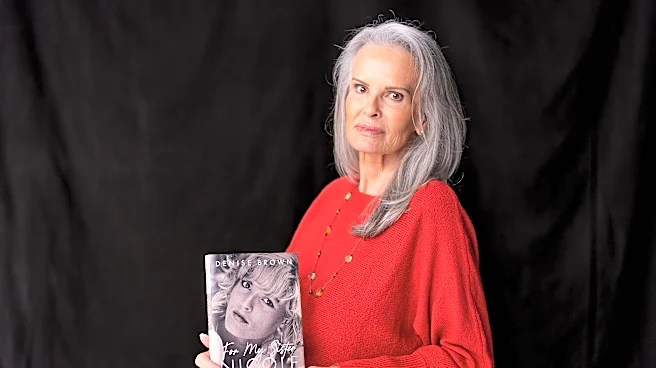
You won’t find it in her memoir, “For My Sister Nicole: Love Shouldn’t Hurt − What to Know About Domestic Violence”
(out now from Blackstone Publishing), where she instead refers to him as “the star football player” or “my sister’s ex-husband” or later, “the defendant.” Nicole Brown Simpson was married to Simpson for seven years. She was murdered outside her Los Angeles condo in 1994.“It’s not about him, except that he was the murderer, the batterer, the abusive partner that my sister had,” Brown tells USA TODAY. “I’ll call him every other word, every other name, but I won’t call him by his name. He doesn’t deserve that.”
Simpson was acquitted of the double homicide of his ex-wife and her
acquaintance, Ron Goldman, after the highly publicized and televised “trial of the century” in 1995. He was later found liable in civil lawsuits brought by the two families of the victims. Simpson died in 2024 at age 76 of prostate cancer.
In the aftermath of Nicole's death, her family says they found letters and journals hidden under the kitchen sink. In them, Nicole described years of abuse at the hands of Simpson. Many are excerpted in “For My Sister Nicole."

“I had no idea that her husband once locked her in a wine cellar for hours, only to beat ... her and lock her back up again,” Brown writes in the memoir. “I didn’t know that on our family Christmas vacation in Hawaii, he had pummeled her in their oceanfront hotel suite one night, only to show up all smiles the next morning.”
Brown has spent the three decades since her sister’s murder as an advocate against domestic violence, working with women’s shelters, speaking to colleges and raising awareness about the signs of abusive relationships. In “For My Sister Nicole,” she shares memories of her late sister alongside advice, education and resources for victims of domestic violence and their loved ones. She hopes the book will save lives.
Remembering Nicole Brown Simpson as a devoted mother, talented photographer
After Nicole died, Brown was offered a million-dollar contract to write a book about her sister. But she knew the publisher only wanted a juicy tell-all, and that wasn’t the story she wanted to tell.
Nicole’s murder has been the subject of documentaries, biographical crime dramas like Ryan Murphy’s “American Crime Story” and podcasts. But in “For My Sister Nicole,” Brown offers a humanizing look beyond the headlines at the sister she remembers.
She was an avid photographer and preferred to be behind the camera. She loved to make arts and crafts for her kids, Sydney and Justin. As a child, she was once kicked from the family horse, Diablo, and badly injured. But as she lay in the hospital for surgery, she pleaded with her family not to sell him.

“Nicole was a real person. Nicole was a mom who didn't give a sh-- about a Ferrari, and had French fries lodged in her gear shift,” Brown says. “She just didn't care about materialistic things. It was all about her kids. It was all about her life. Nicole wanted the white picket fence. Nicole wanted to be a photographer. She wanted to have a life. She wanted, like, thousands of kids running around her house in her backyard.”
Nicole was only 18 when she met Simpson, just a month after moving to Los Angeles and leaving her childhood home.
‘Don’t say all the wrong things like I did’
When Brown thinks back on her late sister’s relationship with Simpson, the first red flag appeared the first day the family met him.
Nicole invited Brown and their other sister, Dominique, up to Buffalo to meet Simpson shortly after they started dating. He was playing for the Bills. He took them to Niagara Falls and was “playing, really, a wonderful host,” she says. But then he spotted Nicole in the stands kissing a mutual friend on the cheek to say hello just as he was pointing her out to a teammate. Later, at Simpson’s rented home, Brown heard raised voices. Nicole ran to her crying, throwing a figurine of Simpson into the bathtub, saying she hated him.
A few minutes later, Nicole was acting like everything was fine. They had made up. Nicole shrugged it off.

“She goes, ‘I embarrassed him,’” Brown says. “Had I known about the cycle of domestic violence, had I known about warning signs, about red flags, about victims of domestic violence blaming themselves for the abuser's behavior, I probably would have been able to do something at the very beginning of their relationship. Didn't learn it in school. I never even heard my parents screaming or yelling at each other. So how was I supposed to know any of this?”
Years later, Nicole asked her sister to take photos of bruising, swelling and scratching on her face, arms and neck.
In the days after her sister’s murder, Brown publicly said that Nicole was not a “battered woman.” But after she found Nicole’s journals, Brown took them to a local shelter and asked the director what to make of them. That’s where she first found the power and control wheel, a graphic that displays the many ways abuse can show up in relationships.
Now, she’s dedicating her life to making sure others don’t say “all the wrong things like I did.”
Sister says Nicole Brown Simpson was ‘put on this Earth to be the face of domestic violence’
Three decades later, Brown says she’ll “never” get justice or closure for her sister’s murder.
“Not guilty does not mean you're innocent,” Brown says, of the 1995 criminal trial verdict. “Our justice system is not perfect. (He) was so far up on a pedestal with our society that nobody believed he could do any wrong.”
In addition to speaking at colleges and shelters, Brown talks with police precincts about handling domestic violence situations. Even if a victim calls 50 times, she says it might be that 51st call that saves their life.
“When a victim asks you for help, that is the hardest thing for them to do, because there's three things that I've learned: hope, shame and fear. The hope that things are going to get better like they were at the beginning of their relationship. The shame of not wanting anyone to know. Not your best friend. Not a family member. And the fear, the fear of where am I going to go and what am I going to do?”

Nicole called 911 several times over the course of her relationship with Simpson. Some officers sought autographs from Simpson.
“She did not have a chance,” Brown says, tearing up. “I truly believe that she was put on this Earth to be the face of domestic violence. As heartbreaking as that is for me, I truly believe that was her purpose in life.”
Three months after Nicole’s murder, former president Bill Clinton signed the Violence Against Women Act into law. The National Domestic Violence Hotline took its first call less than two years after her death. For anyone who recognizes themselves in either sister, Brown hopes the memoir will be another practical resource to educate the country on domestic violence.
If you or someone you know has experienced sexual violence, RAINN's National Sexual Assault Hotline offers free, confidential, 24/7 support in English and Spanish via chat and at 800-656-4673. If you or someone you know is a victim of domestic violence, call the National Domestic Violence Hotline at 800-799-7233 or text "START" to 88788.
This article originally appeared on USA TODAY: Nicole Brown Simpson’s sister says she’ll ‘never’ get justice for 1994 murder