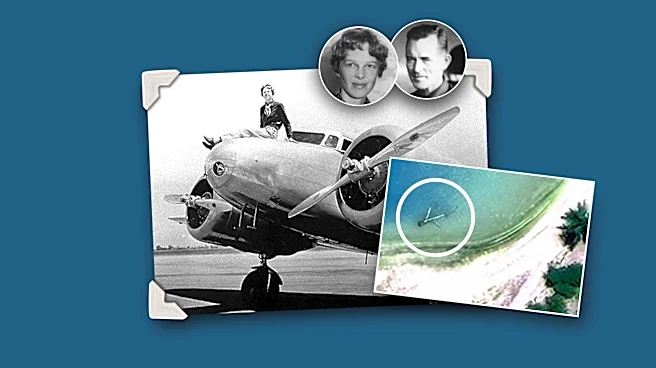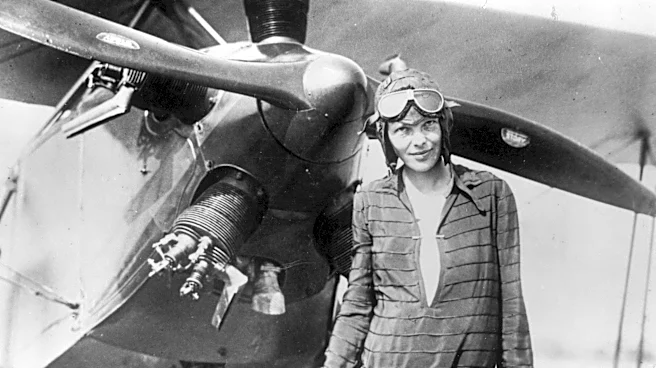








Researchers are now on a remote Pacific island searching for the remnants of the plane in which Amelia Earhart and her navigator Fred Noonan were flying when they disappeared in 1937.
And though they've been hampered by severe weather on Oct. 15 that delayed some of their field work, they expect "to have more information to share with the public within the next 48 hours as that work continues," according to a news release.
The expedition team stressed that they're taking a meticulous approach to data gathering and analysis, as they look at what's been described as a "visual anomaly" in a lagoon on the tiny island of Nikumaroro.
Winds and rough seas near the island created unsafe conditions for the 17-person team, but the mission remains on schedule,
according to Purdue University. The team hopes to have an update, including identification of the "Taraia Object," an anomaly spotted on images of the lagoon that they believe may be remnants of Earhart's lost plane.
The Taraia Object expedition first landed on the island of Nikumaroro on Oct. 13, where they began searching a lagoon and surrounding areas, where some theorize the famed aviator's plane ended up on a late leg in her ill-fated attempt to circumnavigate the globe at the Equator.
Researchers from the Archaeological Legacy Institute, Purdue Research Foundation and Purdue University began to set up equipment they'll use to search for Earhart and Noonan's Lockheed Electra 10-E and any other possible clues to the explorers' ultimate fate.
The team had originally intended to begin its work on Oct. 12 but arrived too late to visit the remote island after five days at sea, the university said in an earlier news release. "As the sun rose, some crew members took smaller transport boats ... into the lagoon."
Others in the crew set up staging areas and cleared a path through the island's thick vegetation to begin field work.
Purdue Research Foundation originally funded Earhart's Lockheed Electra "Flying Laboratory" through the Fund for Aeronautical Research, which bore the aviator's name. The university, where Earhart had been a lecturer, said in a news release she'd intended for the plane to be returned to the Indiana school after her flight.

A path used by prior expeditions on Nikumaroro, which is part of the nation of Kiribati, had been overgrown in the years since the island was last explored, the university said in its release. Called the "Gallagher Highway," it was overcome with vegetation and coconuts, as well as at least four coconut crabs, which can be as large as three feet across. The exploratory team used machetes and small chainsaws to cut through the trail. The work took less time than expected ‒ just a few hours rather than an entire day. (Nikumaroro is 17 hours ahead of Eastern Daylight Saving Time.)
While at the peninsula, the expedition team's first phase of work was "terrestrial archaeology," Purdue said, setting up canopy shelters and sandbags as well as technical equipment. A maritime team assessed conditions in the lagoon, including sediment on its floor.
The team worked until 4 p.m. local time, then went back through the Gallagher Highway to the beach at the head of a man-made channel, to a corner of the island's perimeter reef, where a transport boat was waiting to take them back to the ship Marin Mainiku, where they're staying each night.
A member of the expedition previously said through Purdue that conditions on Nikumaroro are too spartan, and possibly even dangerous, to set up camp. Steve Schultz, senior vice president and general counsel at Purdue University, said "the coconut crabs are one of the reasons we’re leaving the island every night before sundown.”
Speaking with CBS News on Oct. 14, Schultz said the team was still "very much in the data gathering phase," while Richard Pettigrew of the Archaeological Legacy Institute, who's also part of the expedition, said the next step is to analyze the data gathered from the site and begin dredging sediment from the bottom of the lagoon.
"We're the only people who've put together a plan to do something like that," Pettigrew continued. "So it's entirely new."
Phaedra Trethan is a national correspondent for USA TODAY, writing about history and Americana. Contact her by email at ptrethan@usatoday.com, on X @wordsbyphaedra, on BlueSky @byphaedra, or on Threads @by_phaedra.
This article originally appeared on USA TODAY: Search for Amelia Earhart's plane underway; update expected soon