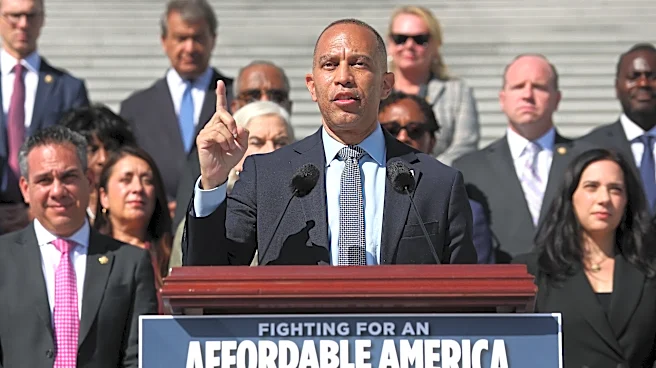










It's the eve of Election Day, and Democrats are expected to do well. Retaking the House of Representatives looks all but certain, and the Senate is within reach.
Control of just one chamber of Congress would be a win for Democrats, but the Senate gives them far more options to stall out the rest of President Donald Trump’s second term.
Trump hasn't needed the House for much. His signature policies – tariffs, the Iran war and quite a bit of his immigration agenda – came via executive action, without Congress lifting a finger. Even after the Supreme Court struck down his tariffs in February, he turned to a different law rather than to Congress.
Executive orders are easier and more Trumpian. They take only the president's signature. Legislation requires
negotiation and consensus, which Trump and his party have shown little interest in, despite his reputation as a dealmaker.
A Democratic House majority won't change much

In 2025, Congress sent just 38 bills to the president's desk, a record low. Even with full control of Washington, Republicans in Congress have been content to stay in the background and let Trump take the heat for an unpopular agenda.
What did pass was mostly about money. The One Big Beautiful Bill Act cleared both chambers with simple majorities through budget reconciliation. Congress holds the power of the purse, and with Washington still funding the government in short-term patches, a united Democratic House would have a lot of leverage over spending. It would also end any hope Republicans have for another party-line bill like the last one.
If they win, House Democrats plan a 100-day blitz: restoring health care subsidies, reversing Trump's tariffs and pushing to end the war with Iran. None of it has a chance of becoming law.
Democrats can pass all the symbolic bills they want, but a Republican Senate will stonewall them. Anything that somehow clears both chambers will meet Trump's veto pen, and without a two-thirds majority in each chamber to override him, that's where it will end.
Legislation may go nowhere, but Democrats can still annoy the president plenty. Their likely committee chairs are already lining up investigations into Trump's pardons, federal contracts steered toward his family and the family's crypto windfall.
Investigations like these tend to become partisan circuses, as the Republican probe of the Biden administration's COVID-19 response and the Democratic inquiry into the Jan. 6, 2021, U.S. Capitol riot both did. But a majority brings subpoena power, a valuable tool for forcing Trump officials to testify. Whether they'd comply is another matter.
A Democratic House could also impeach Trump a third time. Party leaders are wary of the optics, but they've shown no such hesitation about Pentagon chief Pete Hegseth – House Minority Leader Hakeem Jeffries has vowed to run him "out of town." Impeaching him takes a simple House majority. Removing him would take 67 senators, which means winning over a sizable bloc of Republicans.
The Senate is the real battleground
Beyond the budget, the House's tools mostly amount to investigations, symbolic votes and annoyances. And the one real threat it can pose, removing a Cabinet secretary like Hegseth, runs through the Senate anyway.
A Democratic House is far more likely, but a Democratic Senate would give the party much more say over how Trump's final two years play out. It would add to Democrats' leverage over spending, and that goes well beyond the budget.
The Senate confirms the president's nominees, from Cabinet secretaries to federal judges. The biggest prize is the Supreme Court. Chief Justice John Roberts and Justices Samuel Alito and Clarence Thomas are all conservatives in their 70s, and Trump has made clear he's ready to fill any vacancy. A Democratic Senate could hold any vacancy open until after the 2028 presidential election, as Republicans did in 2016, potentially letting a Democratic president fill the seat instead of Trump.
A Democratic Senate would also make it harder for Trump to replace Cabinet officials, something he does often. Any new nominee would need Democratic votes. He could lean on acting officials, but the law limits who can fill those roles and for how long. In practice, the president would be largely stuck with the Cabinet he has.
The majority also runs Senate committees and the floor. Democrats would decide which nominees get hearings and which bills get votes, which matters most on things the filibuster can't touch, like nominations and budget resolutions.
A House majority would be valuable for Democrats. But if they want to stall out what's left of Trump's second term, they need the Senate. These are the stakes on Election Day.
Dace Potas, a law student, is an opinion columnist for USA TODAY. Follow him on X: @DacePotas
This article originally appeared on USA TODAY: Forget the House. Trump's legacy will be decided in the Senate | Opinion