


The Republican Party suffered heavy losses in the midterm elections for a multitude of reasons. An ailing economy, the war in Iran and immigration enforcement have been liabilities for President Donald Trump for some time. But one issue rose to the top: corruption.
In exit polls, 90% of voters called corruption a crucial or major factor in their vote for Congress. Those voters went 57% for Democrats.
Partisans naturally see the other side as the corrupt one, and voters were split on which party would better fight it: 37% said Democrats, 31% said Republicans and about a third said neither. But voters fed up with political corruption sent a message in the midterms, and they broke for Democrats.

Voters were willing to overlook Trump’s inside dealings
and corrupt nature, but once the economy turned for the worse, their patience ran out.
“If the economy were healthier, no one would pay attention to the corruption,” Sarah Chamberlain, president of the Republican Main Street Partnership, told the Daily Caller.
Trump’s opponents on the left and the right now have the opportunity to harness that energy for their own campaigns.
Voters got sick of Trump's misplaced priorities, corruption

Americans' tolerance for Trump's corruption and self-interested behavior lasted only as long as he could deliver on the economy. Americans have always had disdain for that kind of behavior, but they were willing to stomach it for a second term for two reasons:
First, economic struggles will make voters overlook a lot. Voters turned back to Trump in 2024 in hopes he could fix the economy, even though they had rejected him just four years earlier.
Second, voters saw former President Joe Biden as just as corrupt. The Biden family's "influence peddling," and the business dealings that came from it, are a valid point of criticism.
Biden's pardon of his son Hunter after Democrats lost the 2024 election, followed by preemptive pardons for his siblings and their spouses and for Dr. Anthony Fauci, retired Gen. Mark Milley and members of the House committee that investigated Jan. 6, 2021, only reinforced that view as Trump's second term began.
But Trump let other things distract him from what voters truly cared about. In a July CNN poll, a record 73% of Americans said he hadn't paid enough attention to the country's most important problems, and about two-thirds said he doesn't put the good of the country ahead of his personal gain.
Trump's second term brought two self-inflicted wounds to the economy: his sweeping tariff agenda and his failure to secure the Strait of Hormuz during the Iran war, which helped drive gas prices from under $3 a gallon to well over $4.
Voters blamed these blunders squarely on Trump, and their tolerance for his volatile tariffs and the war itself ran out fast.
Meanwhile, Trump's priorities at home had little to do with the cost of living, or even with limiting the harm his backward policies had done. He was building a ballroom, hanging giant banners of his own face on federal buildings, including the Justice Department, and chasing other self-interested projects.
More than 6 in 10 Americans said he'd gone too far pursuing his personal business interests and remodeling the White House and other Washington landmarks. Those actions might not have decided many votes, but they added to the sense that Trump's priority was not the American people.
That sense led voters to look harder at Trump's business dealings. Forbes estimates that Trump's net worth has grown by roughly $3 billion since the 2024 election, largely through cryptocurrency ventures.
Those dealings have raised questions about whether Trump is benefiting from foreign interests and profiting at the expense of supporters who bought his cryptocurrency.
The president's pardons took the corruption a step further. So-called pardon brokers are even charging as much as $3 million to lobby the president to pardon their clients.
Left and right are running against Trump's corruption

The anti-corruption case against Trump is easy to make from the left. Sen. Jon Ossoff, D-Georgia, seems to be the first 2028 hopeful to recognize it as a serious vulnerability for Trump, and the senator built his 2026 reelection campaign against Republican Rep. Mike Collins around opposing Trump's corruption.
"While hundreds of thousands of Georgians lose their health care, Mike Collins builds Trump a ballroom," Ossoff said at a rally in Savannah. "They worked harder burying the Epstein files than they ever worked to lower your grocery bill. And while you pay more for everything, the Trumps are raking in billions from all over the world."
That message worked. Ossoff cruised to reelection and has positioned himself as one of the strongest contenders for the 2028 Democratic presidential nomination.
Other Democrats are following his lead. House Democrats have formed an End Corruption Caucus, whose leaders have introduced legislation targeting what they call Trump's "pardon industrial complex."
I find Democrats' claim to the moral high ground on corruption tiresome, but they've spotted a real vulnerability for Trump and Republicans. The president would surely veto any bill that comes out of this push, but it would only lend their posturing more credence.
Perhaps more opportunistically, Trump's critics on the right are realizing that the corruption angle has legs.
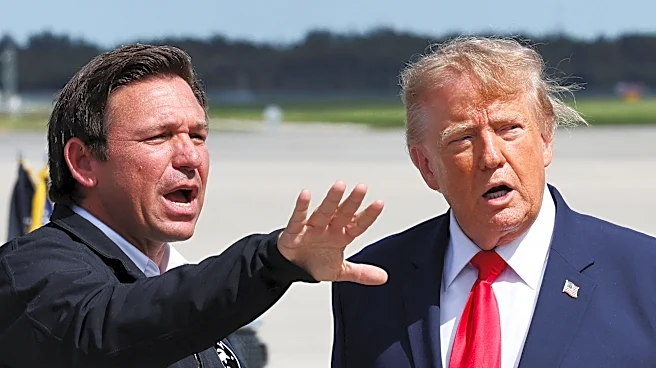
As a leading Republican 2028 prospect outside the Trump administration, Florida Gov. Ron DeSantis is well positioned to call out the president's corruption, and he's doing just that.

DeSantis has been less direct than Ossoff, but he's made clear that Trump's misplaced priorities left voters wondering whose interests came first. Since the midterms, the Florida governor has renewed his call for a ban on congressional stock trading.
It looks like the opening of an anti-corruption case for the nation's highest office.
Both parties recognize that Americans' patience with Trump's inside dealings has worn thin. The 2028 race will be decided, in part, by whom voters trust to do better. Right now, a third of them don't trust either party to fight corruption. Whoever wins them over may well win the White House.
Dace Potas, a law student, is an opinion columnist for USA TODAY. Follow him on X: @DacePotas
This article originally appeared on USA TODAY: Corruption is Trump's weak spot. Both parties are coming for it | Opinion
Our editors independently choose our recommendations. Some content is produced with paid support from a third party, however our editorial decisions remain independent. If you buy through our links, the USA TODAY Network may earn a commission. Prices and availability may change.