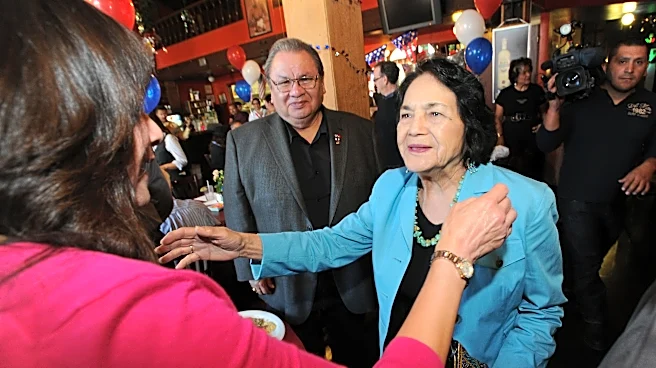










Dolores Huerta, the pioneering labor leader who helped transform California’s farmworker movement, co-founded the organization that became the United Farm Workers and, late in life, publicly accused longtime movement partner Cesar Chavez of sexually abusing her, died Wednesday, Oct. 28 at her home in Bakersfield, California. She was 96.
Her family announced her death Wednesday. A spokesman for the family said the cause was cancer. An initial public account of the family's announcement said they had not yet released a cause.
Few activists were as deeply woven into modern California history as Huerta.
She grew up in Stockton, organized farmworkers in the San Joaquin and Coachella valleys, helped lead the grape boycotts that brought national attention
to conditions in California's fields, and co-founded the organization that became the United Farm Workers with Cesar Chavez.
The movement they built helped fundamentally change the relationship between California growers and the workers who harvested the state's crops. Its campaigns ultimately helped pass the landmark California Agricultural Labor Relations Act of 1975, which established collective bargaining rights for farmworkers.
Huerta also became closely identified with two words that stretched far beyond California's farm fields: "Sí se puede," or "Yes, we can."
By the time of her death, her influence extended from the Central Valley labor camps to Sacramento, Washington and a new generation of activists. President Barack Obama awarded her the Presidential Medal of Freedom in 2012. The Bakersfield-based Dolores Huerta Foundation, which she founded in 2002, continued her work through grassroots organizing and civic engagement. The foundation held a sold-out celebration of her 96th birthday in Los Angeles in June 2026.
From Stockton classrooms to California's farm fields
Huerta was born Dolores Clara Fernández on April 10, 1930, in Dawson, New Mexico. After her parents divorced, she moved to Stockton with her mother and brothers.
California quickly became home.
Her mother worked as a waitress, cannery worker and cook before operating a hotel, sometimes providing food and lodging for farmworkers who could not afford it. Huerta graduated from Stockton High School in 1947 and earned a teaching certificate before briefly working as an elementary school teacher.
What she saw in the classroom helped change the direction of her life.
She later recalled being troubled by children who arrived at school hungry and without adequate clothing. Rather than remain in the classroom, she turned to community organizing.
In the 1950s, Huerta worked with the Community Service Organization, a California Latino civil rights group. She met Chavez through that work and in 1960 organized the Agricultural Workers Association.
Two years later, Huerta and Chavez founded the National Farm Workers Association, a predecessor of the United Farm Workers. Contemporary accounts describe her as a central figure in California's farmworker and labor movements.
Their ambitions were daunting. Farmworkers, many of them immigrants, were scattered across California's enormous agricultural regions, earned little and had few workplace protections.
"People thought we were crazy," Huerta later recalled. "They asked: 'How are you going to organize farm workers? They are poor, powerless immigrants. They don't have any money and they can't vote.'"
The Delano grape strike reshapes California labor
The movement's defining confrontation began in 1965 in Delano.
Filipino farmworkers launched a strike against table-grape growers, and Huerta, Chavez and their organization joined them. Huerta worked alongside Filipino labor leader Larry Itliong during the strike and helped manage boycott campaigns and negotiate with grape companies/
The dispute spread through one of California's most important agricultural industries.
Workers faced strikebreakers, hostility, and violence. Organizers responded with marches, picket lines, and the nonviolent civil disobedience tactics associated with the broader American civil rights movement.
Huerta became one of the campaign's most effective strategists and negotiators.
A nationwide boycott of California table grapes turned a labor dispute in the Central Valley into a test of consumer power across the country. Millions of Americans stopped buying grapes. Major growers eventually signed union contracts, securing benefits and workplace protections that had once seemed unattainable.
In 1972, the organization became the United Farm Workers.
Three years later came one of the movement's most significant victories. California enacted the Agricultural Labor Relations Act, creating a system that guaranteed agricultural workers the right to organize and bargain collectively and required employers to negotiate in good faith.
For migrant workers who had spent years near the margins of California's prosperity, the changes brought access to benefits and new mechanisms for challenging working conditions.
A life intertwined with California politics
Huerta's activism repeatedly intersected with some of the defining political moments of 20th-century California.
She was with Sen. Robert F. Kennedy at the Ambassador Hotel in Los Angeles on June 5, 1968, after he won California's Democratic presidential primary. She joined his entourage as it left the stage. Minutes later, Kennedy was shot in a hotel pantry. He died the following day.
Two decades later, political protest nearly cost Huerta her own life.
In 1988, while demonstrating outside a San Francisco hotel where Vice President George H.W. Bush was speaking, a police officer struck her with a baton, breaking ribs and rupturing her spleen. She underwent emergency surgery and spent months recovering.
Huerta later received an $825,000 settlement from San Francisco and used the money to benefit farmworkers. The city also changed its crowd-control policies.
Her work extended well beyond organized labor. She advocated for immigrants, women and expanded Latino political participation and spent months in Washington lobbying for the Immigration Reform and Control Act of 1986, which provided legal status to millions of undocumented immigrants.
She eventually became a mentor to women seeking elected office and worked with the Feminist Majority Foundation after taking leave from the farmworkers union.
Huerta stepped down as a UFW officer in 1999 after 37 years.
A painful reckoning with Cesar Chavez
The partnership that defined much of Huerta's public life took on a profoundly different dimension late in her life.
In early 2026, Huerta publicly accused Chavez, who died in 1993, of sexually abusing her during their years together in the California labor movement. An account published after her death notes that she made her allegations publicly in March 2026.
Huerta said Chavez raped her in a vehicle in a secluded California grape field in 1966. She said she had remained silent because of her loyalty to the farmworker movement, her distrust of law enforcement and her fear she would not be believed.
"I saw him, again, as my boss, as my hero, as, you know, somebody that would do the impossible," she said in the account provided for this obituary. "I never talked about it to anybody, and the reason I didn't is because I just didn't want to hurt the movement."
Huerta also said two of her children resulted from sexual encounters with Chavez, including the rape, and said she did not know at the time about allegations that he had abused underage girls.
"Unfortunately, he used some of his great leadership to abuse women and children," she said.
Her disclosures complicated the history of a California movement that both leaders had spent decades helping to build. Huerta also confronted criticism from women who said sexism and sexual harassment within the union had not always been adequately addressed.
'Sí se puede'
Huerta's legacy eventually became part of California's civic landscape itself.
Murals depicted her. Schools and public buildings carried her name. "Sí se puede" became a fixture at labor demonstrations, political campaigns, and protest marches far from the California fields where it began.
In 2018, then-Gov. Jerry Brown signed legislation designating April 10 as Dolores Huerta Day in California.
She also became the subject of the 2017 documentary "Dolores," directed by Peter Bratt, and received numerous honors during her life. Her Presidential Medal of Freedom placed her among the country's most celebrated civil rights figures.
Yet Huerta continued organizing well into her 90s rather than settling into the ceremonial role sometimes reserved for historic figures.
Her Bakersfield-based foundation focused on leadership development, civic engagement and grassroots organizing. Even her 2026 96th-birthday celebration was designed as a fundraiser to continue that work across California.
Throughout her life, Huerta argued that lasting political change came not principally from celebrated leaders, but from ordinary people acting collectively.
"When people come together and take collective action, whether it's in a march, whether it's in a union election or, most important, come together to vote," she said in 2020, "this is how we make change."
Family and survivors
Huerta was married twice, first to Ralph Head and later to Huerta, whose surname she retained after their divorce. She later had a long-term partnership with Chavez, Cesar Chavez's brother.
The mother of 14 children, she balanced family life with years spent traveling between California farm communities, negotiating, rallying, and campaigning. Thirteen of her children survive her, along with 24 grandchildren, 23 great-grandchildren and seven great-great-grandchildren, according to the obituary.
Her family said it would announce plans to recognize and celebrate her life and legacy later.
This article originally appeared on Palm Springs Desert Sun: Dolores Huerta, United Farm Workers co-founder and labor pioneer, dies at 96