





WASHINGTON, D.C. – Yellow carnations hung from a wrought iron fence outside a Civil War-era townhome in the Shaw neighborhood this week.
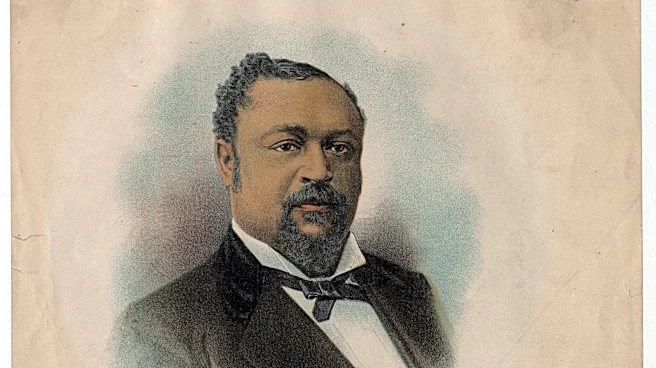
It is unknown who left them in the historically Black neighborhood and why, though yellow is often used to symbolize optimism, justice and equity in a community on a 400-year-march toward equality. The historic home once belonged to Blanche Kelso Bruce, who was born into slavery and went on to become the first Black U.S. senator to serve a full term.
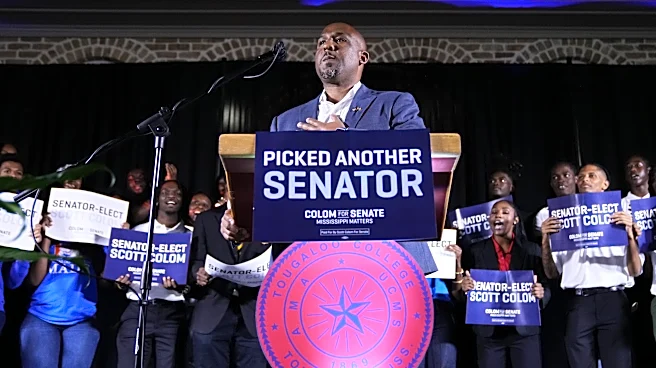
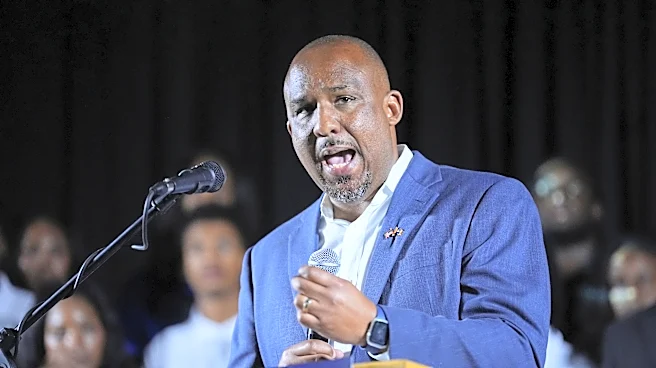
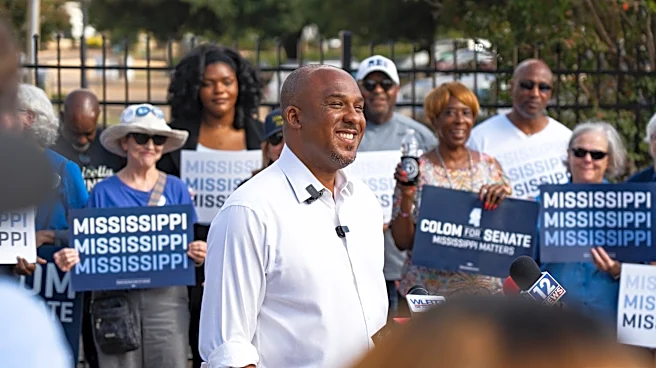
More than 140 years later, Mississippi is sending another Black man to follow in his footsteps. Democrat Scott Colom defeated Republican incumbent Sen. Cindy Hyde-Smith in a race that took more than a week to decide.
A sign in front of Bruce's former home identifies
it as a National Historic Landmark. More than 160 miles south, another placard marks the plantation in Prince Edward County, Virginia, where Bruce was born. One of just two Black senators sent to Washington by a majority Black state during the brief Reconstruction period after the Civil War, he remains the only former slave to serve in that chamber.
The white man who fathered Bruce and enslaved him and his mother moved the family from Virginia to Missouri and Mississippi. Bruce was allowed to learn to read and write alongside his white half-brother before being forced to work in the fields.
After the start of the Civil War, Bruce fled to freedom in Kansas. He went to Oberlin College in Ohio and opened schools for Black children in Missouri and Kansas. He held a variety of political and public sector jobs after moving to Mississippi in 1869, including county sheriff, tax collector, school superintendent and county commissioner. Along the way, he built relationships with powerful politicians, both Black and white, Lawrence Otis Graham wrote in his book, "The Senator and the Socialite: The True Story of America's First Black Dynasty."
Reconstruction policies had been in place for nearly a decade, making it possible for Black people in Southern states to not only vote, but to run for office. In 1874, the Mississippi Legislature chose Bruce to fill a vacant seat in the U.S. Senate.

When Bruce's name was called for his swearing-in ceremony the following year, the room full of white senators turned to watch, waiting for the other Mississippi senator, James Lusk Alcorn, to escort him to the dais, according to an interview Bruce gave to the National Republican newspaper.
"All the others except myself were escorted by their colleagues. Mr. Alcorn made no motion to escort me, but was buried behind a newspaper, and I concluded I would go it alone," Bruce told the newspaper. As he started down the aisle alone, Bruce said, Sen. Roscoe Conkling of New York "linked his arm in mine and we marched up to the desk together."
Conkling went on to become Bruce's mentor, and the namesake for his only son.
After Mississippi’s violent 1875 election – there were riots, lynchings and a racial massacre – Bruce championed a bill to investigate the state's political conditions. The bill passed the Senate, but the House, controlled by Democrats, didn't take it up. He pushed for the desegregation of the U.S. Army. He also railed against the mistreatment of Native Americans, Black people and Chinese immigrants.
"He was determined to demonstrate that he was a peer of the proudest and best. He was quiet, handsome, distinguished in appearance and exceptionally unobtrusive," the Freeman, a Black newspaper in Indianapolis, wrote in his obituary.
The other Black senator to serve during Reconstruction, Hiram Revels, represented Mississippi for a partial term.
"Their influence in national politics was a little bit less in terms of their representative role, but they were symbolically quite important," said David Bateman, a Cornell University associate professor of government.
With the end of Reconstruction and the withdrawal of federal troops in 1877, Bruce didn't bother to run when the Mississippi Legislature, now controlled by Democrats, selected a new senator in January 1880. Lawmakers picked James Z. George, a former white slaveholder and Confederate officer who joined the Mississippi secession convention and signed the ordinance leading to the state leaving the Union.
Bruce became a power broker among white and Black political figures for the next two decades. He was the first Black man to win any votes for national office at the 1880 Republican convention. And he gained the friendship of President Ulysses S. Grant as well as abolitionist Frederick Douglass and educator Booker T. Washington.
"He was the most popular colored man that ever rose to any position of prominence among us," the Freeman obituary said.
Bruce remained in Washington, living on the southern edge of the Shaw neighborhood. It was named for Union Col. Robert Gould Shaw, commander of one of the first Black regiments to fight in the Civil War, the 54th Massachusetts. Shaw is a cultural, social, and economic hub of Black life in D.C. and is famously dubbed "Black Broadway."
The Victorian-style row house Bruce bought in 1878 still stands on M Street. He and his wife Josephine became popular hosts to the city's Black and white liberal society, including the wives of U.S. senators and Supreme Court justices, according to Graham.

When Bruce's Senate term ended in 1881, President James Garfield named him register of the Treasury, making him the first Black person to have his name printed on U.S. currency. He never lived in Mississippi again.
"Why would you come back to the imposition of Jim Crow?" said Marvin King, associate professor of political science and African American Studies at the University of Mississippi. "A man like Blanche would have known what Mississippi was turning into."
President Benjamin Harrison appointed Bruce District of Columbia recorder of deeds. He served from 1891 to 1893 and moved to an elegant townhome in the Dupont Circle area. He served as register of the Treasury in the McKinley administration, from 1897 until his death from diabetes complications the next year.
He is buried in Washington's Woodlawn Cemetery, a prominent Black-majority cemetery established in 1895. Included in the flowers at his funeral was a "handsome wreath from the White House with the card of President McKinley," according to the Freeman obituary.
Today, statues of Bruce's replacement in the Senate, James Z. George, and Confederate President Jefferson Davis represent Mississippi in the U.S. Capitol complex.
In 2002, a portrait of Bruce was unveiled in the Senate wing of the Capitol. It hangs on the landing of the main stairway from the first floor to the Senate chamber. Colom will probably pass it every day on his way to work.
This article originally appeared on USA TODAY: A slave, a lawmaker: Meet the last Black senator from Mississippi