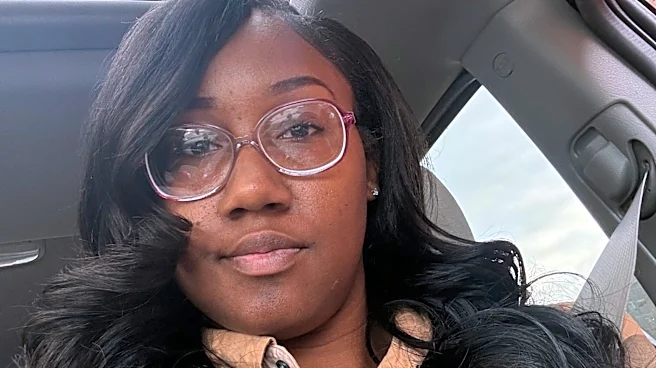









In August 2026, Codyone Cameron made an appointment with an OBGYN at a medical clinic in Brookfield, Wisconsin.
She was pregnant with her third child.
Cameron, 32, had a history of pregnancy loss and complications. Her first pregnancy ended in a miscarriage, and in 2016, she had an ectopic pregnancy − a life-threatening condition that requires an emergency removal of the pregnancy − and nearly ruptured her left fallopian tube. She lost so much blood that she required multiple transfusions.
When she began to experience pain in her right abdomen three weeks before her scheduled appointment, she decided to seek prompt medical evaluation. A single mom of two, Cameron had recently lost her job, so she searched for free or low-cost options. Cameron was
directed by her Medicaid policy to Life’s Connection, a faith-based pregnancy resource center. According to the center’s website, their services included free "limited" ultrasounds that could confirm and determine the viability of the pregnancy.
At the clinic, the waiting room was fairly empty with just a few other patients. Nothing stood out to Cameron as odd or out of place. She shared her concerns about her symptoms to a woman wearing scrubs at the front desk and was led into an examination room, where that same worker performed an abdominal ultrasound.
"I wanted to see the baby in my uterus," she tells USA TODAY in November. "I'd been through this one time before, and I was having too many of the signs."
Cameron says the worker struggled to locate her pregnancy at first, but then pointed out the "yolk sac" on the screen and reassured Cameron that she had a normal, intrauterine pregnancy. They printed out images of the sonogram, with the words "LITTLE BEAN! HI MOM!" imposed on one.
She was scheduled for a second appointment 15 days later, but her symptoms persisted, with shortness of breath and dizziness so intense she could hardly stand up.
She couldn't wait the two weeks − she wanted to seek a second opinion sooner. She found Care for All, a community clinic that offers reproductive health care, where she shared her pregnancy history and an ultrasound image with a physician.
Dr. Meredith Manire, a board-certified OBGYN, knew instantly that the image she was looking at was not of Cameron’s uterus. It appeared to be an image of stool in her intestines.
"There is a very stark difference between what a uterus looks like on ultrasound and what the intestines look like on an ultrasound," Manire explains. "A qualified medical professional is never going to confuse those two organ systems."
After another round of external and transvaginal ultrasounds, Manire was able to give Cameron a proper diagnosis. She indeed had another ectopic pregnancy.
Because her care had been delayed, her condition had worsened and she required emergency surgery to avoid a life-threatening hemorrhage. She lost both of her fallopian tubes, meaning that if she wished to become pregnant again, she would need IVF − which is not covered by her Medicaid plan.
Cameron was placed on bed rest after her surgery and has been unable to look for work. She resorted to organizing a GoFundMe to cover her medical and parenting expenses.

Cameron is not the first to feel like she didn't receive proper care at these types of pregnancy resource centers, often referred to as "crisis pregnancy centers" by organizations like the American College of Obstetricians & Gynecologists.
According to the American College of Obstetricians & Gynecologists, the term is used to refer to "certain facilities that represent themselves as legitimate reproductive health care clinics providing care for pregnant people but actually aim to dissuade people from accessing certain types of reproductive health care, including abortion care and even contraceptive options."
These centers are often funded by pro-life organizations like CareNet and Heartbeat International, and according to the U.S. Government Accountability Office, the Department of Health and Human Services distributed at least $34 million in federal funds across 16 crisis pregnancy centers from 2018−2024 to provide reproductive health-related services. According to Heartbeat International's website, their mission centers both the "mother and baby," and takes "faith-based approach" to reduce abortion and offer support to pregnant women. Life's Connection offers baby items in exchange for attending courses through their "Learn and Earn" program, which includes classes on topics like car seat safety, per their website.
Heartbeat International states on its website that the ultrasounds these pregnancy centers offer can "help abortion-vulnerable mothers bond with their babies." The organization argues that some "pro-choice wordsmiths" have labeled all centers as "fake clinics."
Life's Connection did not respond to USA TODAY's request for comment regarding Cameron's experience.
Other women have taken action against crisis pregnancy centers. In 2025, at a faith-based pregnancy resource center in Texas, a registered nurse reassured a woman that her pregnancy was normal − before a physician had reviewed the ultrasound, per local media reports. Registered nurses may be trained to perform limited ultrasounds, but per the Texas Board of Nursing, cannot make medical diagnoses. Days later, the Texan’s pregnancy was discovered to be ectopic and required emergency surgery. A similar case occurred in Massachusetts in 2023. A woman who underwent emergency surgery to remove an ectopic pregnancy after receiving a "normal" ultrasound later filed a lawsuit against Clearway Clinic for falsely advertising that ultrasound services were provided by a physician, according to her complaint.
Cameron has not filed a lawsuit against Life's Connection but, in addition to exploring her legal options, she has teamed up with the Center for Reproductive Rights, a pro-choice organization, in an effort to prevent this from happening to other women.
In a letter sent to the Wisconsin Attorney General's office on Nov. 18, the Center for Reproductive Rights and Cameron are asking the Wisconsin state government to investigate the practices of anti-abortion pregnancy centers. They are calling on other agencies − including the Wisconsin Medical Examining Board, Department of Consumer Protection and Department of Financial Institutions − to enforce state laws against false advertising and unauthorized practice of medicine.
"We're supposed to trust physicians, but at the end of the day, look what happened to me," Cameron says. "Somebody that was supposed to help me... deceived me, let me down and sent me through a very traumatic experience. One that cost me my fallopian tubes."
These organizations are working to close legal loopholes
In Wisconsin, the Center for Reproductive Rights has identified approximately 50 crisis pregnancy centers. There are an estimated 3,000 nationwide, according to KFF (formerly the Kaiser Family Foundation).
Alice Wang, senior staff attorney at the Center for Reproductive Rights, says maternal care deserts have spread following the overturn of Roe v. Wade, and crisis pregnancy centers often "falsely advertise" themselves as filling that health care gap.
According to the American College of Obstetricians & Gynecologists, crisis pregnancy centers can endanger public health by "causing delays in accessing legitimate health care" and spreading medical misinformation. In particular, crisis pregnancy centers that are not staffed by medical professionals "lack the regulatory oversight that governs legitimate medical clinics," their website states.
Molly Duane, litigation director of Amplify Legal, who is not involved directly in Cameron's case, says contrary to popular belief, these clinics are not more common in Southern states where abortion restrictions are more prevalent. According to Duane, crisis pregnancy centers may open "across the street or in the same neighborhood as an abortion clinic," sometimes using similar names that can mislead women seeking care, and outnumber abortion clinics nationwide.
"They have become a pervasive part of the extra medical infrastructure of our country in every state. Multiple states and localities actually have attempted to regulate them with very limited legal success," she says. "Because while these pregnancy centers present to the public as medical clinics, when they are called into court, they represent themselves as religious centers that are just following their own religious directives."
However, Duane adds that lots of people do receive important resources from crisis pregnancy centers, such as free diapers.
"I have no issue with them spreading their religious message, with them doing it for free, as long as they are being upfront about who they are and what they're doing," Duane says. "That's really where the problem comes in, (and) it's exacerbated by the fact that lots of states provide direct government funding to these crisis pregnancy centers."
In 2011, San Francisco passed a law − the first of its kind − prohibiting "limited services pregnancy centers" from misleading the public into believing they offer abortion services or unbiased pregnancy counseling. In 2018, a local crisis pregnancy center tried to challenge the law before the U.S. Supreme Court, but that appeal was denied.
However, a separate 2015 California state law was struck down only two days prior to that denial for "First Amendment violations." The law aimed to "ensure that pregnant women know when they are receiving health care from licensed professionals," and required centers to disclose that free or low-cost services, including abortion, are available in California. Similarly, in the 2010s, New York City and Baltimore attempted to regulate crisis pregnancy centers by requiring them to publicly state in their waiting room and advertisements that they are not licensed medical clinics, but those laws were also struck down under the First Amendment.
The lack of regulation can result in "consumer confusion, fraud, misrepresentation, as well as malpractice," Duane says.
Cameron's experience is still fresh in her mind − as she talks about it, she stifles tears, and her daughter, 6, comes over to comfort her. She and her 12-year-old brother are getting ready to catch the bus to school.
"Mentally, every day is a different thing. I'm grieving a baby. I'm kind of grieving my old self too, because I'm different now," she says. The loss of her fertility has been particularly difficult to grapple with. "Trying to balance everything, it's just a lot. But, life goes on. I still got two kids."
By speaking out about her experience and calling on Wisconsin officials to take action, she's hoping to save at least "10 lives."
"That might be a small number, but it's a big number," she says. "I want everyone to know now what these places are doing, how they are hurting people. And I'm not going to stop here."
This article originally appeared on USA TODAY: A crisis pregnancy center said her pregnancy was normal. Days later, she needed emergency surgery