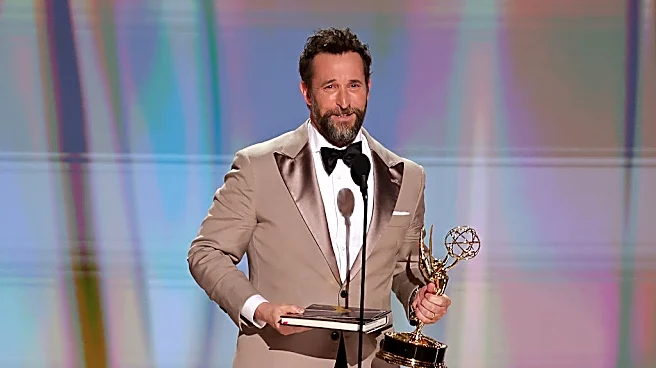

Michael J. Fox accepted the Bob Hope Humanitarian Award at the Emmy Awards on Monday, Sept. 14, delivering an emotional speech marked by his signature optimism.
The award, bestowed upon honorees by the
Television Academy and the Bob & Dolores Hope Foundation, recognizes individuals in the television industry whose humanitarian work reflects Hope’s legacy. The accolade, first given to Oprah Winfrey in 2002, has previously been presented to George Clooney and Sean Penn.
In his acceptance speech, Fox reflected on Hope’s decades of service to members of the military and the example the legendary entertainer set.
“He embodied everything I came to believe in years later,” Fox said. “When circumstances get tough, you show up, you help, and if you can add a little joy while you’re doing it, that seems better.”
Fox connected that lesson to his own experience with Parkinson’s disease, acknowledging that he initially kept his diagnosis private because he feared it could jeopardize his career and his relationship with audiences.
“I understood that accepting Parkinson’s didn’t mean I had to surrender to it,” Fox said. He added that he was proud of the progress made by the Michael J. Fox Foundation and thanked its staff, donors, researchers and the Parkinson’s patient community for advancing the search for a cure.

Fox was diagnosed with Parkinson's disease in 1991 at 29 years old, which he shared publicly in 1998. Two years later, Fox, now 65, co-founded The Michael J. Fox Foundation for Parkinson’s Research in 2000 with Deborah W. Brooks. To date, the foundation has financed more than $3 billion for research.
The fastest-growing neurodegenerative condition in the United States, Parkinson's is a progressive disorder affecting the nervous system. “It causes nerve cells in parts of the brain to weaken, become damaged, and die,” according to the National Institute of Neurological Disorders and Stroke, which can affect balance and mobility and cause tremors and muscle stiffness.
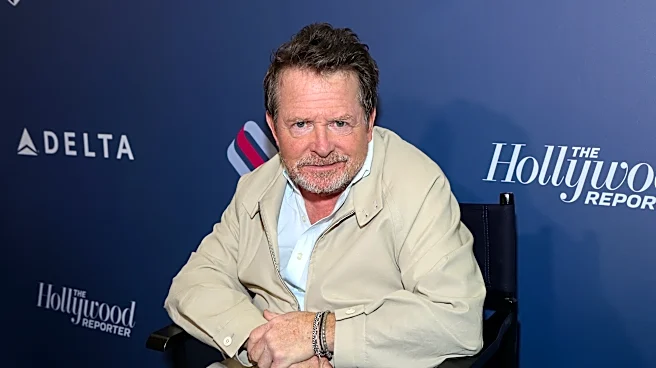
Following his diagnosis, Fox “went into a hidden retreat and hid for seven years, didn’t tell anyone about it,” the “Spin City” star told USA TODAY in July while being honored at The Hollywood Reporter and Social Impact Fund's third annual Social Impact Summit.
“And then when it occurred to me that I might go public with it, I weighed that with my wife [Tracy Pollan] and myself, [had] a lot of conversations about it," Fox added. "And I realized it was a unique opportunity."
Less than a decade after receiving his diagnosis, the Emmy-winning actor came to embrace the role of being the face of Parkinson's.
"I would've been thrilled if you’d told me when I was 17 that I’d be well known as a disease advocate for something I was diagnosed with," Fox says.

Often celebrated for his optimism, Fox reflected on his relationship with the term “impossible” in his book, “Future Boy,” chronicling the period in which he practically bent time to simultaneously shoot the “Back to the Future” and NBC’s sitcom “Family Ties.”
“My experiences so far had taught me that nothing was impossible,” Fox wrote. “Simply put, I had gone from being an undersize and frequently truant C student in Canada − a borderline juvenile delinquent whose only sellable skill was acting − to a semi-employed starving artist, to a lead actor in one of the top-rated television shows in America, all in a few years. I was used to ‘impossible.’”
In fact, Fox was broke when he auditioned for “Family Ties,” about three years after his dad had driven the high school dropout to Los Angeles. He went dumpster diving and played one-sided hide-and-seek with his landlord.
“We’re conditioned to stop and to say, ‘I don’t know if I can go any further. I don’t know if I can do this. I’m not equipped,’” Fox said in an interview. “Just do it. If it speaks to your heart, do it.”
Contributing: KiMi Robinson
This article originally appeared on USA TODAY: Michael J. Fox reflects on Parkinson's in emotional Emmys speech