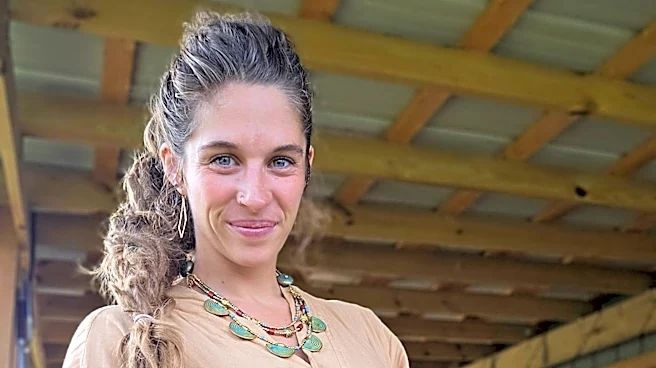





On Aug. 16, 30-year-old Abbey Khopesh gave birth to her second child in her Nebraska home, on a pile of blankets covering the hardwood floor.
There was no doctor on standby, or midwife to guide her through labor and delivery. Just her husband, who encouraged her to relax and stay strong throughout the process, as can be seen in the couple's recounting of their birth story on TikTok. Posts about her pregnancy on their account, Encompass Farming, have upwards of 30 million views.
Khopesh said with both of her children, she didn't see a doctor during pregnancy and instead prepared for pregnancy, birth and postpartum by researching "sovereign births" on Instagram, listening to podcasts on the topic and following other online resources like the Free
Birth Society. She consulted a doula periodically during her first pregnancy, she said, but not during her first birth and not at all during her second pregnancy or second birth. She had strayed from Western medicine years ago, and before she had children she decided her journey through pregnancy and delivery would, similarly, be unmedicated and on her own terms.
"It was an intuition thing," Khopesh told USA TODAY. "It kind of just came to me. I didn't really ever hear of anybody else doing that at the time."
Other mothers in the United States have been bucking recommended pregnancy care protocols as of late. According to data published in February by the Centers for Disease Control and Prevention, about 1 in 4 mothers did not receive prenatal care beginning in the first trimester in 2024, an increase of 13% from 2021. In some states in 2024, more than 1 in 10 mothers had late or no care. Melissa Hanna, CEO of Mahmee, a pregnancy and postpartum care platform, believes this trend is coming from some women's concern about overmedicalized birth and a distrust of America's maternal health system. But moving through pregnancy and birth with no medical oversight at all, she said, is risky.
"There are understandable reasons why women are feeling unheard and disrespected by providers today," Hanna said, adding that many women have traumatic birth experiences in the United States. "That doesn't mean it was a bad birth experience by the health care industry's standards. It might have been a life-saving birth experience that needed to happen a certain way in order to preserve the life of the mother and the child."
The risks associated with 'free births'
There are many risks related to doctor-free pregnancies and free births, said Dr. Terri Traub Mann, a board-certified neonatologist and pediatrician, and the founder of Prenatal Consulting of Georgia. Mann added that the American Academy of Pediatrics does not recommend home births.

During pregnancy, providers can diagnose some congenital syndromes that might need immediate attention after birth. During delivery, it's important to have a provider available who can notice signs of distress in a newborn that people without a medical background might not see right away, Mann said.
"Without having that guidance, you just don't know what's going to happen when the baby's born," Mann said. She added that health care professionals typically screen newborns for all kinds of diseases and disorders in the first few days of life. For some of those conditions, like congenital heart diseases, "it is very important that the baby is diagnosed early and taken care of."

And pregnant patients with less than the recommended four prenatal visits have been found to have a higher risk of pre-term birth and fetal complications, according to Dr. Melissa Walsh, a board-certified obstetrician/gynecologist and Chief Medical Director at SimpliFed, a pregnancy and postpartum care program. Without a birth attendant, she said, there's an increased risk of hemorrhage, uterine rupture, infection and other conditions.
'I don't recommend it'
While some comments on Khopesh's social media showed encouragement − "To be so in tune with your body and instincts. What a gift," one user commented − many expressed concern or even disdain for her choices.
"She is experiencing survivor’s bias," one commenter, who self-identified as a labor and delivery nurse, wrote. "She is very lucky that she and her baby have not had any medical complications."
"It just makes me nervous," another commenter wrote. "As a NICU nurse who gets home births that go wrong all the time, it just seems selfish to not get checked out and make sure a home birth is safe for you. It’s not only your life anymore and I’ve just seen so many home births go bad and the babies need extreme medical intervention just to survive."
Khopesh addressed the growing interest in her story three days after giving birth to her second child, in a Facebook post which she captioned: "I believe in every Woman's right and power to do this. But please don't walk into the portal blindly. It's no joke."
"I'm a two-time free birther and I don't recommend it," she said in the video. "Do I believe every woman is capable by design? Yes. But it's not for the faint of heart."
The distrust some women are feeling is valid, doctors say
Khopesh said she dealt with back pain, sleep issues and other health concerns into her early 20s. Western medicine didn't help, she said, and "it was very frustrating for me."
She eventually started to research herbal remedies, homeopathy and natural medicine, Khopesh said, and went to see a naturopathic doctor for a while.
"After those first few years, I was starting to feel more comfortable on my own," she said. "And then kind of just started really taking things into my own hands."
Khopesh isn't alone in being fed up with Western medicine. Walsh said some patients feel there's been an overmedicalization of births in America, where doctors sometimes intervene unnecessarily just "because the patient is in the hospital."
"There are definitely reasons for modern medicine to support healthier pregnancies," she said, but there is a concern when interventions are introduced "and the patient is not part of a shared decision making process."
The health care system has not always been kind to women. A 2024 Kaiser Family Foundation survey of more than 5,000 women found nearly one in four women report that a doctor, health provider or other staff member treated them unfairly or with disrespect in the past two years. And when it comes to pregnancy and birth, some communities just don't have enough resources. According to a 2026 March of Dimes report, 5.8 million women and 358,000 infants are in counties without full access to maternity care. In 2023, the Centers for Disease Control and Prevention found that 45% of moms reported holding back from asking questions or sharing concerns during their pregnancy or delivery, for reasons spanning from embarrassment, not wanting to appear "difficult" to thinking their health care provider seemed "rushed."
"We all need to be more empathetic when we are speaking to any mother, and truly listen to their concerns and what they want for themselves and their babies, especially during birth and around pregnancy," Mann said. "I have met a lot of women who have multiple reasons for wanting an unmedicated birth."
But she worries that some of these videos of free births online might be giving expectant couples false encouragement.

"There is a lot of misinformation online," she said, adding that what works for one person won't necessarily work for someone else. "(There are) perfectly healthy moms that have perfectly healthy babies, and during delivery something can go wrong, or right before delivery, or right after delivery."
The power of choice
Pregnancy is not an explicitly medical experience, Hanna said. She believes expectant mothers should have access to a non-medical team, too, to provide spiritual, mental and emotional health support.
But pregnancy and delivery always carry risk, Mann said, whether the expectant mother is at a hospital, at a birthing center or at home. Walsh recommends patients understand their own health status, first, before conceiving and deciding on a birth plan. For example, women who have had previous C-sections shouldn't attempt home births, she said.
Khopesh said she is planning to bring her son to a doctor within his first month of life, just as she did with her first child, "just to have the paperwork of like, hey, we did this, the baby's good."
That doctor, Khopesh said, was "really respectful of our choices." It's an important choice, Khopesh said, and takes a lot of work.
"I did not wake up one day just ready to do this," she said. "I spent five years before my first child really getting my mind, body and spirit in the right place to bear a child on my own."
Madeline Mitchell's role covering women and the caregiving economy at USA TODAY is supported by a partnership with Pivotal and Journalism Funding Partners. Funders do not provide editorial input.
Reach Madeline at memitchell@usatoday.com and @maddiemitch_ on X.
This article originally appeared on USA TODAY: Some pregnant women are trying 'free births.' Doctors are worried.