


The MLB offseason is on a 15-day clock.
The collective bargaining agreement expires at 11:59 p.m. ET on Dec. 1. Owners are expected to lock out the playersminutes later and freeze every signing and trade involving a big-leaguer. Players would be shut out of teams facilities, too.
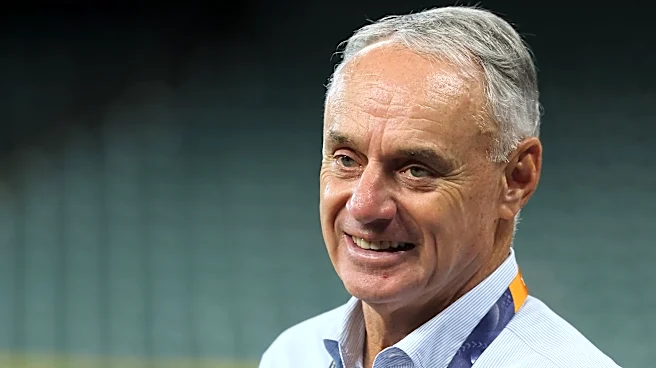
Commissioner Rob Manfred has seen how these go. He was a junior lawyer on the owners' bargaining team in 1994, the last time the owners formally proposed a salary cap before now. That fight became a 7 ½-month strike, and the World Series was canceled.
Now, Manfred is the commissioner and the cap is back on the table.
MLB's latest offer, made Nov. 3, delayed a hard cap until 2028 and raised it to $258.2 million. The players union turned it down almost immediately and said
owners "continue to propose blowing up the current system."
Asked in June whether he worried about another 1994, Manfred was not a beacon of hope for baseball fans.
"Of course I do."
When does the MLB lockout start?
Most likely at 12:01 a.m. ET on Dec. 2.
That's what happened in 2021. Owners voted unanimously and locked the players out two minutes after the old deal expired. Manfred called it a "defensive" move to jumpstart talks.
It lasted 99 days.
Owners don't have to lock anyone out. The league could keep bargaining and let free agency and trades run under the old rules. Nobody in the sport expects that to happen.
At the World Series, union chief Bruce Meyer called the cap proposal a "nuclear bomb."
What happens to MLB free agency and trades during the lockout?
The 40-man roster is the group of players under major-league contracts and they are the union members. For every one of them, business stops cold. That means no signings, trades, waiver claims or releases.
That last time, in 2021, teams hurried to get business done before the deadline. Clubs committed more that $1.9 billion in new contracts before the 2021 freeze. More than $1.4 billion of it came in one day.
Any free agent still unsigned on Dec. 2 waits out the lockout for a new deal, however long that takes.
Minor leaguers who are not on the 40-man roster can keep signing, getting traded and working out or rehabbing with the teams.
Can MLB players use team facilities during a lockout?
No.
The weight room, the training room and the fields are all off limits. Injured players can't rehab with team trainers. A hitting coach can't call a player to ask how his winter swing work is going. In 2021, MLB.com took 40-man players photos off its website.
The union offered zero-interest loans and help with health insurance that winter.
Players aren't paid until the regular season anyway, so the money doesn't really stop for them until spring. That's when the pressure starts on their side.
What does lockout mean for MLB offseason calendar and Opening Day 2027?
The next three deadlines are still on:
- Nov. 17: Free agents must accept or reject qualifying offers, the one-year, $23.15 million deals teams offer their top free agents. It's also the last day for teams to protect prospects from the Rule 5 Draft, which lets clubs pick up unprotected minor leaguers from other teams.
- Nov. 17-19: Owners meetings in New York
- Nov. 20: Non-tender deadline. Teams decide whether to offer contracts to arbitration-eligible players or cut them loose in free agency.
After, Dec. 1, nothing is certain.
The Winter Meetings, usually the busiest week of the offseason, are set for Dec. 7-9 in San Diego. Almost nobody expects them to happen. In 2021, the meetings and the major-league portion of the Rule 5 Draft were both canceled.
Spring training games are scheduled to start Feb. 19, opening night is set for March 24 on Netflix, with 14 more games March 25. The teams for opening night were not announced.
How long did the last MLB lockout last?
It lasted 99 days, from Dec. 2, 2021 to March 10, 2022.
The owners took six weeks to make their first proposal, on Jan. 13. Opening day slid from March 31 to April 7. Makeup games kept the full 162-game schedule.
Before that, baseball lockouts were short spring affairs. They ran about two and a half weeks in 1973, 17 days in 1976 and 32 days in 1990.
None of them cost a game.
The stoppage that actually cost games, including the World Series, was a strike. That was over a salary cap.
What is a 'disclaimer of interest?'
This is the players' most extreme legal option, and it means the union walks away from being a union.
The MLB Players Association would declare that it no longer represents the players in bargaining and would reform as a trade association. With no union, there's no collective bargaining.
Players would lose the protections they have under labor law. MLB would lose the legal shield that keeps its lockout and other labor rules safe from antitrust lawsuits.
That opens the the door to the courts. Players could file antitrust lawsuits, likely as a class action, and argue that locking out workers who no longer have a union is an illegal group boycott. Damages in antitrust cases are tripled under federal law.
That's why former NBA commissioner David Stern was among those who called it "the nuclear option."
Baseball players couldn't realistically do this for most of sport's history. MLB's antitrust exemption, which dates to a 1922 Supreme Court ruling, protected the league from those lawsuits. The Curt Flood Act of 1998 changed that for major league players. It put their employment under antitrust law the same way it covers athletes in other pro sports.
The MLBPA has never used it. Every negotiation since 1998 has ended in a deal.
Players in other leagues have, though.
NBA players dissolved their union Nov. 4, 2011, and filed antitrust suits. Twelve days later, they had a tentative deal to end the lockout. They had to re-form the union before they could sign it.
NFL players went to court during their 2011 lockout and won an order lifting it. An appeals court put the lockout back in place days later.
If the MLBPA tries it, expect MLB to argue what the NBA did in 2011, that the disclaimer is a "sham" meant to gain leverage.
So why is this coming up now, before a lockout has even started?
Both sides have spent months making their case to fans. MLB has tied its cap proposal to ending local TV blackouts. Meyer pushed back, saying the blackouts are "one hundred percent something the league has agreed to with network partners."
The disclaimer talk came out the same way. The Wall Street Journal reported that MLB is preparing for the possibility, citing people familiar with the matter. It's been brought up every time there has been a lockout since 1998.
If the union does go that route, it likely wouldn't happen until deep into a lockout.
This article originally appeared on USA TODAY: MLB lockout countdown: Where owners and players stand as CBA nears expiration