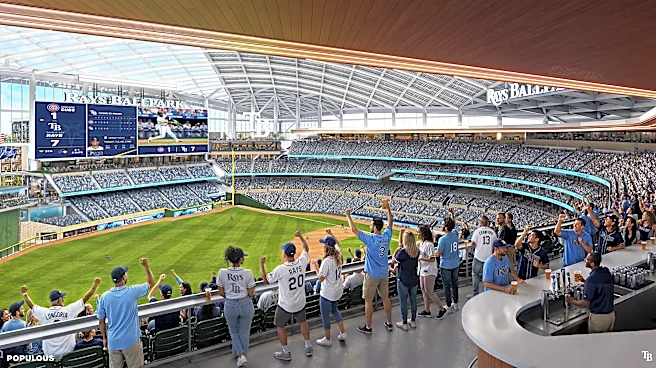

Thanks to narrow votes from Tampa’s city council and the Hillsborough County Board of Commissioners, the Tampa Bay Rays are as close as they’ve ever been to securing a new stadium.
The two-decade saga that’s spanned multiple ownership groups, several municipalities and eyed warily by two Major League Baseball commissioners might be, could be, probably will be coming to an end, as approval from the city and county to ultimately provide more than $1 billion to the $2.3 billion project were the largest hurdles to climb.
The latest step in the process came Friday, Aug. 28, when the county approved by a 5-2 vote a $796 million funding package that one commissioner estimated will cost Hillsborough $1.83 billion over the next 35 years.
And with that,
Tampa is on the verge of luring the Rays from St. Petersburg across the Howard Frankland Bridge (or the Courtney Campbell Causeway, if you prefer) to Hillsborough County. The club hopes to begin playing in Tampa by 2029.

While the Rays waltzed with Pinellas County and St. Pete on numerous occasions – pulling out of a deal to redevelop land around Tropicana Field in March 2025 – a move to Tampa had the perception of righting a wrong. The Trop was outdated even before the Rays moved in in 1998 and the mere existence of the then-Devil Rays was generally ill-considered, though MLB owners could not resist the lure of a $130 million expansion fee and a shovel-ready stadium option, flawed as it was.
Since then, the club has sold twice, most recently to Jacksonville real estate developer Patrick Zalupski for $1.7 billion in 2025.
Once Zalupski gets the deal for the projected 31,000-seat stadium across the finish line, the ramifications for the area and MLB will be significant. Here are key takeaways from a momentous week for the Rays:
Rays got city, county to fold quickly
For all the talk of the long road to a Rays deal, it was relatively easy getting city officials and county commissioners to capitulate – even as key parts of the deal remain opaque.
The Rays delivered a semi-final draft of the deal to the city at the close of business Friday, Aug. 21, turning any notion of due diligence into all-night cram sessions that even a procrastinating college freshman might find inappropriate. But to key swing votes on the council, token resistance to the Rays’ original terms appeared to suffice.
The key deodorant for the deal appeared to be the Rays agreeing to pay $4 million in annual rent. County commissioner Harry Cohen called the deal “markedly better” than the May memorandum of understanding, noting that the Rays’ pilfering of the county’s community investment tax fund is partially mitigated by moving $100 million for a road improvement from the county to the state. (Never mind that taxpayers will still pay for it).
Yet county commissioner Joshua Wostal, a Republican, ran the long-term numbers on the $463 million coming out of the community tax ($360 million) and the general fund ($103 million funded by property taxes) and said “taxpayers are at a significant delta.”
Over 35 years, at a conservative 4% future growth value, he computed the total county cost at $1.83 billion. And that simply doesn’t make sense, he says, when the Rays would rake 100% of revenues from game and concert tickets, concessions, parking and naming rights from the publicly-owned stadium.
“None of these financial metrics make up for these massive losses and disparities between the two numbers,” says Wostal, who along with commissioner Donna Cameron Cepeda were the lone no votes. “This deal is an albatross.”
It’s almost the stadium funding equivalent of a baseball labor negotiation in which commissioner Rob Manfred proposes delaying free agency from six to 10 years. The players, believing they are standing firmly on the issue, gladly compromise at eight years.
Constituents found raiding the CIT, perhaps, to be most distasteful. Voters renewed the half-cent tax in 2024, which, as the ballot language said, was earmarked “to fund infrastructure for transportation and public works, public safety, public facilities, public utilities and public schools.”
How funding a live-work-play mega-development and billion-dollar stadium figures into that is a question voters will certainly weigh when commissioners are up for reelection. And nothing can sweeten a deal for owners than dealing with a city that has a self-esteem problem.
Fear-mongering works with fanboy politicans
Multiple public speakers at Thursday’s city council meeting and Friday’s county meeting invoked the Orlando Boogeyman – that the Disney-fied city on the other end of I-4 would swoop in and steal the Rays if they didn’t act now, a notion that seems even more far-fetched when you talk to baseball people with actual Orlando connections.
It’s one thing for fans to wear jerseys to meetings – shoutout to the dude in the James Shields kit at Thursday’s vote – but quite another for elected officials to do so. “I just can’t understate how big this is,” city councilperson Alan Clendenin said when the city agreed to terms on a revised deal and he unbuttoned his dress shirt to reveal a Rays jersey.
“We are a major-league city with major-league sports.”
Might as well shine Mr. Zalupski’s shoes while you’re at it.
County commission chair Ken Hagan took that a step further, wearing a Rays polo under his coat and a lapel pin at Friday’s meeting. He could have thrown in a Las Vegas Athletics hat while he was at it.
“Do we want Tampa to be a world-class community? And what side of history do we want to be on?” he asked his fellow commissioners. “To be a world-class community requires vision, courage and the ability to think big. You need professional sports teams.
“I don’t know about you, but I don’t want to be another Oakland. Do we really believe one additional pothole has been filled since Oakland left? Having three teams in Tampa will elevate us from most of our competitors.”
Perhaps Hagan is not aware that Los Angeles continued to exist from 1995 to 2016 without an NFL team.
Still, though, image is everything. And enough commissioners have been sufficiently frightened into believing that the picturesque Gulf Coast loses significant shine unless it ponies up the funds to build a playpen.
Especially when those sweet drone shots kick in from the AL Division Series.
“We are 30 games away from the playoffs,” says Cohen, before his yes vote. “We’ve shown that we can win championships in this community. And when cameras pan over Hillsborough County and the sun setting over the Bay, and a worldwide television audience sees this community, you know what they will say?”
“That’s the place I want to visit. That’s the place I want to live That’s the place I want to open my business. That’s the place I want to raise my family!
“I want to be a community that has three major pro sports because we are able to exist in the top tier of cities and counties in the country.”
These impassioned pleas were certainly music to the ears of baseball’s top executive.
Now we see why Rob Manfred let John Fisher dip to Vegas
It didn’t make much sense: MLB’s commissioner allowing a franchise to bail from the 10th-largest media market in the country to the 40th, from a rich and picturesque Bay Area to the underfunded desert.
And while Manfred scarcely hesitated to waive the relocation fee for John Fisher’s moving the A’s from Oakland to Las Vegas, there’s still a payoff: Let a relocation threat prove true once, and multiple franchises will reap the benefits.
“We don’t live in a perfect world. Cities always have and always will roll out the red carpet for a team. They are champing at the bit for the Rays,” says Hagan. “The Chicago Bears and Kansas City Chiefs are all but gone from their states. Well guess what? If this agreement doesn’t go through, the Rays are next.
“This isn’t hyperbole. Commissioner Manfred has said so.”
Always refreshing to know that when someone says “Jump,” there are still people willing to say, “How high?”
Public sentiment – bipartisan or not - doesn’t matter
We learned this recently in Kansas City, where the city council, less than two years after seeing voters resoundingly reject public subsidies for the Royals and Chiefs, instead jammed through a $600 million approval for a Royals downtown stadium before the issue could get on the ballot again.
There’s nothing scientific about public comment but for what it’s worth, opponents of the stadium took the mic at the county meeting at a 3-to-1 ratio over proponents – and most of the “Yes” supporters worked for associations that would directly benefit form the project.
One notorious No speaker was Carmen Edmonds, chair of the Hillsborough County Republican Party, who said the majority of her group sided against using county funds for the Rays stadium.
“They have plenty of money,” she says of the Rays, “to do it themselves."
That’s a particularly significant stance given that this project made it this far largely due to Zalupski’s friendship with Florida Gov. Ron DeSantis, who has helped facilitate the conversion and relocation of Hillsborough Community College to accommodate the Rays project.
Yet it seems opposing this massive subsidy can unite across party lines, not unlike the anti-data center movement picking up steam nationwide. Popular sentiment can only matter so much, though, in a representative democracy.
“The super majority of people I have talked to have said yes, they love baseball. But they simply do not want to pay for a stadium,” says Cepeda, one of the two no votes.
The deal was certainly rushed
With DeSantis’ term ending Jan. 5, there was a relatively firm deadline to get the deal done. And it wasn’t just the rapid capitulation of city and county officials on terms of the deal that reflected this.
Multiple opponents – and even proponents – noted that the community benefits agreement between the team and the city and county is, in essence, a blank page at this point. No firm dollar commitment, no concrete proposals.
“Good conversations” with the Rays seemed to suffice for multiple yes votes. Yet for all the talk of how pouring this public money into a deal will result in public good, a significant commandment was defied.
Always get it in writing.
“That’s not a CBA,” Hillsborough resident Ron Dow said of the lack of specifics during public comment. “That’s a press release.”
Rays payroll: No guarantees, either
The long-bedraggled Rays have always hid behind their perceived small-market status even though Tampa-St. Petersburg is the 11th-largest market in the country, just two slots behind “large market” Boston.
Yet due to a consistently progressive front office and strong culture, the Rays have been a perennial threat and two-time World Series participant, even as their largest free agent commitment has been a mere $40 million deal for pitcher Zach Eflin.
Will that change in their new crib?
Don’t necessarily count on it. The populace has accepted this Rays reality, showing up at a decent rate in the 25,000-seat reduced capacity Tropicana Field and tuning in to provide the club some of the strongest local TV ratings in the country.
For $1.7 billion, Zalupski bought not just a franchise but also an expectation – that the Rays won’t spend like their East brethren in New York and Boston. Just like the community benefits agreement, there’s no guarantee that will change, either.
This article originally appeared on USA TODAY: Rays win crucial vote for new stadium in Tampa. Fear-mongering works. | Opinion