




Alysia Montaño had simply had enough.
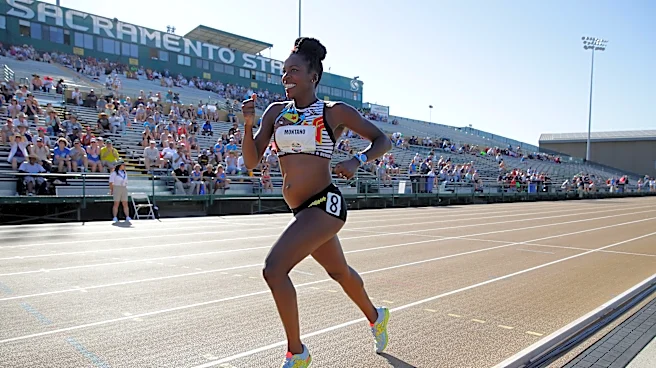
In 2014, Montaño became known as the “pregnant runner” when she competed in the USATF Outdoor Championships while eight months pregnant and became a symbol of resilience. But behind closed doors, Montaño had spent years fighting to secure maternity protections.
She witnessed brand executives and sports policies using language that equated pregnancy to injury. She heard sponsors go silent when she mentioned her desire to have a kid.
So in 2019, the Olympian co-wrote an explosive op-ed in the New York Times, in which she revealed that she’d lost her Nike sponsorship and her USA Track & Field health insurance while pregnant.
The response was swift. Other athletes including track and field Olympian Allyson Felix
spoke out. Nike announced a new maternity policy a few months later.
But Montaño realized the scope of the problem was even bigger. In 2020, she founded the nonprofit For All Mothers+ to advocate for better conditions for moms in sports and beyond. And now, the mother of three is launching a collective for businesses to get behind her mission.
“It really pushed us to say, this is not just an athlete problem,” Montaño told USA TODAY Sports. “This is not a sports industry problem. This is a widespread social issue.”

On Thursday, Sept. 17, Montaño launched the Mother in Sport Collective, which invites companies to pledge to end discriminatory practices against moms and families in sports. Eleven brands – Strava, Brooks Running, Hoka, Lululemon, Clif, Altra, Hettas, Brodo, rabbit, Oiselle and Gu – signed the pledge.
The acronym for the collective is MISC, a nod to the fact that contingencies involving pregnancy or parenthood are often under a miscellaneous line item in budgets and contracts. The idea, Montaño said, is to drive change by creating a network of allies – businesses, athletes and consumers – committed to a long-term continuum of care for mothers.
That can take many different forms: creating a standard maternity policy, covering fertility or adoption costs, and providing lactation stations. The MISC pledge doesn’t just ask brands to commit to parent-friendly practices but also asks them to encourage their business partners to do the same.
“It’s going to have a larger ripple effect,” Montaño said. “We know that sports is a microcosm of what’s happening in the world. And these changes that we use in sports, it is a blueprint for success on how we tackle greater social issues.”
Montaño's nonprofit funding research on the 'motherhood penalty'

In the years that immediately followed Montaño’s op-ed, maternity protections for professional athletes improved, largely thanks to public pressure. But as time wore on and scrutiny faded, Montaño watched discriminatory practices return and heard from other athletes that they still didn’t feel adequately protected.
Now, there’s evidence to prove it.
Over the last year, researchers at Carleton University in Canada surveyed 42 professional athletes and found that 76% of them had at least one funding source reduced, paused or terminated due to pregnancy, postpartum recovery or motherhood.
The preliminary findings report, released Sept. 17 by Carleton University’s Health & Wellness Equity Research Group in partnership with For All Mothers+, calls this the “Motherhood Penalty.”
“We kept hearing the same story from athletes: They were losing sponsorships, their contracts were not renewed, their funding was pulled, so their opportunities were kind of quietly disappearing around pregnancy and motherhood,” said Dr. Francine Darroch, one of the researchers and an associate professor of health sciences at Carleton.
Darroch and her research assistant, Sydney Smith, emphasized that their study is still ongoing. But they said that athletes across multiple sports described fear of disclosing pregnancy to sponsors, agents and national governing bodies because of the financial risks involved.
Athletes in individual sports such as running said they lost out on prize money and appearance fees due to the nature of individual sponsorship, which is often contingent on an athlete meeting certain ranking and points criteria. Athletes in team sports said they often felt unsupported by coaches and leagues, which impacted their team contracts and roster selection.
Some athletes couldn’t even go on record to talk about penalties within their contracts because they’d signed non-disclosure agreements with sponsors.
Darroch and Smith are continuing to interview athletes as part of their research. Eventually, they hope to develop best practices and policy recommendations for sports businesses and other industries. The goal is to make inclusive policies the proactive standard rather than reactive.
“It is a part of the conversation now, but it seems to be brought up when something happens to an athlete or an athlete speaks out,” Smith said. “Regardless of an athlete considering pregnancy or not, it should be offered on the table and be part of the conversation without the athlete having to look for those answers themselves and take that burden on.”
Montaño now knows what it’s like to be supported by as a mom athlete. She was sponsored by Altra and Clif during her second pregnancy and postpartum, with contracts that included fully guaranteed maternity protections.
Her advice for sponsors and sport governing bodies who want to do better? Practice what you preach.
“Listen to mothers,” Montaño said. “Just be OK with challenging outdated ideas and policies and working toward the change that we need to see and then build a community around it. The hardest place to be is alone.”
This article originally appeared on USA TODAY: This Olympian lost her Nike deal after giving birth. Research shows she's not alone