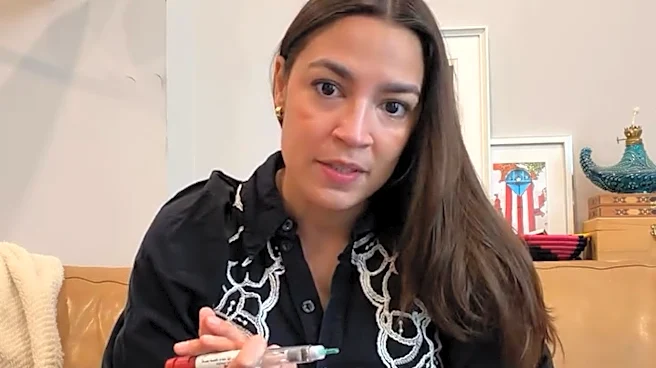







When Rep. Alexandria Ocasio-Cortez, D-New York, began sharing her egg freezing process, she gave voice to questions I hear from patients every day – and that millions of women are asking themselves:
- When should I think about freezing my eggs?
- What are my chances of success?
- How much does my age matter?
- How much will it all cost? Is it worth it?
Part of the reason stories like AOC’s resonate is that fertility decisions are deeply personal and consequential, yet the information patients rely on to make them is too often lacking, opaque or downright misleading. Patients want candid guidance about what we know fertility medicine can do, what it can’t and where the science is still uncertain.
Egg freezing illustrates the challenge particularly well. It only began moving into mainstream fertility care about a decade ago.
There is also an unusual lag built into measuring success: Freezing eggs is only
the first step. The real test comes years later, when a woman returns to thaw those eggs and tries to use them to have a baby.
Egg freezing isn't a guarantee – or a gimmick

Because many women who froze their eggs in recent years haven't yet returned to use them, the industry is still collecting the long-term data patients understandably want, and deserve.
Patients looking for real-world outcomes have surprisingly few places to turn. The Centers for Disease Control and Prevention and the Society for Assisted Reproductive Technology – the two major public sources for U.S. fertility treatment outcomes – do not currently publish clinic-level or national aggregate-level egg thaw success rates. And out of hundreds of fertility clinics, only a few – including Extend Fertility, where I practice – have published detailed, peer-reviewed reports of their egg freezing and egg thaw outcomes.
This challenge extends beyond egg freezing. A recent systematic review in The Lancet Obstetrics, Gynaecology, & Women's Health examined 10 commonly offered in vitro fertilization, or IVF, add-ons and found that seven showed either no benefit or inconclusive results, while only three showed preliminary evidence of potential benefit.
None of this is an argument against innovation. Quite the opposite.
I cofounded Extend Fertility in 2015 specifically to improve awareness and access to egg freezing technology. This was at a time when most fertility clinics were focused primarily on treating infertility rather than helping women proactively preserve their fertility. Reproductive medicine should keep pushing forward. The faster our field advances, the more important it becomes to be honest with patients about those advances.
Egg freezing is neither a guarantee nor a gimmick. It is a medical tool whose value varies enormously depending on a woman's age, biology and goals. Patients shouldn't have to become their own medical researchers to understand that.
Our field can do a better job. I see patients every day who are confused about their options and feel they haven’t been given the information they need to make decisions that are right for them. Some women have said on social media that they learned more about their fertility from a 10-minute video from Rep. Ocasio-Cortez than from their longstanding doctors.
It’s our job as physicians to explain the evidence, costs and uncertainty in terms they can actually use.
Three ways fertility medicine can do better

But what should that look like?
First, recommendations should be individualized. Freezing eggs at 28 is different from freezing them at 38, and not every 28- or 38-year-old is the same. Patients deserve realistic guidance based on their age, medical history and goals.
Second, doctors need to be candid about evidence and uncertainty. If the science is preliminary or still evolving, we should say so. “We don't know yet” can be a frustrating answer, but sometimes it is the most honest one.
Third, clinics should hold their marketing to the same standard as their medicine. Claims about success should be backed by transparent outcome data. If that data is small or lacking, this needs to be clear to the patient.
That standard applies to my own practice, too. My colleagues and I recently published our first eight years of egg thaw outcomes in the medical journal Fertility and Sterility because detailed public data about what happens when women return to use their frozen eggs remains limited. When clinics have meaningful outcome data, we should publish it, subject it to peer review and let patients scrutinize the results for themselves.
Rep. Ocasio-Cortez’s story has brought important and overdue questions into public view. As research continues, the fertility industry won't always be able to give answers with absolute certainty. But patients should never be left with information that is lacking.
As physicians, we owe our patients clarity about what we know, honesty about what we don’t and transparency about everything in between.

Dr. Joshua U. Klein is a reproductive endocrinologist and the cofounder and chief clinical officer of Extend Fertility.
This article originally appeared on USA TODAY: I'm a fertility doctor. AOC was more honest about egg freezing than we are.