




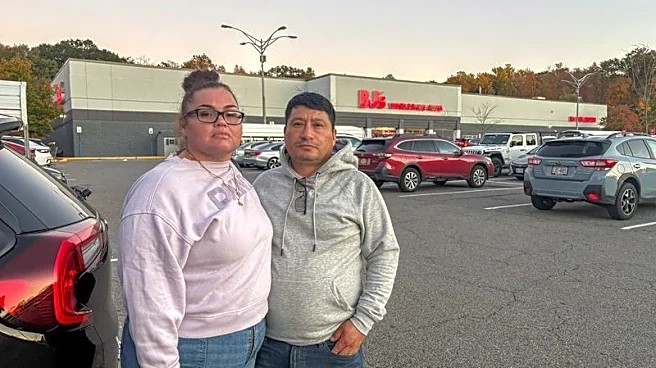




Snapshots of the Economy: Relentless inflation and a stagnant job market have thrust the economy to the forefront of the November midterms. In the run-up to election day, USA TODAY Money reporters fanned out across the country to examine how Americans are coping with the financial squeeze, from the gut-punch of sudden layoffs and endless job searches to the daily grind of making ends meet. This is the fourth story in a six-part series.
The last year has been hard on Will Parker and his family of four.
They've increasingly had to rely on others to afford their groceries. Parker, who is the only family member able to work and who made $43,000 last year but has seen his pay cut nearly in half with a new position, often borrows money from his mother-in-law
to pay for food or gas to get to work.
"I have to pay her back two or three weeks later just to make it through the week," said Parker, who works as a music teacher and paraprofessional at a school in Seymour, Connecticut. "It's not like we're getting extras. We're just getting your basic, simplistic meats."
Parker estimates that he spends about $400 a week on groceries and some household supplies, and that the cost has doubled in the last two years.
And last year, when the family's food budget couldn't keep up with their needs, Parker had to take a step that he'd never envisioned. He visited a food bank for the first time.
It's now a monthly ritual, though it leaves him wracked with guilt.
"Am I taking something away from somebody who's making even less?" he asks himself.
Families borrowing from family or using credit for groceries
Parker is not alone. American shoppers are going into debt or turning to loans to pay for their groceries.
In a survey by Omnisend, 30% of respondents said they used a credit card to pay for essentials, such as groceries, gas, utilities or medical bills, in the past three months, knowing they may not pay off their bill.
An additional 20% said they borrowed from friends or family, 18% used buy now, pay later products, and 17% said they had to use savings meant for something else.
"Many families are feeling their wallets get squeezed, yet essentials like groceries need to be purchased. Add in rising fuel costs and unexpected expenses such as medical bills and car repairs, and families are forced to choose between carrying balances or going without," Marty Bauer, e-commerce expert at Omnisend, told USA TODAY.

Rising food prices are a challenge
When Parker heads to the grocery store, there's a lot on his mind.
Though inflation has risen 3.7% over the last year, with the costs of certain food categories shifting up or down month to month, Parker's expenses have grown significantly greater as he fills his shopping cart with some of the special foods some members of his family need due to health conditions.
His wife has several disabilities, including celiac disease. That requires Parker to buy gluten-free products, which can often cost more.
"To get a loaf of bread is almost like 10 bucks a loaf just for her to eat," said Parker.
One of his daughters also has a brain disorder.
"The one thing she really wants all the time in the morning is milk. But even that ... can become a little tricky when it goes from a couple of bucks to almost five bucks a gallon," he said.
The family's financial struggles accelerated last year, when they moved to Seymour to be closer to relatives who could help care for his daughter with disabilities. There were fewer grocery stores to choose from, and food prices in general had ticked higher.
Parker eliminated buying all extras, like cookies, chips and soda, or "the stuff that isn't necessary for survival."
Then the school position, which paid him $41,000 a year, was eliminated, and the music lessons he taught on the side to earn an additional $2,000 dried up as well. He found a new school position at the start of this school year. However, the new job and a loss in students who can afford music lessons is going to cut his income by nearly half to approximately $24,000 a year, he said.
He's begun to increase the family's use of dried peas and dried beans to stretch their food dollars further.
The family receives Supplemental Security Income (SSI) of $963 a month for their daughter with disabilities, but if the family tries to apply for SSI for Parker's wife, they've been told it would reduce their daughter's payments, Parker said. His wife also doesn't have enough qualifying work credits from a nanny position to be eligible for disability benefits, he said.
Grateful and humbled by assistance
As he tries to stretch his biweekly checks, Parker asks his mother-in-law for between $50 to $100 every two weeks to buy groceries or gas to get to work.
"I would prefer to be there for her as opposed to her helping me," Parker said.
Still, despite his salary, the disability assistance for his daughter and short-term loans from his mother-in-law, the family's grocery budget consistently comes up short. Last year Parker started going to a nearby food bank once a month. Going that first time was difficult, Parker said.
"For lack of a better term, I guess, I had situational embarrassment in that feeling like I 'can't believe I'm here,' but 'I'm grateful it's here,' " Parker said.
The food he gets at the food bank, including meats, are needed, but Parker said he wrestles with whether he should be going there at all.
"I struggle in that I am making money,'' he said. "Not a lot, but I am making it."
At the Seymour Oxford Food Bank where Parker goes, the demand for assistance has grown dramatically, said Sue Blasavage, the food bank's vice chair.
In two years, the food bank has gone from serving 90 families to more than 827 in September, she said.
"People are hurting," Blasavage said. The increase in clientele includes both first-time visitors and many families who have jobs, but need the extra assistance, she said.
The cost of groceries, or food at home, fell by 0.1% in September, but remained 1.8% higher than a year ago, according to the latest U.S. Bureau of Labor Statistics Consumer Price Index. The food index in August was 2.2% higher than a year ago.
Food banks are resources for all community members when they are in need, whether that is temporary or more long term, said Ami McReynolds, chief advocacy and community partnerships officer for Feeding America, a national network that connects people to food banks, food pantries and local meal programs.
"We don't want anyone to feel guilty about having to turn to a community resource to help support them," she said.
Still, Parker's worry that he is taking food from someone else is a common lament heard at the food bank, Blasavage said.
"They feel they are not worthy," she said.
Need for food assistance is growing
In 2024, nearly 48 million people, including 14 million children, experienced food insecurity, according to the latest data available from the U.S. Department of Agriculture.
Additionally, approximately 25 million people – or nearly half of all people experiencing food insecurity – had incomes too high to qualify for federal nutrition assistance, according to Feeding America.
Feeding America says 80% of its national network of food banks saw the same or an increase in demand for food assistance in June compared with May and the same percentage was reported for food distribution demand from the same period a year ago.
"There's increased and sustained demand nationally," said McReynolds.
But accessing food assistance through the federally funded Supplemental Nutrition Assistance Program (SNAP) has become more difficult, some food advocates say.
From July 2025, when H.R. 1 became law, through May 2026, expanded time limits, work requirements and other eligibility restrictions have left more than 5 million people without SNAP, many of whom are children, older adults and people with disabilities, said Gina Plata-Nino, director of SNAP policy and advocacy with the anti-hunger nonprofit Food Research & Action Center.
“SNAP is our first line of defense against hunger, helping millions of people put food on the table each month and keeping grocery dollars flowing through local economies," Plata-Nino told USA TODAY. "Cutting people off SNAP is not an indicator of success. It's an indicator of the failure of the wealthiest country on earth to let its people go hungry.”
A change that went into effect Oct. 1 makes state governments responsible for 75%, instead of 50%, of the administrative costs for SNAP, fueling worry among advocates about future funding and coverage.
Other parts of budget are also tight
As Parker tries to figure out how to help keep his family fed, he's also struggling to pay other monthly bills.
"Just to make sure everything gets paid every month, there are things that I have to put off and pay late and end up paying a late fee because I can't afford to pay that, and rent and gas at the same time," he said.
The overall costs of owning a car have soared, for instance. "The insurance is so incredibly high so with grocery bills and everything, it just becomes sometimes a little bit too much," he said.
Most months Parker does what he calls "defensive banking," or choosing which bills to not pay based on what will have the least detrimental consequences. For instance, he might delay paying the phone bill to make sure he keeps the lights on and then try to catch up in a future month.
"I don't feel like I'm ever getting ahead at all," he said.
The family is on Medicaid for their health benefits and with his recent drop in pay, Parker said he now qualifies for SNAP benefits. He is in the process of applying and estimates the family will get $200 a month in benefits.
Once those benefits are approved, that will help with food shopping, Parker said. And he has recently picked up some Christmas caroling gigs over the upcoming holidays, which should temporarily bring in another $400 to $500.
"People like me, we are working hard,'' he said. "We're working several jobs at once. It just isn't enough."
Betty Lin-Fisher is a consumer reporter for USA TODAY. Reach her at blinfisher@USATODAY.com or follow her on X, Facebook or Instagram @blinfisher and @blinfisher.bsky.social on Bluesky. Sign up for our free The Daily Money newsletter, which breaks down complex consumer and financial news. Subscribe here.
This article originally appeared on USA TODAY: 'I have to pay her back.' One family's struggle to afford food