






Long before Bonnie Garmus wrote "Lessons in Chemistry" -- before it sold millions of copies and was translated into more than 40 languages, before Brie Larson starred in the Apple TV original series based on the book, before Garmus moved to Europe while still working as a copywriter and later became a debut author at 65 -- she lived in Seattle and returned to a habit of reading poetry every day.
One day in the early 2000s, Garmus tuned into a radio show on her commute home from work. A reading of Nikki Giovanni's poem, "The Laws of Motion," sounded through her car speakers. Despite labelling herself as "not a huge poetry person," Giovanni's words got Garmus thinking about her career working as a copywriter in tech.
"I just though, oh my gosh,
this poem is all about substance. What is substance in your life? And so I was listening to that and thinking...am I doing the right thing? Am I in the wrong career?" she said.
Garmus thought back to the last time she heard "The Laws of Motion." She was 14 years old and had an English teacher who "begged us all to read a poem a day." Garmus didn't follow those instructions at the time ("Maybe my classmate did, but I didn't," she remembers) and hearing that poem years later, at that particular moment in her life, turned Garmus into a daily poetry reader.
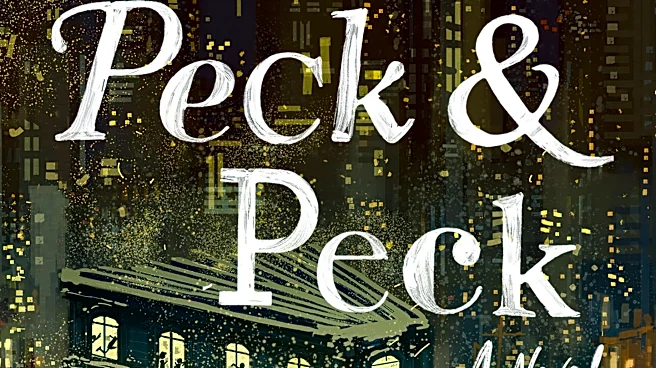
Batter Gray, the protagonist of Garmus' second novel "Peck & Peck" (out Oct. 13 from Scribner), never had a moment of discovery like Garmus -- poetry was always part of his life. The novel is a poetic bildungsroman of sorts; Batter Gray knows from a young age that he wants to work in poetry. His childhood is marked by outlandish stories from his typography-obsessed mother and questions of practically from his history teacher father.
Gray stumbles through numerous college majors and personal crises only to have a university librarian recommend he read the prestigious Peck & Peck poetry journal. The first page consisted of only two words, a poem in its entirety by George MacDonald: "Come / Home."
Garmus's new novel follows Gray through the early years of post-graduate life, as he moves to New York and later happens upon a job in the basement copying room of Peck & Peck itself. The quarterly is run by Salton Peck, a business man and half of the latest pair of Peck twins (the other, Declonius, served as the journal's artistic genius and Salton's enemy before getting into legal trouble) to lead the publication bearing their name. Salton wants to game the journal to his capitalistic goals, adding advertisements and limiting the journal's artistic license and experimentation -- the exact qualities that gave Peck & Peck such a prestigious place in the publishing world.
Gray's artistic coming of age plays out amongst the tightening budgets and increasing creep of technology in the publishing world of 1980s New York City. And Peck & Peck is at risk of falling victim to the drive for money and content.

Writing 'Lessons in Chemistry' vs. writing 'Peck & Peck'
How do you follow up a debut novel that sells millions of copies, makes it onto television and continues to sell years after it was first published?
For Garmus, the answer was to just move forward with the work. "This is because of copywriting -- we switch gears all the time," she said. "So I want to write about creativity and originality. I want to do something original. So I didn't even think twice. I just went, oh, here's this voice."
Garmus was travelling to a book event for "Lessons in Chemistry" when that voice popped into her head. "I heard [Batter] so clearly in my head -- his embarrassment, his frustration, his everything, his uncertainty about what he should be doing," she said. The novel's narration fluctuates, as Batter Gray does in his own life, by paring his sense of feeling adrift with a precise, encyclopedic recall of poetry and its creators.
Writing "Peck & Peck" happened the same way all of Garmus' other projects develop. She listens to her characters and follows them as a story unfolds. And Gray had hundreds of poems to show Garmus in the process of writing the book.

Garmus recalls her publisher asking for a list of all the poems that inspired "Peck & Peck." They expected a list of around ten; Garmus gave them 400.
The pages of "Peck & Peck" are filled with poems: T.S. Eliot's "The Love Song of J. Alfred Prufrock," William Carlos Williams' "To a Poor Old Woman," Adrienne Rich's "Diving into the Wreck," and Henry Wadsworth Longfellow's "The Arrow and the Song."
In writing "Peck & Peck," Garmus inhabited the mind of a poetry obsessive. Beginning in elementary school, Batter devours every piece of poetry he can get his hands on: anthologies, The New Yorker's poetry section, The Paris Review and writers like Shakespeare and Keats. He develops an "ear" for poetry starting at a young age, a skill that was not "a gift" but one carefully crafted over years of study.
"I didn't love it all. Some of it was boring. A ton of it was confusing," Gray recalls of his poetry reading habits, "But I kept at it. That is how an ear is built."
Garmus went through a similar education to write the book. She picked back up the practice of reading a poem a day (helped by the Poetry Foundation's Poem of the Day newsletter) and rediscovered old favorites like W.H. Auden, Yeats and Langston Hughes. She doesn't have a favorite writer, but Garmus recently discovered Seattle poet Esther Lin's work after reading her 2025 debut collection "Cold Thief Place."
"If we pay attention, we will notice in short order that poets tell the truth," Garmus said. "And we have very little truth left in our world, but poets just tell it like it is, and they have no reason to lie."
'This book is about the danger of conformity because it's the basis of fascism'
"Peck & Peck" bares little resemblance to "Lessons in Chemistry" in terms of detail: Garmus has moved from Southern California in the 1960s to the publishing world of New York City in the 1980s; from the world of science and cooking shows to that of arts and culture; from the beloved main character of Elizabeth Zott to the uneasy Batter Gray. But the books feel more connected to Garmus.
"They talk about different things, but the humor is kind of the same. And the idea that I'm mad about something is also the same," she said.
The sexism, misogyny and racism that ignited "Lessons in Chemistry" has now given way to a fear of conformity and consensus in a time of political upheaval in "Peck & Peck." Salton Peck's drive to monetize and streamline the publication into a piece of content mirrors, for Garmus, the rise of artificial intelligence and funding cuts to arts programs around the country.
Garmus intentionally set "Peck & Peck" before the widespread use of technology and phones. Even as Salton tries to monetize the publication to death, Peck & Peck seeks to find poets from around the world and introduce them to new readers. Without the ability to encounter something new and unique, Garmus said, society risks slipping into dangerous territory.
"This book is about the danger of conformity because it's the basis of fascism. And we are in pretty much a fascist state with our current administration and with the AI tech bros trying to get every own, every single bit of information and then sell it back," she said.
Every unique part of Peck & Peck, the publication, is creation of Garmus' own mind: 39 editors meet in a five-story New York City building that sticks out amongst the skyscrapers with French doors, limestone framing and carefully tended English boxwood topiaries on each balcony. When Gray first encounters the building he stands out front, on a Sunday evening in the snow, lost in its orbit.
The book, while set in a very different time, still offers poignant reflections on the current moment. All poetry submissions come through the mail. Every editorial meeting leads to shouting. The publication struggles to make a profit. No one at Peck & Peck is looking at a screen.
Peck & Peck: A Novel. Scribner, $30 (hardcover), 432 pp. Oct. 13, 2026. 9781668251065.
Upcoming events:
- Bonnie Garmus will be in conversation with Jeff Martin at Third Place Books, Lake Forrest Park (17171 Bothell Way NE Ste A101, Lake Forest Park, Washington 98155) on Monday, Nov. 23, 2026 at 7 p.m. to discuss "Peck & Peck." Get tickets at thirdplacebooks.com.
Zachary Fletcher is a trending news reporter with USA TODAY Network's Washington state team. Keep up with him on X (@zdfletch), BlueSky (@zfletcher.bsky.social) or reach him at zfletcher@usatodayco.com.
This article originally appeared on USA TODAY: Why Bonnie Garmus turned to poetry for her second novel, 'Peck & Peck'