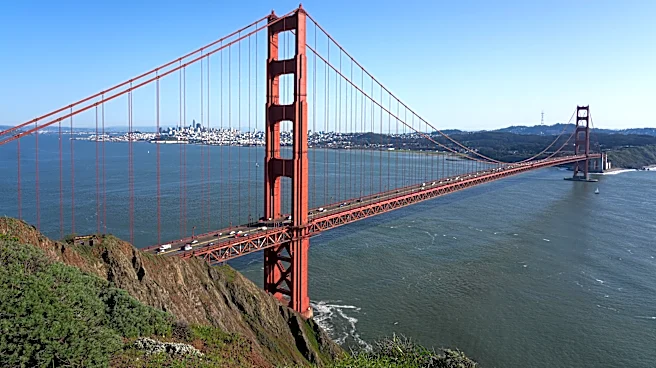



Late-night commuters who frequently cross the Golden Gate Bridge should expect to spend some time admiring the twilight construction, as crews will close three of the six lanes this week for a seismic retrofit project.
The project began Monday, Oct. 5, with crews closing two southbound lanes and one northbound lane starting at 9 p.m. and reopening all lanes of traffic by 5 a.m. the following morning. These three lanes are expected to remain closed until Friday morning, Oct. 9.
Crews will construct 230,000 square feet of decking in preparation for the next phase of the Golden Gate Bridge $1.8 billion seismic retrofit project, which has been in the works for decades.
The next phase will see crews strengthen and reinforce the main span between the two
towers and the two side spans, add floor beams, replace expansion joints, install new struts, add new latticework to the road, and install giant shock absorbers to help mitigate vibration from earthquake tremors.
Officials want to reinforce the Golden Gate Bridge to withstand an 8.3 earthquake on the Richter scale, believed to be as strong as the 1906 San Francisco earthquake that devastated the city.

For folks hoping to avoid late-night traffic back into the North Bay, unfortunately there are very few alternatives.
Although the San Francisco Bay Ferry and Golden Gate Ferry offer service from Vallejo, Larkspur, Sausalito, or Tiburon to San Francisco, each service stops running a couple of hours before construction crews start closing lanes.
It's unclear when the crews will officially start long-term construction on the Golden Gate Bridge, but the first half of the project is expected to last up to six years.
The bridge reinforcement is the final phase of the Seismic Retrofit project, which has been in development for close to 30 years. The Golden Gate Bridge is also one of the last California bridges to be reinforced, a requirement after the Loma Prieta Earthquake in 1989. The quake struck the San Francisco Bay Area with a magnitude 6.9 tremor, which led to the death of 63 people and left more than 3,700 people injured.
The Board of Directors of the Golden Gate Bridge Highway and Transportation District awarded its first contract for this project in 1997, establishing a construction administration team of District staff and consultants to determine an optimal plan.
In 2001, the District began construction on its second phase, which retrofitted structures in the southern portion of the bridge, including the south approach viaduct, Fort Point arch, south pylons, and south anchorage housing. Construction on this portion was completed in 2008 without closing the Golden Gate Bridge to traffic.
In April 2008, crews began a similar retrofit on the North Anchorage Housing, which was completed in 2014.
It would be nearly a decade before the District began planning construction of the final portion of the retrofit: reinforcing both towers and the south tower pier on the Golden Gate Bridge.
Golden Gate Bridge history and why it's an American icon
The Golden Gate Bridge is one of California's most recognizable landmarks. Construction began in 1933, and the bridge opened in May 1937 after four years of work. Its 4,200-foot main span was the world's longest suspension bridge at the time and helped transform travel between San Francisco and Marin County.
Nearly 90 years later, the bridge remains a global symbol of San Francisco and one of the nation's most visited attractions. A 2023 analysis by travel platform Explore Worldwide ranked it thesixth most popular landmarkin the United States.
Today, roughly 89,000 vehicles cross the bridge each day, making it one of the Bay Area's busiest transportation corridors. Drivers pay a toll only when traveling southbound into San Francisco; FasTrak users are currently charged $10.25 per crossing.
This article originally appeared on USA TODAY: Golden Gate Bridge closes lanes to prepare for retrofit construction