


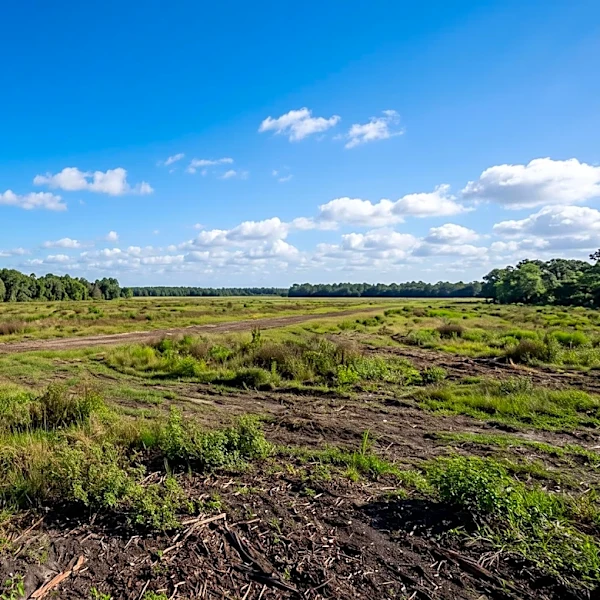



Once a year in October, people travel from all over the country to visit ground zero for the infamous Trinity test in New Mexico's Jornada del Muerto desert.
A two-lane highway to the site becomes bottlenecked. It leads to an open house event where the world's first atomic bomb was detonated on July 16, 1945.
“It's a great opportunity for us to be transparent with everything we're doing out here," said Col. Mike Luekeman, garrison commander for the White Sands Missile Range.
For some, the event is a chance to witness history. For others, it's a painful reminder of a legacy far from over, with families continuing to grapple with cancer. As the U.S. government plans to expand nuclear weapons production in the state, New Mexico remains at the center
of a debate over national security and public health.
Gaps in historical data limit what scientists can establish about the full impact of the Trinity fallout. The National Cancer Institute supports the likelihood of additional cancers in the most heavily exposed areas. However, researchers could not find evidence of health effects passed down to children, despite residents describing cancer diagnoses spanning generations.
"We know that we bear the legacy of that bomb in our bodies," said Tina Cordova, an Albuquerque resident whose family once lived near the test site. "We pass that legacy on one generation to another."
Cordova has spent years raising awareness about fallout from the blast. She co-founded the Tularosa Basin Downwinders Consortium, which advocates for government compensation. Downwinders are those who have been exposed to radioactive fallout from nuclear testing.
In 2025, federal legislation expanded the Radiation Exposure Compensation Act to include eligible New Mexico downwinders.
"We have multigenerational cancers," Cordova said. "In my own family, I'm the fourth generation to have cancer since 1945. And there's five generations in my family with cancer now. We don't ask if we're going to get cancer. We ask when it's going to be our turn."
Paul Pino, who also lives in Albuquerque and whose family once lived in the Trinity fallout zone, said his mother and older brother died from cancer. The former American history teacher added his sister has survived both thyroid and breast cancer.
"Cancer is slow, so people didn't die like that overnight," Pino said. "The truth came out really slowly. And for me, somebody that was a teacher, it took decades and decades and decades for me to learn the truth."

U.S. government’s renewed nuclear ambitions
New Mexico is still connected to the American government’s nuclear ambitions. The United States is expected to spend $946 billion between 2025 and 2034 to operate, sustain and modernize its nuclear stockpile, according to the Congressional Budget Office.
Part of that budget includes increased production of plutonium pits, the central radioactive cores of nuclear weapons that trigger the explosions. For now, the Los Alamos National Laboratory in New Mexico, where the world's first nuclear weapon was designed as part of the top-secret Manhattan Project, is the only location in the United States capable of producing these cores.
That increased production is needed to replace aging cores in the country's stockpile, according to the National Nuclear Security Administration.
“Given the importance of the nuclear stockpile to America’s national security, it would be irresponsible to delay restoring the nation’s capability to produce plutonium pits," a spokesperson for the agency told USA TODAY in a written statement.
But critics said that could lead to the development of more nuclear weapons around the world.
"The biggest danger of all is a nuclear arms race," said Jay Coghlan, executive director of Nuclear Watch New Mexico, a watchdog group. "In the old days, it was just the United States versus the Soviet Union and now Russia. But now, we also have China, which is expanding its nuclear forces."
Legacy of distrust
Myrriah Gómez, a professor at the University of New Mexico and author of "Nuclear Nuevo México," said her grandfather worked as a laborer on the Manhattan Project and later died of cancer.
“Many people had their imaginations recaptured when the film 'Oppenheimer' came out in 2023, and they want a bit of that culture,” Gómez said, adding she wishes "we could begin thinking about ways that we would be able to benefit society versus creating weapons that would ultimately end the world.”
Despite the large presence of government facilities and nuclear industry in the region, New Mexico has one of the highest rates of poverty in the country and lower average wages than neighboring states.

Carl Willis, a professor at UNM's Nuclear Engineering Department, says the state's economy is closely tied to nuclear technology. In 2024, government and military spending accounted for 22.4 percent of New Mexico's gross domestic product, according to the New Mexico Department of Workforce Solutions.
“I’m pro-nuclear in the sense that I work with it. I don’t fear it,” Willis said. “I think there are appropriate uses for nuclear technology.”
At the same time, Willis said, developing a stronger nuclear deterrence in the United States means confronting a legacy of distrust among communities in New Mexico still impacted by the fallout from the Trinity test.
"If you have secrecy, that breeds distrust," Willis said. "These people were not moved. They weren't told that this was happening. And that's a trade-off. You’re trading security for trust."
This project was made possible by support from the Outrider Foundation and Journalism Funding Partners.
This article originally appeared on USA TODAY: Trinity test fallout haunts New Mexico as US expands nuclear plans