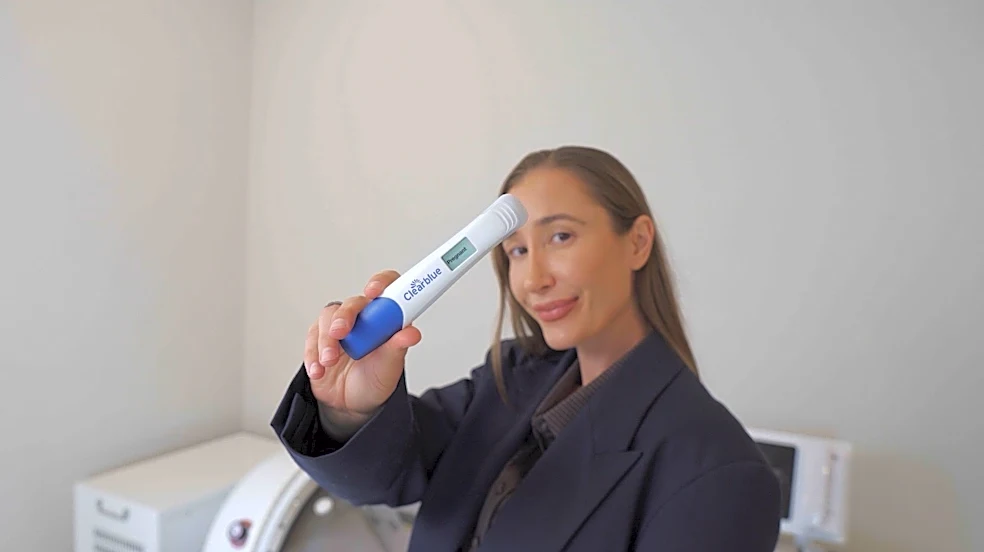

Kayla Barnes-Lentz – the 35-year-old woman who's built a cult following in the longevity space as the most publicly measured woman in the world – is pregnant. As of this writing, she's exactly seven weeks
and two days into her pregnancy. Exactly 229 days to go until her June 5 due date. Why do we know all these details? Because Barnes-Lentz, as she's done for years, has disclosed her health metrics for the world to see. Her pregnancy will be no different, with a protocol of its own.
During the first trimester, she's prioritizing protein and whole foods and getting labs done of her complete blood count and ferritin. In the second trimester she'll start pelvic floor work with a specialist, and by the third focus on sleep positioning and nervous-system regulation and blood pressure monitoring, even at home. Some of her discoveries are already well-known, including eating more smaller meals each day throughout pregnancy.
If you follow Barnes-Lentz on Instagram, you'll see this play out. She's trying out foods like kefir, prune and zen basil pudding because high progesterone in pregnancy slows gut motility. She's planning to gather over 9,000 biomarkers and 40 million data points across her pregnancy and postpartum. Not every medical practitioner out there endorses this granular level of testing. For Barnes-Lentz, it's a passion.
Over a phone call, however, she dishes she's like any other pregnant woman with confounding cravings. Like meat loaf. "I've not thought about a meat loaf in over a decade for sure," she says. "I mean, probably even longer. So I found that to be really interesting, and I actually made it. I made it like a very healthy from scratch type of way, and it was OK I'll say. It's not a food item that is like super desirable, to be honest."
Barnes-Letz chats with USA TODAY about everything she's cooking up in the Q&A below.
This interview has been edited and condensed for clarity.
Question: How are you feeling? This is such big news. Congratulations!
Answer: I know! It's so exciting. I'm feeling really good. I mean, I have some of the symptoms, but they're really mild, a little bit less energy, a little bit of low-level nausea. But overall, I mean, I feel so good, and I'm also just super excited for this (pregnancy).
Feel free to share how much or how little as you want. But is it something that you were actively planning for? What were you thinking about timing?
From a data standpoint, I always knew that, at least the first pregnancy that we had, I wanted to get the deepest data collection ever. So, yeah, that's been on my mind for a while. In terms of us trying, I knew I wanted to really get my book pretty much done first, and I just had so many incredible opportunities the last couple of years to travel and speak all over. I actually got pregnant the same day that I turned in my book manuscript, which was so fun.
Tell me about the book.
It'll be entitled the "Female Longevity Protocol," and it's coming out with Harper Collins (in June). I would like to think it's like the field guide to the female body. It's almost every system of the body that we can track, and early diagnostics, but it's also incredibly science-backed. So I have a female medical doctor that specializes in female health to fact-check the entire book. Then I have another female PhD to fact-check the whole book, who also specializes in female health and longevity. And then I have over 25 either medical doctors or PhD contributors throughout the book to each chapter. So we dive deep into everything from changes in hormones and ovarian aging and menopause and hormones and gut health and we have all the basic stuff, but then we dive into a lot of stuff that isn't really mainstream and we talk about a lot of the more advanced stuff that I do. I'm hoping it's just the comprehensive guide.
Is pregnancy going to be a part of that at all, or is that something that's separate?
I think that that'll probably be separate. We of course touch on it in the book because it's interesting. Like, things that you develop during pregnancy. So let's say maybe like gestational diabetes or preeclampsia. Those are actually big factors for your longevity. So if you develop any of these conditions during pregnancy, it can significantly increase your risk for conditions, mostly cardiovascular problems and metabolic problems later in life. So it's a part of the longevity kind of female protocol, but it won't have a ton of focus on it.
How has your pregnancy been health-wise?
From a health standpoint, everything that we want to be, in terms of optimal ranges, it's there, and yeah, I mean, just a little bit at lower energy, which is to be expected. But I've also had some fun findings too, just because I have so much data and I'm watching things, and I have such a significant baseline, like so many changes. I mean, your glucose in the first trimester changes immensely. You have super low glucose because your body is just doing so much work and mobilizing so many stores. So I've changed the way that I've eaten. Typically, before I would just eat like two meals and then a protein shake, and now I'm having to eat smaller meals throughout the day to maintain glucose because it was just dipping too low on CGM. I also monitor every single bowel movement, and as progesterone increases, which is very healthy and natural, it just changes your gut motility. So that's an interesting finding. Obviously, (heart rate variability) and resting heart rate change totally. So there's been a lot of interesting finds already.

How did you plan out your whole pregnancy protocol?
I planned this out with Dr. Sara Szal ... She's been my consulting longevity physician for some time now, Harvard-trained OB-GYN. But I'm also having a lot of other additional experts or physicians, PhDs, etc. One area that we're going to dive even deeper to is like oral microbiome changes during pregnancy.
It'll be different from my regular protocol. One, we're doing actually more testing than I normally would. We're doing a more like ultra-comprehensive every month, not every quarter. Some tests I do more frequently. But then we're going to be doing a lot of pregnancy-specific stuff. So there are a lot of new tests that you can like test for gestational diabetes really early on. I'm also going to be having in a little later in the pregnancy like my own daily fetal monitoring. So I'll be doing at home like ultrasounds and at-home fetal monitoring like on the heartbeat and all that stuff to just get literally an unprecedented dataset (Editor's note: This close monitoring is not widely recommended by doctors). Like you know, women don't have access to these clinical grade tracking devices at home typically, and then we're also going to be diving super deep into things like pelvic floor, like in my current protocol, I'm doing pelvic floor testing only twice a year. Now I'm doing this four times just throughout the pregnancy. I'm also doing vaginal microbiome testing every single month. I'm doing some sort of gut microbiome testing every single month. I wouldn't typically do it at these frequencies, but because we want to just see the shifts, I think it's going to be important to do them even more frequently than I would do it prior. And then, of course, also anything that is pregnancy-specific will be new to this protocol, such as the early tests for gestational diabetes and preeclampsia and hypertension and all that type of stuff.
How would you talk to your child about why you wanted to track all of these things?
I would love to lead with the the part of the conversation or the reasoning as to like following your passion because this truly is my passion. I was doing this when nobody was looking for a very long time, and doing it when it wasn't cool and all that stuff. So, I think No. 1, talking about following your passion is important. I think No. 2, also just explaining how health works to our children when it makes sense, that you know there are a lot of things that can give you better health, and there's a lot of things that can give you less optimal health. And I think the third piece of it is wanting to be a part of at least opening a conversation. We know that this is all "n of 1." So just because something works perfect for me on my protocol, that's a big reason why I have the podcast. Because I want doctors that have clinical experience to be able to speak to what works for women as a whole, instead of just what works for me. But I also will be excited to share that, in some small way at least, I want to contribute to improving the conversation and starting to potentially remedy a little bit the lack of testing for women. Not only are women undertested, but I mean, pregnant women are by far, one of the least tested groups in the world. So we just don't have really much information at all on pregnant women.
This article originally appeared on USA TODAY: She's the most publicly measured woman in the world. Now she's pregnant