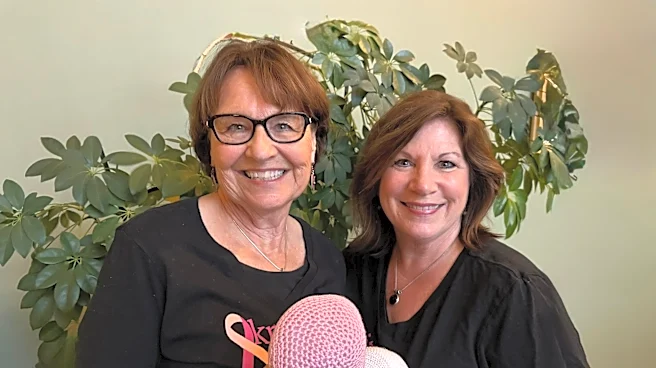


The lowest point of Barbara Demorest's breast cancer journey wasn't her diagnosis, or undergoing a mastectomy. It was being told she wouldn't be able to put a traditional breast prosthetic against her surgery scar for weeks.
"That was the first time that I cried throughout the whole thing," she told USA TODAY. "I wanted to get back to work. I wanted to get back to life. I wanted to have a sense of normalcy."
Her doctor explained that many patients aren't satisfied with silicone prosthetics, either − they can be heavy, sweaty, often require specific bras and get expensive. But he had heard of people making a lightweight, knitted version of a prosthetic that she could try. So, Demorest told one of her knitting friends, who got to work with her needles.
Soon after, the pair met up. Self-conscious and wearing a loose-fitting jacket to hide her temporary solution of socks stuffed in her bra, Demorest took her newly knitted knockers − delivered by her friend in a Victoria's Secret bag − to their church's bathroom stall.
"I couldn't believe what I saw. It was soft. It was light. It was beautiful, and it was made by somebody who cared," Demorest said, explaining putting them on "changed everything."
"I know that sounds dramatic, but it truly did. Barb was back!" she smiled. "I could get a hug with this. I took my jacket off, and I re-engaged with life."

In that moment she knew she needed to turn this craft into a larger cause, creating knittedknockers.org, an organization that provides free, knitted prosthetics for anyone who needs them.
More than a 'grandma' hobby
Since Knitted Knockers began in 2011, the organization has grown into nearly 8,000 registered "makers" groups across 50 states and 76 countries. And volunteers range in age, from a nearly blind 90-year-old woman who knits by magnifying glass in her nursing home, to groups of middle schoolers "all with their braces and their happy faces" stuffing knockers to help others.
As Knitted Knockers' President Patti DeFreeuw explained, knitting and crocheting "isn't just a grandma's craft anymore." It's "had a huge resurgence," she said, adding how more young people are also getting involved in the organization.

One of those young people is Aditi Mohan, who grew interested in crochet during the COVID-19 pandemic and later formed a makers group at her school. Since then, she's become a medical student and the organization's director of youth, encouraging even more young makers to join in at the chapter she leads in Augusta, Georgia.
This sense of community and feeling of giving back is why "grandma hobbies" have become so popular among younger crowds, according to DeFreeuw.
'Inundated with orders' after Instagram post
Now, DeFreeuw is hoping even more young people take part after the organization's Instagram page recently took off.
"To be honest with you, we are inundated with orders right now because the word has got out," she said, explaining one of their "little nine-second reels" has been viewed over 3 million times.
About 1 in 8 women in the United States will be diagnosed with breast cancer in their lifetime, making it something many people − both young and old − are impacted by either personally or through a loved one.
Younger women are increasingly being diagnosed, too. Over the past decade, breast cancer rates have risen by 1% per year, with the steepest increase occurring in women younger than 50.
And DeFreeuw is seeing excitement online from both survivors in need and those wanting to help turn this pain into purpose.
"99% of them are people that didn't know about us," she explained. "So we're getting all of these like, 'Oh my gosh, I didn't know this existed!'"

Why not just manufacture?
Over the years, Demorest has been asked, "why don't you just manufacture these and sell them?"
But that totally misses the point, she says.
"Nobody's profiting from this. This is what I call a pure organization. There's no paid employees. We are all doing it because we care," she said. "And the makers continue to make them out of the goodness of their heart because they know that it is transferring directly to the recipient, and all we're doing is facilitating it."
Those looking to get involved can get free patterns or info on other ways to help on its website, like donating money for shipping costs. And those in need of knockers can request a pair through the site to be mailed at "no cost, no strings attached," as the site notes, or pick up a free pair at a one of the 2,500 (and counting) medical offices that partner with the organization.
Plus, as much as it's helping the patients, it's also providing purpose to the makers, Demorest added.
For Mohan, it's preparing her for a future career as a physician.
"Through studying medicine, I will be helping my patients with medications, surgeries and clinical judgment, but through Knitted Knockers, I am also able to help them in their recovery by providing comfort, dignity and kindness," she recently shared in the organization's newsletter. "As I become a physician, I hope to keep this aspect of patient care in mind."
And for the nursing home knitter, Demorest said the 90-year-old's email to the organization will always stick with her: "Being able to make these has given me a reason to live."
This article originally appeared on USA TODAY: They’re knitting for a good cause – fake breasts for cancer survivors