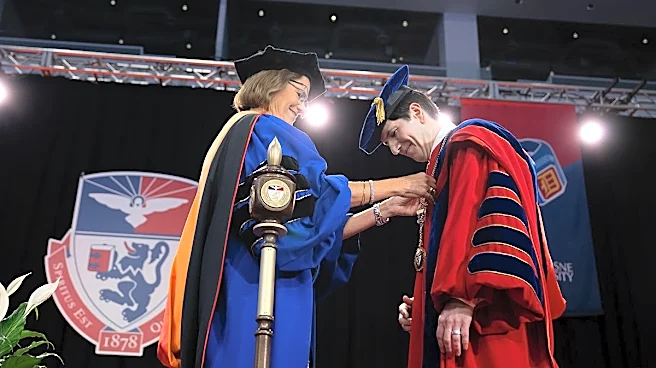






As Duquesne University approaches its 150th anniversary, newly inaugurated President David Dausey is looking toward the future while keeping the institution's mission at the center of its growth.
Dausey, who was officially inaugurated as Duquesne's 14th president last week, said his priorities are rooted in both expanding opportunity and preserving the culture that has defined the university for nearly a century and a half.
A Pittsburgh native, Dausey described becoming president as a full-circle moment.
Growing up in a working-class family, college was never part of his original plan, he said. Like many members of his family, he expected to work in the steel mills.
Today, he leads a university that is experiencing significant momentum, particularly
in healthcare education. Duquesne has opened its College of Osteopathic Medicine, is constructing a new health sciences building and continues to attract growing interest from prospective students.
Dausey said the university's investments in healthcare are helping make Duquesne a more desirable destination, particularly for students who want to approach medicine through a broader lens.
"I'd like to believe it's more than that, that they want to pursue a different type of medicine, no matter their specialty, that allows them to really recognize the fullness of the human experience and the people that they're treating," Dausey said.
The medical school has received thousands of applications for a limited number of seats, a sign of what Dausey sees as growing demand for programs that blend clinical excellence with a focus on the whole person.
That philosophy extends beyond healthcare.
Before formally stepping into the presidency, Dausey embarked on a university-wide listening tour to hear directly from students, faculty, staff and alumni. What he heard, he said, was overwhelming support for Duquesne's mission and a desire to maintain the qualities that make the university unique.
Among the ideas emerging from those conversations are new opportunities in health sciences, arts education, artificial intelligence and ethical leadership.
"We've also been talking about the importance of the arts at Duquesne, the importance of the liberal arts, and ways in which we might be able to continue to expand our thought leadership in those spaces, especially related to AI and the governance of AI, the ethical adoption of AI, creating leaders of integrity who utilize tools, but also recognize the importance of human flourishing," Dausey said.
As technologies like artificial intelligence continue to reshape higher education and the workforce, Dausey said Duquesne has an opportunity to help develop graduates who pair innovation with ethics and service.
Looking ahead to the university's sesquicentennial in 2028, Dausey said his goal is to ensure Duquesne remains known not only for academic excellence, but for developing people who improve their communities.
He hopes the university's legacy will continue to be one built on what he calls "radical hospitality," inclusion and integrity, preparing graduates to lead companies, healthcare systems and organizations while remaining committed to the common good.
For Dausey, the role is ultimately about service.
As Duquesne enters its next chapter, he said the university's impact will be measured not by buildings or enrollment numbers alone, but by the ripple effect created by generations of students carrying its mission into the world.
This article by Gabby Sartori was created with the assistance of Artificial Intelligence (AI). Journalists were involved in every step of the information gathering, review, editing and publishing process. Learn more.
This article originally appeared on USA TODAY: Duquesne's new president charts future built on healthcare, AI and integrity