


In 2012, when I was chairman of the Democratic Congressional Campaign Committee, an aide told me that a New York state assemblyman had been trying to reach me. His name was Hakeem Jeffries.
I was vaguely aware of his career and said I’d take the call. My staff warned me it wouldn’t be pleasant. They’d learned that Jeffries planned to tell me he was going to primary a Democratic incumbent, Rep. Ed Towns, and they advised me to discourage him. We had a firm policy of avoiding primaries. They soak up resources better spent beating Republicans. This Brooklyn district was so heavily Democratic that it didn’t matter who won the primary. Plus, the cohesion of the House Democratic Caucus required that we back every one of our incumbents.
The call was
brief, civil and straightforward. Jeffries told me his plan. I said we couldn’t get involved and asked him to reconsider. He suggested we stay in touch.
I figured that was the last I’d hear from Assemblyman Jeffries.
Months later, Towns stunned us by announcing his retirement, then endorsed a former Black Panther and city councilman who’d called Libyan dictator Moammar Gadhafi a hero. Jeffries called again. I reminded him that the DCCC would stay neutral but committed to helping him personally. He won with 72% of the vote.
After he took office in January 2013, Jeffries asked for a one-on-one meeting. Typically, a new member would arrive with a list of requests for their reelection: money, donor access, prime committee assignments (entirely out of my purview) or formidable-sounding titles that offered visibility or other perks. That’s why I called them MEetings.
This was different. Jeffries offered to take on whatever we needed: attending events, making recruiting calls to candidates, fundraising. I’m not saying he was a selfless member of Congress with no ego or ambition. There’s no such species. But he made clear he wanted to be a team player.
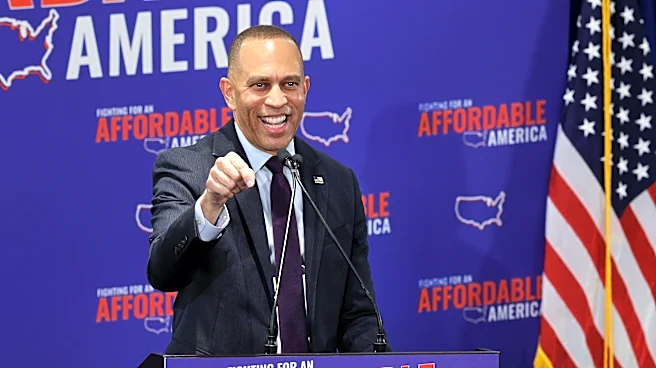
Now he leads the team.
Don't mistake Hakeem Jeffries' calm for overcaution

As a member of the House Democratic leadership, I watched him over the years. We were never best friends, but our relationship was entirely collegial. We worked together on health care for 9/11 first responders and to secure federal disaster aid after Hurricane Sandy ravaged our communities.
In meetings, he was engaged but not performative. He didn’t get in his colleagues’ faces or elbow his way into the spotlight (believe me, that takes discipline in the New York media market). His approach was quiet. Surgical. In a political culture where conflict raises money and red meat sells, his mantra is: “Calm is an intentional decision.” That kind of stoic leadership is easily misunderstood.
Of course, even after Jeffries helped steer Democrats to an epic victory, a few voices snipe that he’s too cerebral, even risk-averse. But it’s a dangerous mistake to equate outward calm with overcaution. Behind the demeanor is a political operative who calculates how and where to win.
The assumption that Jeffries’ style doesn’t equip him for mortal combat ignores the very essence of his career. What part of challenging a 15-term incumbent and winning his seat, then being unanimously elected House Democratic leader, then leading Democrats to the biggest House majority in a generation, then standing on the verge of the speakership, second in line to the presidency – all within 14 years – suggests a lack of moxie? Those elbows are sharp, the political muscle well exercised, the mind thinking several moves ahead.
Underestimate his warrior instinct at your own peril.
Democrats are hard to unify. Jeffries is built to meet the challenge
In late 2016, I received another call from Jeffries. I was weeks from retiring from Congress. He wanted to discuss seeking a co-chairmanship of the Democratic Policy and Communications Committee, which Nancy Pelosi had created in 2015, naming me chair. Its function was to build consensus within the House Democratic Caucus on a unified, disciplined message.
Let me be clear: Getting every Democrat in Congress to preach from the same hymnal is the stuff of miracles. Sitting across from him, I noticed something slightly different from our first encounter four years earlier. He was still methodical, cerebral, analytical. But there was an unmistakable drive, and in his eyes, an ambition to unite Democrats around the prospect of victory.
House Democrats are notoriously hard to unify. Blue Dog conservatives in rural districts have different priorities than hard-left progressives in urban ones. A position that wins base votes in Brooklyn, New York, could easily lose votes in Brooklyn, Iowa.
That’s why Jeffries is uniquely built for this moment. A broad, diverse, unwieldy majority requires leadership that is both ambitious and inclusive, that listens carefully to members and rallies them around one strategic imperative: delivering for the American people, and thereby keeping the majority.
Style doesn’t matter. Winning does. Jeffries wins quietly and methodically. But he wins.
Steve Israel, a Democrat, represented New York in the U.S. House from 2001 to 2017 and chaired the Democratic Congressional Campaign Committee from 2011 to 2015. He directs the Institute of Politics and Global Affairs at Cornell University’s Brooks School of Public Policy.
This article originally appeared on USA TODAY: Democrats desperately need unity. Jeffries is built for that | Opinion