
Across the country, a chilling shift is occurring. Political violence has become a twisted form of virtue signaling. Mahatma Gandhi is out and Luigi Mangione is in. For an increasing number of young people,
nothing signals your values like a willingness to kill others for them.
For decades, being nonviolent has been the touchstone for many on the left. Something is changing. On my campus and others around the country, students are rationalizing violence and even idolizing assassins.
A recent Emerson College poll shows that 4 out of 10 voters ages 18-29 (39%) view Mangione’s role in the fatal shooting of United Healthcare CEO Brian Thompson as "acceptable" or "somewhat acceptable." Other polls show a troubling number of liberal voters consider political violence as justified, including polls showing 40% of young people embracing political violence in some circumstances.

For college students, the rationalization of the killing of a Charlie Kirk or a Brian Thompson is now a litmus test of your movement bona fides. I have heard exchanges where students identify with shooting suspect Tyler Robinson, who allegedly wrote, “I had the opportunity to take out Charlie Kirk, and I took it.”
To put it simply, violence is in vogue.
Hollywood isn't helping our political violence problem
Hollywood is commoditizing political violence. Many conservatives were critical of the movie "One Battle After Another,"with Leonardo DiCaprio, as glorifying domestic terrorism and fueling liberal paranoia.
Other actors seem eager to make their films part of a political rage fest. “Spider-Man” actor Andrew Garfield actually said that he hoped his new movie, "The Uprising," would make billionaires scared, declaring that “I hope that if any billionaires watch it, they're scared s---less."
Garfield wanted to take this film as his own bona fides with the mob, demonizing the rich. He apparently forgot Spider-Man's motto, "With great power comes great responsibility."
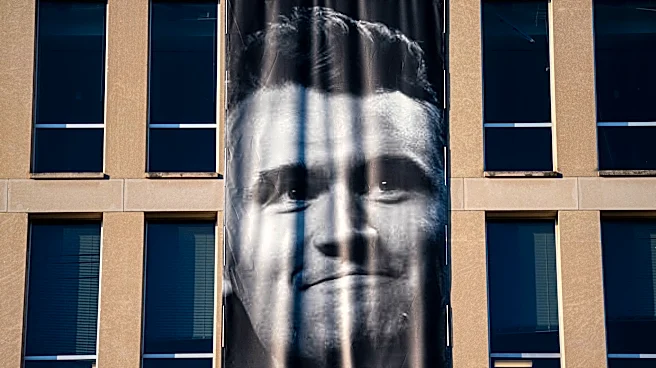
Others are more direct. Lexi Alexander, director of the 2008 Marvel film "Punisher: War Zone," triggered a firestorm Sept. 1 with an X post showing Mangione’s face superimposed on Batman’s bat signal. The posting featured a news article’s headline: “Bank of America vice president killed in Times Square stabbing.”
The vice president, Erin Piacenti, 32, left a five-month-old daughter who will now grow up without a mother.
When people noted the obvious that Alexander, who bills herself as a “Palestinian filmmaker,” was seemingly celebrating the death of bank officer Piacenti, who was just back from maternity leave, Alexander accused them of being Israeli propagandists, or “Hasbara bots.”
In a now-deleted post, Alexander dismissed criticism that she knew about the executive being a new mother and said it was enough at the time that she was an executive because "it sounded like another Luigi situation."
Apocalyptic rhetoric only makes violence more possible

For years, politicians, pundits and professors have fueled political rage by claiming that those with opposing views are seeking to end democracy, bring back the Confederacy or turn citizens into slaves of the oligarchs. Such apocalyptic claims give a sense of license to people to free themselves from all social and moral constraints, allowing them to hate completely and unreservedly.
The saddest aspect of this trend is what it says about our hold on not just our civility but also our humanity. The irony is that the arc of the moral universe, famously described by Martin Luther King Jr., is being bent back in the name of perverted notions of equity and justice. By demonizing others like corporate executives, many on the left are now free to enjoy gratuitous violence, even the killing of a new mother in Times Square.
In "Rage and the Republic," I write about the fear of the Founding Fathers that democracies historically devolved into what Benjamin Rush called “mobocracies.” John Adams put that history in its starkest terms: "There never was a Democracy Yet, that did not commit suicide."
The founders watched as the French Revolution, occurring shortly after our own, unleashed a blood-soaked “Terror” as a population engaged in a spasm of violence against aristocrats, clergy and then themselves.
Maximilien Robespierre would legitimize the slaughter by telling citizens that violence was noble and that mercy was weakness. “Terror is only justice: prompt, severe and inflexible," he said. "It is then an emanation of virtue.”
Past movements from the French Revolution to the Cultural Revolution to recent genocidal campaigns in Europe and Africa show that a dark element rests deep within us that can be released when we are sufficiently angry or afraid.
In my book, I call it the "Saturn Gene." During the French Revolution, journalist Jacques Mallet du Pan observed that “like Saturn, the Revolution devours its children.” It is an inexorable pattern where movements release long-suppressed rage only to destroy those who led the mob to collective acts of murder and mayhem.
With influential figures and even political leaders fueling the rage, we can no longer ignore the growing appeal and acceptance of political violence. This country has never allowed the Saturn gene to become dominant in our body politic. However, as the citizens are increasingly conditioned to accept political violence, we are dangerously resembling not our Revolution 250 years ago, but that of France.
If we are to proceed down that road, citizens would be wise to consider the words of Emmanuel-Joseph Sieyès, one of the most important voices of the French Revolution. When he was asked what he had done during the Revolution, the old abbot pondered the question and answered: “J’ai vécu” (“I survived”).
Jonathan Turley is a law professor and the best-selling author of “Rage and the Republic: The Unfinished Story of the American Revolution."
This article originally appeared on USA TODAY: Political violence has become a twisted form of virtue signaling | Opinion