










An object orbiting well beyond the reaches of Pluto may not only be the latest dwarf planet discovered in Earth's solar system, but it may be the largest and brightest object yet spotted in its region.
So, why did it take so long for astronomers to make such a tantalizing find? Well, the discovery came just a few months after a ground telescope in Chile
embarked on a 10-year mission promising to unlock the secrets of the cosmos.That telescope, known as the Vera C. Rubin Observatory, is what first spotted the world, which is now considered a candidate to join our solar system's list of dwarf planets. The roster is one that controversially includes Pluto.
Here's everything to know about the possible dwarf planet discovery beyond the orbit of Pluto.
Astronomers discover possible dwarf planet beyond Pluto
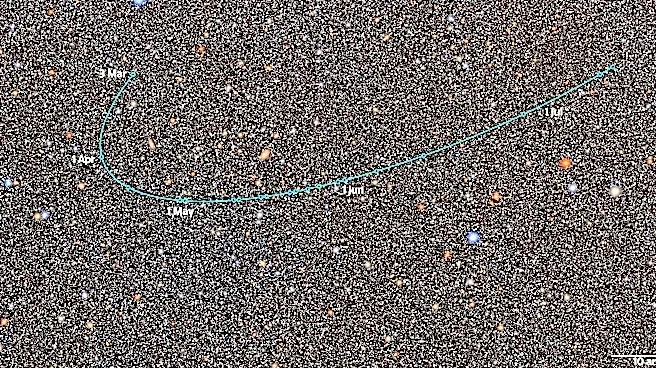
The possible dwarf planet, temporarily designated as 2026 ED138, was found amid a crowded region of the Milky Way filled with millions of stars.
Given its technical capabilities, the Rubin telescope was able to cut through other overpowering light sources to find the small moving object. Observations across 20 nights between March 4 and July 11 further helped scientists solidify what they were seeing.
Its distance from the sun places it beyond the orbit of not just Neptune – our solar system's outermost planet – but dwarf planet Pluto. That classifies the world as a trans-Neptunian object.
Initial analysis also suggests that the object may be among the largest and brightest bodies discovered in that far-off region of the solar system.
The object is now under consideration by the International Astronomical Union Minor Planet Center, the global authority on classifying celestial bodies, for official recognition as a dwarf planet, according to an Oct. 27 press release.
What is a dwarf planet? How many dwarf planets are there?
The most commonly accepted definition of dwarf planets describe objects that have enough mass for their own gravity to pull them into round shapes, but not enough to clear their orbital neighborhoods of debris.
While further observations are needed, the newly spotted object's suspected size – diameter estimated at between roughly 370 and 930 miles – could make it big enough to be classified as a dwarf planet.
Not all TNOs are considered dwarf planet candidates, with the distinction being in the size and shape of the object. To be a dwarf planet an object needs to be massive enough for its own gravity to pull it into a round shape. Based on ED138’s distance, brightness and estimated surface reflectivity (albedo), the team estimates that its size is between 600 and 1,500 kilometers, and icy bodies this large are expected to be round.
If classified as a dwarf planet, ED138 would join five others officially recognized by the International Astronomical Union: Pluto, Ceres, Eris, Haumea and Makemake. While Ceres is located in the main asteroid belt between Mars and Jupiter, the other four orbit beyond Neptune, Reuters reported.
See photos outlining possible dwarf planet in our solar system
What is the Vera C. Rubin Observatory?
Perched on a mountain in northern Chile, the Vera C. Rubin Observatory is at the beginning of a decade-long mission to explore the mysteries of the cosmos in unprecedented detail.
Named for famed astronomer Vera Rubin, best known for discovering evidence of dark matter, the observatory is equipped with a specially designed large telescope and a car-sized digital camera. For the next 10 years, the telescope will observe and collect data on the southern night sky in our Milky Way and beyond.
The National Science Foundation jointly funds and operates the observatory with the Department of Energy’s Office of Science.
“Rubin will image the whole southern sky again and again for 10 years, so any others hiding in the places earlier surveys skipped are now within reach," astrophysicist Matt Holman of the Center for Astrophysics, Harvard and Smithsonian, who first spotted 2026 ED138, said in a statement.
Astronomers previously discover outer world with atmosphere
Rubin's observation of a possible new dwarf planet is the latest discovery made in the outer reaches of Earth's solar system.
About six months ago, Japanese researchers published findings in early May about a small icy object in the outer solar system that, like Pluto, is miraculously able to sustain an atmosphere.
One of thousands of worlds beyond Neptune known as trans-Neptunian objects, the body sets itself apart from the other desolate cold rocks because it has a thin atmosphere. Though the object is far too small – roughly 310 miles in diameter – to be classified as even a dwarf planet, astronomers observed an atmosphere composed of methane, nitrogen or carbon monoxide that is 5 million to 10 million times thinner than Earth's, Reuters reported.
Contributing: Reuters
Eric Lagatta is the Space Connect reporter for the USA TODAY Network. Reach him at elagatta@usatodayco.com
This article originally appeared on USA TODAY: World spotted beyond Pluto could be solar system's next dwarf planet