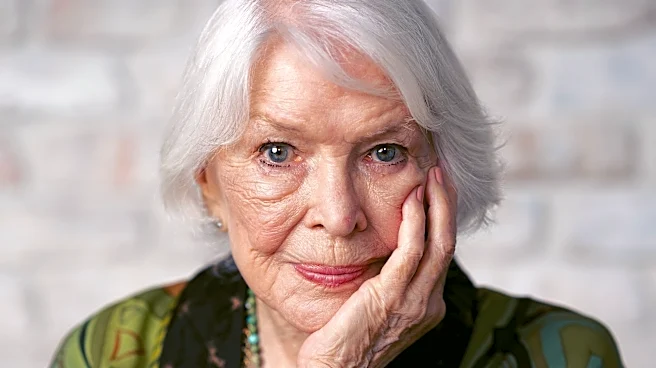



NEW YORK – Ellen Burstyn won’t go anywhere without her poetry pack.
Just moments into a conversation at USA TODAY’s studio, the Hollywood legend whips out a stack of flashcards from her purse, containing dozens of poems printed and glued onto multicolored paper. Her eyes widen – sometimes with glee, others with melancholy – as she spontaneously recites the works of Mary Oliver, Portia Nelson and Edna St. Vincent Millay.
“I carry them with me because most of them are memorized, but every once in a while, I think, ‘What's that line?’ ” Burstyn, 93, says warmly. “So I like to have my pack.”
Earlier this year, Burstyn released “Poetry Says It Better: Poems to Help You Wake Up,” an anthology of her favorite poems that also serves as a quasi-memoir,
detailing how poetry has helped her through life’s ups and downs.

“It’s a living presence in my life; it’s a source of spiritual food,” says Burstyn, who recorded a poignant and witty audiobook to accompany the collection.
If she earns her second Grammy Award nomination for best audiobook, she’ll be in striking distance of coveted EGOT status, having won an Oscar (“Alice Doesn’t Live Here Anymore”), a Tony (“Same Time, Next Year”), and two Emmys (“Political Animals” and “Law & Order: Special Victims Unit”). She would also become the oldest person to EGOT, surpassing British actor John Gielgud, who was 87 when he achieved the prized quadfecta.
“If I was that lucky to win a Grammy, that means I would have all the major awards, which is just so humbling,” Burstyn says. “It’s not something I had an ambition for until my granddaughter, Emily, said, ‘All you need is a Grammy!’ That started me on the path of being a bit eager for [one].”
Ellen Burstyn shares emotional reason why she's 'most proud' of her son
Over the course of her seven-decade career, Burstyn has spellbindingly portrayed all manner of matriarchs, conveying a mother’s desperation (“The Exorcist”), loneliness (“Requiem for a Dream”) and manipulation (“Pieces of a Woman”). But her piercing vulnerability and grit burned brightest in 1974’s “Alice Doesn’t Live Here Anymore,” playing a former singer and new widow trying to make ends meet for her young son.
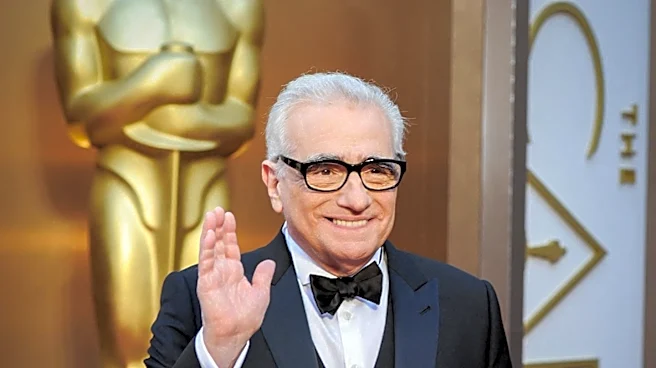
Coming off double Oscar nods for “The Last Picture Show” and “The Exorcist,” the studio gave Burstyn her pick of directors for “Alice.” She chose relative newcomer Martin Scorsese, knowing from his work on “Mean Streets” that he could depict “real people.”

At the time, Burstyn was thrice divorced and a single mother to son Jefferson, now 65.
“We were right in the birth of the women's movement and we were changing our idea of what a woman does,” Burstyn recalls. “We were coming into the realization that we were independent human beings, even when we were in love and raising a family. I was feeling it as a single mother and reading Gloria Steinem, God bless her. I wanted to express that, which I let Marty know in our first meeting.
“I said, ‘Marty, I want this film told from a woman's point of view. What do you know about women?’ " Burstyn adds. “He said, ‘Nothing, but I'd like to learn!’ I just love that answer.”
Burstyn’s relationship with her own mother, Correine Gillooly, was “turbulent.” Gillooly was both physically and emotionally abusive, and in her new book, Burstyn describes growing up in a home where she felt unwanted. But at 16, she found empowerment through William Ernest Henley’s poem “Invictus,” which contains the line: “I am the master of my fate; I am the captain of my soul.”
In that moment, she understood: “It’s up to me how I deal with my life. I’ll improve it,” Burstyn recalls. “That changed my life and I became a poetry fan forever from that.”
With age, she’s gained empathy and forgiveness for her mom. “I came to the realization that she really tried hard to be a good mother – it’s just we didn’t have the same view of what a good mother was,” Burstyn says now. “I was surprised one day after she was gone that I found myself wishing I could call her. I missed her.”

The experience ultimately taught the six-time Oscar nominee about the kind of parent she hoped to be.
“I have been asked: What am I most proud of in my life?” Burstyn says, her eyes welling with tears. “I always have the same answer: I am most proud that my granddaughter, Emily, has told me that she has the best father in the world, and that I didn’t mess that up. I was able to raise one of the sweetest, dearest human beings I know ‒ and he's a good father, despite what I went through."
Burstyn wants 'something celebratory' for her 94th birthday in December
The audiobook culminates in Burstyn reciting Oliver's profound "When Death Comes." She says the poem has helped her come to terms with her own mortality.
"Poetry presents deep subjects to you in a beautiful way so that you ... get intimate with the difficulty of life," Burstyn says. "I love [Oliver] calling death 'that cottage of darkness.' It's like the cottage is a country home, like, 'Wow, what could that be?' "
Burstyn lives on New York's Upper West Side and she remains active. (After this interview, she's headed to her daily workout and then a massage.) She recently starred in Maggie Gyllenhaal's short film "Flesh Impact," which premiered last month at Venice Film Festival, where the nonagenarian was also bestowed a lifetime achievement award.
Oliver wrote that "I don't want to end up simply having visited this world," which has become a mantra of sorts of Burstyn.
"I feel like a resident of the world; I've taken part in my time on planet Earth," Burstyn says. "I'm OK with what I've done. ... I've had so many adventures so far, and in a couple of months, I'll be 94. I'm not quite sure how many legitimate adventures I'll still have."

Her friends all flew in last year for her 93rd birthday, although she hasn't yet made plans for this December's festivities. It'll be "something celebratory," Burstyn says. "I'm not going to have any, 'Oh, dear, I'm so old!' feelings like that. I enjoy life too much."
Every morning, she tries to ensure that the first words out of her mouth are "Thank you." She occasionally forgets to say it, of course, and some days are harder than others.
"But a lot of it is just a sheer blessing," Burstyn says. "I don't want to ever forget, especially when I'm in a cantankerous mood, how blessed my life has been and how lucky I feel. And if I don't remember clearly enough, I open a book of poetry and see who wants to speak to me today."
This article originally appeared on USA TODAY: Ellen Burstyn, 93, reflects on poetry of life and her latest ambition