






The blood clot that will keep Philadelphia Eagles star Jalen Hurts on the sideline for a Week 6 matchup against the Carolina Panthers is located in quarterback's calf and “superficial," according to the team.
Superficial blood clots in the leg differ from deep-vein thrombosis (DVT), but according to medical experts who specialize in blood clotting, should still be taken seriously.
“People often don’t think about it in athletes and people that don’t have a lot of the other risk factors, so I think getting the attention out there to symptoms that people should be evaluated with is important for both athletes and non-athletes alike,” Dr. Jordan Schaefer, a hematologist at the University of Michigan Health System and associate professor of internal
medicine at the University of Michigan Medical School, told USA TODAY Sports.
What is a superficial blood clot?
Superficial blood clots will often cause redness, pain or a cord-like lump that can be felt beneath the skin, according to Shcaefer. All blood clots carry the risk of breaking loose and moving toward the lungs, which could result in a pulmonary embolism, a potentially fatal event. Schaefer said superficial clots matter not only because of the symptoms, but also because 10 percent of patients experience the clot moving to the deep-vein system and becoming more serious.
It’s more common for clots to exist in the deep-vein system higher up the leg, Schaefer said. The Eagles said a follow-up ultrasound on Oct. 14 revealed movement in the small blood clot in Hurts' leg and ruled the Super Bowl 59 MVP out for Sunday’s game against Panthers.
Dr. Rushad Patell, who is a hematologist at Beth Israel Deaconess Medical Center in Boston, Massachusetts, and is an associate professor of medicine at Harvard Medical School, wrote in an email to USA TODAY Sports that superficial vein thrombosis – or a blood clot – exists on a spectrum. Some cases are relatively low risk and require only symptomatic treatment, such as warm compresses, compression stockings and non-steroidal inflammatory drugs like Ibuprofen.
“Not all blood clots are preventable,” Patell wrote, “particularly when they occur following an injury.”
Jalen Hurts hurt during Rams' game
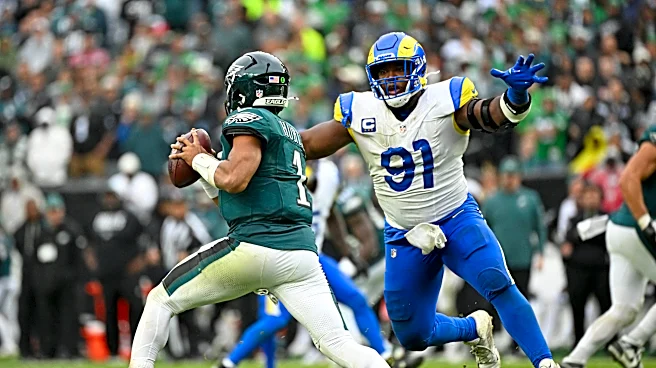
According to the Eagles’ statement, Hurts sought after treatment after his calf was stepped on during an Oct. 4 game against the Los Angeles Rams. That type of trauma could potentially lead to a superficial blood clot. Trauma can damage the endothelium, which is the lining of the blood vessel, and can be injured – damage to the wall is one of the three classic mechanisms that contribute to blood clot formation, according to Patell.
“It is plausible that a cleat injury could have contributed to the development of a superficial clot,” Patell wrote. “However, without prior imaging, it would be impossible to establish whether the clot was already present or definitively attribute it to the injury.”
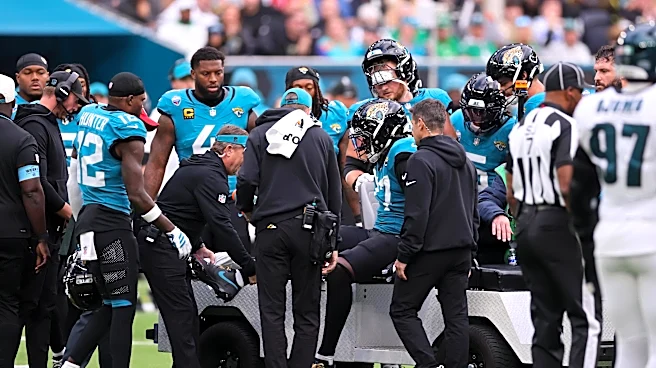
The Eagles said their medical staff deemed Hurts OK to play against the Jacksonville Jaguars on Oct. 11 in London, England, following an ultrasound the day before the game. The doctors said “mobility and activity were important,” according to the statement.
Schaefer thinks long periods of travel that could affect clotting for an athlete because of minimal blood flow – individuals aren’t moving much on a plane or bus.
Long-distance travel is a recognized, although relatively weak, risk factor for venous thrombosis, Patell wrote.
“It would be difficult to attribute any change in the clot to a single flight, particularly in the setting of a recent injury,” Patell wrote.
Repeat imaging can sometimes identify changes that lead clinicians to reconsider the initial management strategy for a clot and are necessary to track improvement. In a conservative approach, 72 hours would be considered a normal gap between exams, Schaefer said.
Superficial blood clot treatment options
There can be some variability in terms of the recovery depending on individual circumstances, Schaefer said.
“A lot of times, what we’re doing, is kind of following people closely over time,” Schaefer said. “It’s not like a one-time visit and then you’re done. It’s often reassessment in how you’re feeling and a physical of how the leg looks. Is that swelling and redness and exam getting better?”
Patell wrote that recovery depends on the location and extent of the clot and what type of treatment is required. The length of the clot is also a consideration, Schaefer said.
Patients with more extensive clots or those at higher risk for progression may require anticoagulation medication – blood thinners – for approximately 45 days.
If Hurts is being treated with blood thinners, Schaefer said, his recovery timeline would be more complicated because football is a contact sport. Blood-thinning medications increase the risk of serious bleeding with traumatic injuries, including internal bleeding.
Those are all obvious serious concerns. But the initial symptoms that brought Hurts into the Eagles’ training room – redness, leg pain, swelling, “things that don’t seem right,” Schaefer said – can be difficult to distinguish from a muscular injury.
“I think it’s important that people seek medical attention and work with their doctors to determine the appropriate treatment for their individual situation,” Schaefer said.
“Oftentimes, we want to catch these things kind of early,” Schaefer added. “It can get, potentially, worse.”
This article originally appeared on USA TODAY: Experts explain why Jalen Hurts' blood clot diagnosis warrants caution