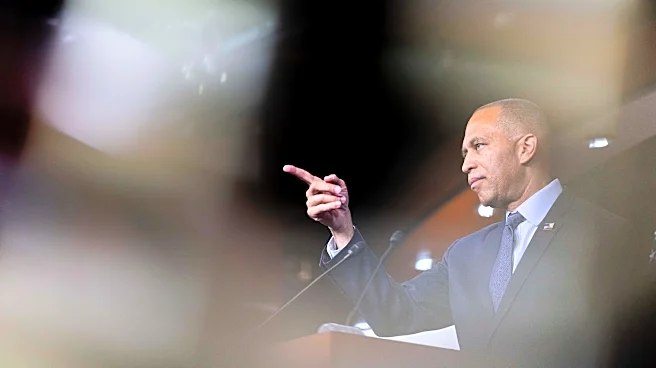

WASHINGTON – For much of this year, infighting among Republicans in the House of Representatives dogged Speaker Mike Johnson, paralyzing his legislative agenda and giving outsized power to singular lawmakers.
On the verge of winning back power, Democrats who slammed the dysfunction may now be facing the same kinds of problems.
If the party takes control of the lower chamber in the midterm elections, as is increasingly expected, the Democratic caucus could include a half-dozen or more far-left lawmakers who took on and defeated incumbents, as well as electorally vulnerable moderates — resulting in clashing agendas and priorities.
At the center of those competing ideologies is Minority Leader Hakeem Jeffries, a Brooklyn-based congressman and the presumptive next speaker of the House.
And at stake is the party’s ability to push back on President Donald Trump during his final two years in office — as well as the brand of the Democratic Party heading into the 2028 presidential election.
“I'm convinced that every single part of the House Democratic caucus will understand the mission, which is deliver for the American people,” Jeffries told USA TODAY in an exclusive interview. “What’s most important, in terms of how I proceed, is us figuring out what unites us.”
Building a 'big tent'
Jeffries, who succeeded former House Speaker Nancy Pelosi as party boss in 2022, told USA TODAY that he believes his party is on the edge of claiming a broad majority that will surpass the exceedingly narrow, two-vote margin that congressional Republicans have been contending with.
“I think we're heading for a more robust majority than that,” Jeffries said. “The goal initially, of course, we’ve got to get to 218, and then we try and win as many seats on top of that as possible.”
A bigger majority would help prevent just two or three members from being able to freeze the House floor for days at a time, though it wouldn't paper over the sometimes bitter disputes over Israel, privacy and other major issues that Democrats will face.
A month before the midterms, Jeffries is gearing up to welcome more progressives, center-left lawmakers and fiscally conservative, moderates to his caucus, rounding out what Democrats have been referring to as their “big tent.” The group is likely to include a handful of self-proclaimed democratic socialists or closely-aligned candidates that ousted allies for whom he had campaigned.

The potential makeup of the caucus has fueled nascent worries among some Democrats about intraparty divisions dragging down their ability to pass bills next year.
"I would hope that we would stick together," Delaware Rep. Sarah McBride told USA TODAY, "whether in the minority or majority.”
A mutiny by moderate members just before the congressional recess cast doubt on whether a new crop of party leaders that includes Jeffries, Democratic Whip Katherine Clark, and House Democratic Caucus Chair Pete Aguilar, will be as effective at quelling defiance as the old guard.
“He's going to have this new flock of DSA candidates and other candidates that are not going to be 100% aligned with his agenda, that are going to have their own objectives, in many cases, to come in and be a disruption,” said Ashley Etienne, who was a senior adviser to Pelosi when the California Democrat when she was House speaker.

As House Democratic leader, Pelosi famously ruled the caucus with an iron fist. But her tenure was not without its publicized skirmishes. She routinely tussled with progressive Rep. Alexandria Ocasio-Cortez, who unseated the number four Democrat in the caucus, and other members of the far-left “Squad.”
Warning signs

A month ago, a political wake-up call came for Jeffries and the rest of the House Democratic caucus. Two moderate Blue Dogs, Washington Rep. Marie Gluesenkamp Perez and retiring Maine Rep. Jared Golden, crossed party lines to salvage Republicans’ legislative agenda at a critical moment.
The defiance incensed their colleagues. Jeffries and his chief deputy, Clark, called for a “serious response” to what they characterized as “significant breach of trust.” They’ve since sent mixed messages about how, or whether, they will punish the pair — who’ve teamed up to buck leadership more than once.
Rep. Pramila Jayapal, a former leader of the Congressional Progressive Caucus, said party leadership has, in her view, a bad habit of moving “toward the most conservative members.”
"There needs to be some way to make sure that people are part of a team,” the Washington Democrat told USA TODAY, adding: "Nancy had a lot of ways of exercising power.”
Some lawmakers called on Jeffries to strip Gluesenkamp Perez of her sole panel assignment on the powerful Appropriations Committee. Jeffries’ number two, Clark, endorsed a hardline approach, saying Democrats need “team players.” Jayapal also said he “has a right to do that.”
Jeffries declined in the interview with USA TODAY to explain what his response would entail. He did, however, promise a “family conversation” after the midterms – aimed at making sure “we're all operating as a team.”
One party lawmaker, who requested anonymity to speak freely about the dynamics of the caucus, said it would be unwise for Jeffries to crack down before he becomes speaker. The move could alienate lawmakers whose votes he needs to win the job, the lawmaker said.
But former Pelosi adviser and senior White House official Etienne argued that the consequences should have been immediate.
“It's not just your foes, but your friends are also watching,” Etienne, who worked for Barack Obama and Kamala Harris, said. “Everyone's taking notes in these moments.”
A new left flank

Unreliable moderates may not be Jeffries' biggest problem in the next Congress, depending on the size of Democrats’ majority. According to Ballotpedia, 23 Democrats announced their retirement or opted to run for other offices. In seven other districts, lawmakers who unseated incumbent Democrats are on the ballot in November, a USA TODAY analysis shows.
“It's important to recognize that the blue wave is likely to be a progressive wave,” said Joseph Geevarghese, the executive director of the progressive activist group Our Revolution. “And the incoming class of progressives has clear demands.”
Several of those anti-establishment candidates have refused to say if they’ll back Jeffries for speaker, setting up a potential clash with party leadership from the get-go. They include Melat Kiros in Colorado, Darializa Avila Chevalier in New York and Adam Hamawy in New Jersey.
Jeffries told USA TODAY he’s had conversations with every single candidate “who's won the Democratic nomination and is on their way into serving in the next Congress,” including those in New York, New Jersey, Philadelphia, Denver and Detroit, “who may fall into that category.”
In an interview, Rep. Ro Khanna, a progressive Democrat from California, also said he’d help Jeffries whip votes.
Geevarghese said incoming lawmakers need to be strategic about when and how to confront leadership. He held up the Congressional Progressive Caucus’ approach during former President Joe Biden’s presidency, when Biden was pushing his Build Back Better agenda through Congress, as an example of how to extract concessions from the establishment.
Geevarghese advised new members to work through the existing group to force votes on policy priorities like Medicaid for All in the next legislative session.
“It’s incumbent that the caucus acts together and is disciplined in support of that policy and other progressive policies that get advanced and not acting as lone wolves,” he said.
Contributing: USA TODAY’s Terry Collins and Phillip Bailey
This article originally appeared on USA TODAY: Can House Democrats stay unified next year? It may be up to one man