
On the Thursday, September 17, 2026, episode of The Excerpt podcast: After an Anthropic researcher quit and warned about the risks of advanced AI, pressure is mounting on lawmakers to respond. USA TODAY
Congressional Correspondent Zach Schermele explains why the warning is getting lawmakers' attention and whether meaningful AI oversight is finally gaining momentum.
Hit play on the player below to hear the podcast and follow along with the transcript beneath it.
This transcript was automatically generated, and then edited for clarity in its current form. There may be some differences between the audio and the text.
Podcasts: True crime, in-depth interviews and more USA TODAY podcasts right here
Dana Taylor:
AI researcher Jacob Coxon recently resigned from Anthropic with a warning that leading AI companies are gambling with all our lives. Tech leaders like Anthropic CEO Dario Amodei have issued their own stark warnings and agree that AI companies need more regulation. So why aren't they slowing down? I'm Dana Taylor, and this is USA TODAY's The Excerpt. The question everyone is asking is whether Coxon's warning is credible, and if so, is Congress ready to act? USA TODAY Congressional Correspondent Zach Schermele joins me now to break down some of this. Welcome back, Zach.
Zach Schermele:
Thanks so much for having me, Dana.
Dana Taylor:
Zach, this wasn't the first dire AI warning heard by Congress. Why did Coxon's resignation break through?
Zach Schermele:
It's interesting what exactly breaks through on the internet these days, particularly in political conversations. But I was actually scrolling through X, formerly Twitter, the night that this Anthropic researcher's, now former Anthropic researcher's post went viral. And it was interesting to see the politicians that have kind of a more overt and consistent online presence that were retweeting him and how that was sort of playing to both kind of the more conservative MAGA ecosystem online, the more right-wing ecosystem online, as well as progressive spheres. People like Representative Anna Paulina Luna, who's a Florida Republican and kind of a maverick on some issues, were tweeting very soon after this warning came out saying that Congress needed to do something.
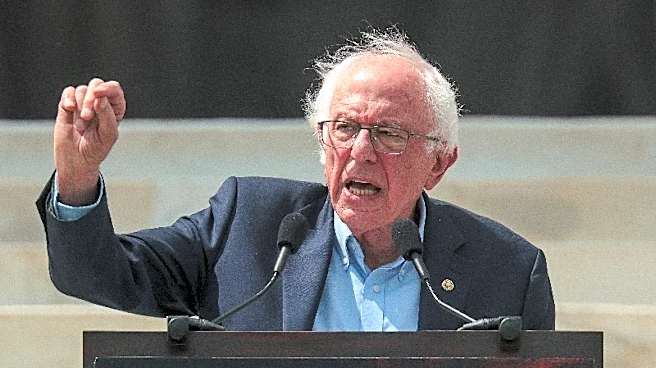
Congresswoman Luna said that Congress needed to call a special session on AI guardrails. And then, of course, you had folks like Senator Bernie Sanders and Congressman Greg Casar, who is the Chair of the Congressional Progressive Caucus, who were sounding a lot more dire alarm bells about the future of AI and its implications on humanity, the workforce. There were all sorts of warnings that for a period there, just because of the nature of the way that social media works, it was something that just broke through all of the barriers online. And there are a lot of members of Congress and lawmakers and very important people who could actually do something about this who are on these social media platforms, and I think that it resonated with them.
Dana Taylor:
I want to go back to Bernie Sanders since you mentioned him. He and conservative Steve Bannon, they've teamed up together. What are they pushing for right now?
Zach Schermele:
Yeah, it was very interesting. Steve Bannon, Senator Bernie Sanders, Greg Casar, like I said, arguably one of the most progressive members of Congress congressman Chip Roy, a Texas Republican, member of the House Freedom Caucus, very conservative, all of those people were at the same event this week in Washington called the Pro-Human Assembly, where they were essentially pushing for the future of the American economy, of society to continue to primarily be led by humans. It's actually incredibly dystopic that we're even talking about this and having these types of conversations.
And I think they would agree with that assessment, which is why they were all gathered at this event in Washington and talking about the need to be policymaking when it comes to AI and super intelligence and ensuring that there is some sort of a slowdown, independent monitorship of the development of more advanced AI. Very strange political bedfellows on this issue that have been created over the past couple of weeks, and I think certainly forming over a lot of this summer as Americans' concerns about the advancement of AI have grown.
Dana Taylor:
When you look at this larger coalition that's forming here, is this a genuine political movement?
Zach Schermele:
I think it is. And when you have strange bedfellows in politics, that is usually a good sign or at least a better sign that there could be some significant progress at some point on that kind of an issue. I think we have seen time and again that when conservatives and progressives kind of come to similar conclusions about a particular issue, that we can see some significant progress on a particular issue.
Dana Taylor:
Zach, Senate minority leader Chuck Schumer, he's demanding a classified briefing. We have House Speaker Mike Johnson who plans to meet with AI execs. What are they looking for or hoping to determine?
Zach Schermele:
There is already a very notable bifurcation, I think, among Republican leaders in Congress and Democrats in Congress about what the path forward needs to look like with respect to regulating artificial intelligence. But these are significant steps forward. Bernie Sanders is going to be holding and all senators bipartisan briefing about artificial intelligence. As you said, Senate Minority Leader Chuck Schumer was calling for Trump administration officials, the ones who are primarily in charge or would be in charge of AI regulation, to come to the Hill to talk to senators in a classified setting about what their frameworks are going to look like in light of some of these more new developments about concerns related to advanced AI. And Speaker Mike Johnson said he was going to be sitting down potentially at the White House.
He told reporters with the President to speak with some of those leaders about where their heads are kind of at about AI. I also know there are a number of senators that have spoken consistently to some of these people like Dario Amodei, the CEO of Anthropic, Sam Altman, the head of OpenAI. Actually, I think it was maybe two months ago, at some point earlier this summer, I was getting off of an elevator in the Capitol building and almost literally ran into someone that I didn't quite see the face of initially. And then, I saw that he had a large coterie of people around him and turned around and wondered, "This person must be important." It was Sam Altman. So he has been on the Hill, not infrequently even before all of this stuff was happening, meeting with lawmakers who have significant concerns and want to be involved with regulation of this emerging technology.
Dana Taylor:
I want to get a reality check here. We're less than two months out. What can Congress realistically accomplish before the midterms?
Zach Schermele:
I think that that is a very good question. There is an extremely tight schedule on Capitol Hill that both the House and the Senate are facing. I mean, the House is only in a couple of days this week and then they're gone. So the chance of actual legislation being passed and then signed into law by the President before the midterm elections, I think, is honestly extremely low. But that doesn't mean that significant steps couldn't be taken, that legislation can't be introduced, that the first step often when more significant pieces of legislation are going to start to move forward is senators and members of Congress just learning more about the technology.
And there are a decent number of them that do not have a good understanding of this. Senator Thom Tillis, the Republican from North Carolina who's retiring, said to reporters the other day that he doesn't think a lot of senators know the first letter in AI. So I think a significant step would be for them to start to learn more about it, certainly the ones who are not as much of experts about the technology, and that's important. So the Senate's going to be in for a couple more weeks and then they're gone for most of October, both chambers before the midterms. I think if we see any more significant action, it could potentially come in the lame duck and the period between the midterms and when Congress turns over in January.
Dana Taylor:
Are there any proposals that might have a real chance of advancing?
Zach Schermele:
So the House of Representatives passed a bill on Wednesday called The Ratepayer Protection Act, which would encourage state utility regulators to consider implementing rules that would protect regular American consumers from seeing their energy bills, their electricity bills rise as a result of hyperscale data centers being created near their neighborhoods. There are a lot of Republicans who say that it's a significant step and that it sort of walks a fine line and strikes the right balance between needing to be at the frontier of AI competitiveness as a country and as a workforce and implementing some important guardrails. But there are lots of Democrats who say that that piece of legislation does not go nearly far enough to protect Americans from potentially seeing their costs rise as a result of these really energy-sucking data centers that are being built across the country and that a lot of communities have rejected.
When it comes to legislation that is more concerned with advanced artificial intelligence and super intelligence, there has been, I think, more of a bipartisan consensus around the possibility of requiring that AI companies have independent monitors that go in, not dissimilarly to nuclear weapons to assess what the status of their development is. There's some legislation that I think could see some real progress over the course of the next few months primarily in the lame duck around that. And then there is some legislation around something called an AI kill switch, which is really just a colloquialism for requiring these AI companies to build into their models essentially exactly what that metaphor describes, which is an ability for them to completely unplug, turn off, kill the model if it starts to go rogue and if it starts to infect other portions of the internet, takeover systems that it's not supposed to, which we have seen evidence of models doing on their own in very concerning incidents over the course of this summer.
Dana Taylor:
Zach, the AI race with China has led Mike Johnson to warn against aggressive regulation. How much is China influencing what happens here in the U.S.?
Zach Schermele:
It is influencing how lawmakers, particularly Republicans, are talking about this issue in a very notable way. They have consistently decided and said over the course of the past couple of days when this AI panic, for lack of a better term, has kind of gripped a lot of lawmakers on both sides of the aisle and predating this debate that it would be bad for American companies, American-based companies to develop some of these really advanced technologies, but it would be worse if China were to do them. And I don't know the extent to which that resonates with Americans who are very concerned about where AI is going and advanced intelligence and super intelligence is going. But what we know from the polling is that a majority of Americans, according to several recent surveys, are very concerned about AI and advanced AI potentially wiping out the human race.
And they're concerned, according to other polls, that AI is going to sever human bonds going forward. So there is really a grassroots concern that is reflected among the majority of lawmakers. I think they heard from their constituents over the course of the August recess, over the course of those couple of weeks outside of Washington about AI and data centers. There is a lot of angst within the American public right now. And I think that when lawmakers go home to campaign over October, they could be hearing a lot more about this. And there is nothing that motivates politicians, primarily members of Congress more, than hearing firsthand face-to-face concerns from their constituents in their districts. So don't underestimate the degree to which that could generate some movement in the coming months.
Dana Taylor:
President Donald Trump recently dismissed calls for additional guardrails. Does his position limit what a Republican-controlled Congress can do?
Zach Schermele:
It totally does. You can do all of this hoop jumping in Congress and try to pass all sorts of legislation, but if it is subject to a presidential veto, that changes the political calculus. And it not only changes the political calculus because it changes the math, but it also changes the politics of having to potentially override a veto. I mean, a lot of lawmakers, Republicans don't want to be seen as going against the President on anything. So if there is significant legislation that passes both chambers, makes it to the President's desk, he vetoes it, there could be conversations about it coming back to the Hill and overriding a veto. But I think that there will certainly be reticence should that happen. And I think that more consistent Hill watchers might hear me say that and think that there is less of a likelihood of the President not paying a lot of attention to legislation that's moving forward.
But he is someone that has demonstrated pretty consistently that pretty notable things can be happening on the Hill and he won't be always paying attention to more of the fine details of the sausage making of the legislative process. And we have seen that he is kind of in the same boat as House Speaker Mike Johnson with respect to AI development and where things need to go. There are not insignificant number of Republicans who are basically saying that industry needs to be leading the way on this. But it's interesting because at the same time you have these AI leaders, these tech company executives who are basically begging for regulation. I mean, they are posting online doing interviews where they're saying, "We need independent oversight." And that disparity between the rhetoric that's coming from high-level Republicans in Washington and from these tech CEOs is quite striking.
Dana Taylor:
Zach Schermele covers Congress for USA TODAY. It is always good to speak with you, Zach.
Zach Schermele:
Thanks so much.
Dana Taylor:
Our stories come from USA TODAY reporters across the country. We'll be back tomorrow.
This article originally appeared on USA TODAY: AI insiders warn of danger. Will Congress act? | The Excerpt